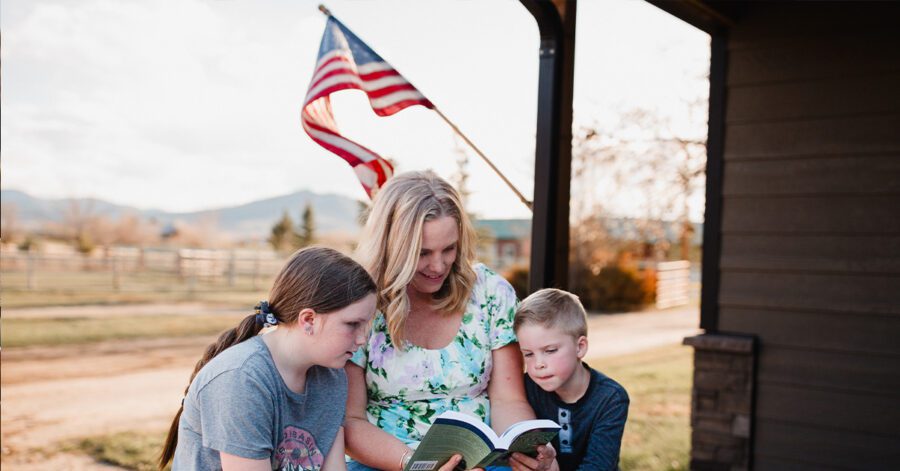
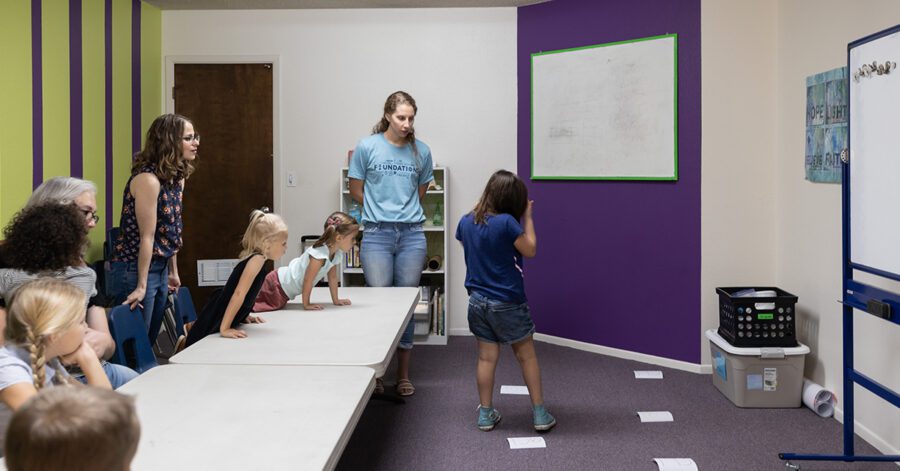
The Core Habit of Expressing is using the body and senses to share knowledge—demonstrating through reciting, drawing, dancing, building, or performing what children have learned about persons, places, things, and ideas.
Young children are like bottles of soda that have been shaken. All that wonder and knowledge they’ve absorbed through naming, attending, and memorizing builds up pressure until it must burst forth. They can’t help but share what they’ve discovered.
As homeschool parents, we want to cultivate this natural overflow into a disciplined habit that deepens learning and leads to worship. But how do we practically encourage expressing without forcing creativity or leaving non-artistic children behind?
Classical Conversations has made classical education approachable for families, and Expressing is highlighted as one of the core habits of how children process and celebrate their learning. Understanding the habit of expressing equips you to guide your children from knowledge to wisdom, from wonder to worship.
What Is Expressing?
At its core, expressing means demonstrating ideas through activity.
Expressing looks like:
- A five-year-old imitating Aslan’s growl from The Lion, the Witch and the Wardrobe, as he recites his Foundations memory work
- A seven-year-old drawing elaborate maps of imaginary kingdoms
- A ten-year-old choreographing a dance to explain the water cycle
- A teenager presenting her science fair board showing the steps of her experiment
Children want to show what they know, and their active bodies serve as vehicles for sharing their discoveries.
The Word Itself
The etymology of express reveals something profound. This Late Middle English word comes from the Latin ex (out) and pressare (to press). To express literally means to “press out” like squeezing juice from an orange or wringing water from a sponge. This captures the experience of learning: knowledge and wonder accumulate inside us until they must be pressed out through our voices, hands, and bodies.
Classical Understanding of Expression
The ancient world understood that expressing shapes the soul. Plato wrote in The Republic:
“Musical training is a more potent instrument than any other, because rhythm and harmony find their way into the inward places of the soul, on which they mightily fasten, imparting grace and making the soul of him who is rightly educated graceful, or of him who is ill-educated, ungraceful.”
The ancients believed that what we express, and what we allow ourselves to absorb, form us at the deepest level. Consider how different musical traditions shape entire cultures:
- Irish folk music embodies spirited character through reels and jigs
- Germanic marches reflect order and precision
- African tribal drumming communicates through complex polyrhythms
Each tradition expresses something essential about its people’s identity.
Biblical Foundation for Expressing
Scripture overflows with examples of expressing as worship and response to God’s work.
Miriam’s Dance (Exodus 15:20-21)
After the Israelites crossed the Red Sea, Miriam grabbed a tambourine, and all the women followed her with dancing. Miriam sang, “Sing to the Lord, for he has triumphed gloriously.” Her expression was spontaneous, physical, musical, and communal—exactly how children naturally respond to wonder.
Mary’s Magnificat (Luke 1:46-47)
When Mary learned she would bear the Messiah, she burst into song: “My soul magnifies the Lord, and my spirit rejoices in God my Savior.” For ten verses, she expressed her wonder, her theology, her understanding of God’s character. The knowledge in her mind demanded expression through poetry and praise.
Jesus Defends Children’s Praise (Matthew 21:15-16)
When children shouted “Hosanna to the Son of David!” in the temple, religious leaders were indignant. But Jesus responded, “Have you never read, ‘Out of the mouth of infants and nursing babies you have prepared praise’?” Children’s uninhibited expressions pleased Him.
The Psalms demonstrate that God lovingly gave His people a theology textbook in the form of a hymnal. Rather than systematic theology, God chose to reveal His character through songs meant to be expressed—sung, shouted, whispered, and wept over.
Read Emotions and the Psalms
Why Does Expressing Matter?
Expressing Is Natural and Delightful
Most young children are natural performers. They haven’t yet learned which times or places are “appropriate” for expression. They compose elaborate songs about breakfast cereal, turn living rooms into stages, and transform cardboard boxes into spaceships.
God designed children to learn through their whole bodies. Since young children often lack vocabulary for complex thoughts, they spontaneously act out what they’re thinking and feeling. This imaginative play is expressing by making the invisible visible, the abstract concrete.
Expressing Declares Ownership
As children mature, their expressions become deliberate demonstrations of mastery, marking ownership of their learning.
A Knight’s Presentation
A twelve-year-old arrived at Foundations with historically accurate knight’s armor he had researched and assembled over months. He explained how the gorget protected the throat, why pauldrons allowed shoulder movement, how gauntlets balanced protection with dexterity. His classmates sat riveted through his presentation and had a flood of questions: How much does it weigh? Can you see through that helmet?
This wasn’t just showing off. This was a young scholar expressing years of accumulated knowledge about medieval warfare, metallurgy, and historical craftsmanship. That confidence carried into Challenge, where he became known for thorough research presentations.
Expressing Sparks Insight
When children express what they’re learning, parents gain a window into their thinking.
One CC mom was explaining American government with her eight-year-old during Foundations Cycle 3. Everything seemed clear until her daughter drew a diagram of “how government works” with three stick figures in separate rooms, each with tall walls between them. When asked about the walls, she explained: “They each have their own power, and they can’t get into the other rooms unless the other person opens the door.”
The mother realized her daughter understood the separation of powers but thought the branches rarely interacted. Without that drawing, the misconception might have persisted. The act of expressing revealed what needed attention.
Expressing Leads to Worship
The ultimate purpose of expressing is worship. As children grow in knowledge of God’s world, they naturally want to praise the One who made it all. This is the doxology of education—the culmination of catechesis.
Psalm 148 captures this spirit: “Young men and maidens together, old men and children! Praise the Lord!” Everything that has breath praises the Lord, and our expressions join this cosmic chorus.
Who Benefits from Expressing?
Young Children: Unselfconscious Expressers
Young children overflow with what they’re learning. Watch Foundations students during New Grammar—some sing out the songs with the Tutor while others jump up and down, some are quiet, and some like to yell! Each brain processes the information, and then their bodies respond energetically.
Older Children: Selective Expressers
As students mature, many become more self-conscious, processing internally before sharing. One mother watched her talkative Foundations student become a quiet Essentials student. She worried until one afternoon her daughter launched into a twenty-minute analysis of their historical writing topic, making connections her mother hadn’t considered. She had been processing deeply—just expressing differently.
All Family Members: Lifelong Expressers
Even parents need outlets. One ‘non-musical’ mother learned the Timeline song alongside her children. Her children saw Mom trying something difficult, making mistakes, and persisting. They learned that expressing isn’t about perfection—it’s about participation.
When Do We Express?
A Place in the Core Habits
Expressing is part of Naming, Attending, Memorizing, and Storytelling in the Five Core Habits of Grammar.
This mirrors Scripture. We encounter God’s truth, meditate on it, hide it in our hearts, then declare it. The Psalmist writes, “I have stored up your word in my heart” (Psalm 119:11), and later, “My tongue will sing of your word” (Psalm 119:172). Storage leads to singing.
The Power of Song and Memory
Long before writing systems were developed, communities preserved their histories through songs and poems. Rhythm and melody served as mnemonic devices, helping people remember people and events accurately across generations.
In Classical Conversations, children learn grammar through song because it transforms disconnected facts into memorable wholes. When a child learns parts of speech through the grammar song, they’re receiving a complete musical phrase their mind can grasp. The song becomes a framework for future understanding.
Expressing Across the Trivium
The Art of Grammar: Full-Body Expression
In Foundations, children act out the timeline with gestures and march while singing prepositions. At home, families can build clay models and taste foods from cultures they’re studying. These full-body engagements creates neural pathways that pure mental processing cannot.
The Art of Dialectic: Purposeful Expression
In Essentials, Challenge A and Challenge B, expressing becomes intentional. Students ask, “What’s the best way to show this?” They write paragraphs with structure, analyze literature through logical arguments, and develop presentation skills through capstone projects such as Faces of History and Science Fair and Mock Trial.
The Art of Rhetoric: Eloquent Expression
Challenge I-IV students use expressing for persuasion and complex ideas. Team Policy debate requires expressing arguments with precision. Senior theses require expressing original research. Expression blooms into elocution and delivery.
Students have learned not just what to express but how to express it effectively for their audience by learning to control their hands, bodies, and faces to make the best impression on their audience as they deliver their speeches.
Listen to The Core Habits on the Everyday Educator podcast
How to Encourage Expressing in Your Homeschool
1. Recognize Different Expression Styles
Not all children express themselves in the same way. One races through memory work at lightning speed. Another methodically draws detailed diagrams. A third processes silently before producing a mature essay.
Provide multiple outlets:
- Keep art supplies accessible
- Allow movement during recitation
- Make space for performances
- Let builders build, and dancers dance
2. Create Low-Pressure Opportunities
Family worship or morning time offers perfect practice. Take turns reciting without critique. Sing hymns together. Draw while listening to music with no requirement to show anyone. Let children rehearse presentations with siblings before community day.
3. Model Expression Yourself
One father, though he did not consider himself artistic, sketched alongside his children. His willingness to try showed them expressing matters at every skill level. Another mother learned the tin whistle alongside her daughter. Years later, the daughter credits her mother’s example for teaching her that musical expression is for everyone.
4. Use Expression to Process Emotions
When children struggle to communicate their feelings verbally, allowing them to express through other mediums helps them to process what they are going through. Whether it’s a long-distance move or the death of a beloved pet, a winning goal or an exciting upcoming event, offering a ‘feelings journal’ is an outlet for children to draw, write, or paste pictures without pressure. Through these expressions, parents can guide their children in meaningful conversation to make connections and process feelings in a healthy way.
5. Connect Expression to Every Subject
Make expressing a natural extension of classical learning:
- Science: Create comic strips showing processes, build molecular models, and demonstrate cycles
- History: Stage debates between historical figures like Hamlet’s Mock Trial in Challenge III, write journal entries from different perspectives
- Math: Explain mathematical processes aloud, create visual proofs, and design games using concepts
- Literature: Perform scenes such as the dramatic interpretations in the Challenge programs, create book trailers, and compose alternative endings
- Geography: Draw maps from memory like in Challenge A, cook regional recipes, and create travel brochures
6. Adjust Expectations Developmentally
A kindergartener’s water cycle drawing might be unrecognizable blobs—that’s appropriate. A Challenge student’s diagram should show accurate details. Trust the progression. The child giving halting Foundations presentations often becomes the confident Challenge student delivering polished speeches.
7. Preserve Unstructured Time
Schedule white space—blocks with no planned activities. Children need mental space to process. Often, the most creative expressions emerge during unstructured time. One family’s “quiet time” produced spontaneous stories, Lego creations, and composed songs. Boredom breeds creativity. Empty time becomes fertile ground for expression.
8. Pay Attention to What Gets Expressed
What children choose to express reveals what has captured their hearts. A child who constantly draws medieval castles shows their interest. A student returning to justice questions wrestles with moral philosophy. Ask questions to find out more about the interests and passions of your child.
Be the audience. Put down your phone during presentations. Display artwork. Listen with full attention. Children express more freely when someone truly sees and hears what they’re offering.
Homeschool Room Ideas: Practical, Fun, and Focused on Learning
Why Expressing Matters Most: The Spiritual Dimension
Expression Reveals Treasure
Jesus taught, “Where your treasure is, there your heart will be also” (Matthew 6:21). What we express—songs we sing, stories we tell, images we create—reveals our hearts.
As parents, we shepherd what our children behold, influencing what they treasure. We choose which books fill our library shelves, which music fills their ears, which images fill their eyes. Eventually, what fills them will be pressed out through their expressions.
Expression as Worship: The Story of Handel
In 1741, George Frideric Handel received a libretto—Scripture passages telling the Messiah’s story from prophecy through glorification. Working with intense focus, Handel composed the 260-page oratorio in just twenty-four days. When he completed the “Hallelujah Chorus,” his servant found him weeping. Handel declared, “I did think I did see all Heaven before me, and the great God Himself.”
At his manuscript’s end, Handel wrote: “SDG”—Soli Deo Gloria, “To God alone be the glory.” This wasn’t music for human applause. This was expression as offering to the King of Kings.
Nearly 250 years later, Messiah still moves listeners to worship. The “Hallelujah Chorus” still causes audiences to rise in reverence. Handel’s expression continues pressing out through countless choirs, inviting generations to join the eternal chorus.[^1]
Expression as Imago Dei
We are made in the image of a Creator God. When we create and express, we reflect His nature. God expressed Himself in Creation—speaking light into darkness, forming humanity from dust, assessing each act: “And God saw that it was good.”
We share this impulse. We encounter beauty and want to create beauty. We experience wonder and need to share it. This creative expression is how we worship—offering back to the Creator the gifts He’s given us.
Community Through Expression
Expression creates bonds that form community through shared expression. When the early church sang hymns together, they united hearts through common worship, something we still do today.
In Classical Conversations, children share what they heard during classical music, support each other’s presentations, and collaborate on Mock Trial. Family expression, such as singing hymns at dinner or reciting memory work in the car, becomes defining memories of family identity.
Expression Shapes Formation
What we express shapes who we become. The child expressing gratitude develops a grateful heart. The student articulating complex arguments develops clear thinking. The young person dancing in worship becomes a worshiper.
Plato understood: “rhythm and harmony find their way into the inward places of the soul.” What we repeatedly express forms pathways in our souls. We become what we practice expressing. This is why content matters—we want children expressing truth, goodness, and beauty.
Read Finding God in Music: A Classical Homeschool Music Curriculum Approach
Expression as Doxology
The habit of expressing is ultimately about worship. As we name, attend to, and memorize God’s world and Word, expressing becomes the natural overflow, the doxology, the culmination of our learning.
Like Handel, we have one primary Audience. Our expressions may delight our children, edify communities, and reach unexpected audiences. But ultimately, we express Soli Deo Gloria—to God alone be the glory.
The Lord provides everything we need: His world to explore, His Word to study, His Spirit to guide us. We behold His glory and can’t help but respond with expressions of praise. The heart of education is not merely gaining knowledge but being transformed until we overflow with worship.
As homeschool educators, may we cultivate the Core Habit of Expressing in our homes, providing outlets for our children’s natural overflow. May we celebrate their expressions in all forms. And may we remember with every song sung, picture drawn, presentation given: this is more than education. This is worship. This is wisdom. This is wonder.
Learn about the other 5 Core Habits here:
- Naming: A Habit of Grammar That Awakens Wonder, Worship, and Wisdom
- Cultivating the Habit of Attending in Classical Homeschooling
- Mixing Up the Memory Work
- The Power of Storytelling: Teaching Classical Education Through Narrative
*Contributions from Classical Conversations community members and educators Kelli Wilt, Jennifer Courtney, Timothy Knotts, and Lisa Bailey.
[^1]: Crookshank, Esther. “The Scriptures in Handel’s Messiah: An Overview.” Christ Over All, December 4, 2024. “The Scriptures in Handel’s Messiah: An Overview” ? Christ Over All.
Written by: