Music begins to atrophy when it departs too far from the dance…
poetry begins to atrophy when it gets too far from music.
-Ezra Pound, ABC of Reading
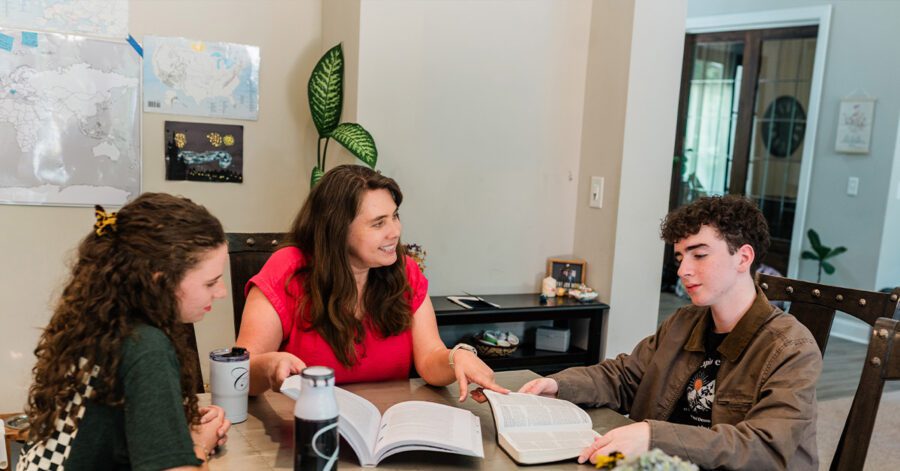
I recently attended a Parent Practicum where I had the opportunity to listen to a wonderful conversation. The discussion tied together ideas that are central to the vision of Classical Conversations: God-centered education, the classical model, the integration of subjects, and the biblical worldview. The conversation began with this question: “What makes education God-centered rather than man-centered?” One of the answers given was that the integration of subjects is critical to nurturing a God-centered education in our children.
Several themes came up, and the end result was a lovely representation of the interconnectedness the classical model so often produces—a testimony not only to its effectiveness, but also to its beauty. One of the first responses to that opening question was about studying literature and poetry and integrating them with other subjects. Someone pointed out that poetry is not simply language, but also music. The very sounds of words are musical; added to that is the dimension of rhythm:
Poetry and music have always been closely related. Perhaps the most basic element shared by the two is rhythm…Poetry can contain many different kinds of rhythm…Individual lines may be composed in the regular patterns of stressed and unstressed syllables that we call meter, but there is also a rhythm between lines, as metric patterns are repeated or varied. Repeated sounds, whether of end-rhyme, or internal rhyme, or the subtler echoes of half-rhyme, to say nothing of other devices such as assonance and alliteration, all combine to create a complex rhythmic fabric.
– The Norton Anthology of Poetry, 5th ed.
(The Norton Anthology of Poetry)
The next logical step in the conversation was to connect poetry and music with mathematics, because rhythm and meter are all about counting and measuring. But the connection is vastly deeper, even, than that. James Nickel puts it this way in his book Mathematics: Is God Silent? (Ross House Books, CA. 2001):
To fully comprehend [music] involves a thorough knowledge of trigonometry…sinusoidal functions not only perfectly describe sound waves, but they also completely describe the distinct, wavelike motion of visible light and in fact, the entire electromagnetic spectrum…Any wavelike, or regular motion—e.g. the path of meandering rivers, ocean tides, the crest and trough of ocean waves, and the majestic rotation of galaxies—can be described mathematically in terms of trigonometric functions (p. 238).
The next integration was inevitable: Someone pointed out, of course, that mathematics is orderly. From that point it was an obvious observation that orderliness is found in all aspects of creation. This statement about the orderliness of creation itself then became the springboard for a discussion about science—the observational study of creation—and within that context someone mentioned that when pictures are taken of cross sections of human DNA, the pictures bear a remarkable resemblance to stained glass art:
Christian apologist Ravi Zacharias wrote about this striking similarity in The Grand Weaver: How God Shapes Us Through the Events of Our Lives:
I had the privilege to speak at a conference at Johns Hopkins University…Before my address, Francis Collins, the director of the Human Genome Project and the co-mapper of human DNA, presented his talk…In his last slide he showed two pictures side by side. On the left appeared a magnificent photo of the stained glass rose window from York Minster Cathedral in Yorkshire, England, its symmetry radiating from the center, its colors and geometric patterns spectacular—clearly a work of art purposefully designed by a gifted artist…On the right side of the screen appeared a slide showing a cross section of a strand of human DNA. The picture did more than take away one’s breath; it was awesome in the profoundest sense of the term…And it almost mirrored the pattern of the rose window in York Minster…The audience gasped at the sight, for it saw itself…We can map out the human genome and in it see the evidence of a great Cartographer…We can sing and now see poetry in matter…
This connection between poetry, DNA, and stained glass windows instantly brought to my mind a particular word in Ephesians 2:10: “For we are God’s workmanship, created in Christ Jesus…” (NIV 1984) The word which leapt into my mind went back to the original starting point of our conversation—poetry—because the word for “workmanship” in the original Greek is ποίημα. This is rendered into the English alphabet as poiēma*, meaning ‘that which has been made’ or ‘a work.’ Our English word, poem, is directly derived (through Latin and then French) from the original Greek verb poieō**, which means ‘to make or to fashion.’
The Greek noun ποίημα appears exactly in that form in one other place in the Bible, Romans 1:20: “For since the creation of the world God’s invisible qualities—his eternal power and divine nature—have been clearly seen, being understood from what has been made…” (NIV 1984) In this case, the word appears in the phrase ‘being understood from what has been made.’ This is an affirmation that all things which were created by God in the beginning are works of art—God’s poetry!—and that each one of us is a uniquely designed poem ‘spoken’ into being—incarnated by God.
We are made in God’s image, and Christians are further molded into Christ’s likeness through the process of sanctification. Note that the Greek verb poieō has many meanings, including: to prepare, produce, ordain, cause or bring about, act rightly, celebrate, perform a promise, and fulfill. It is also fascinating to consider that the word poiēma can be translated ‘fabric,’ which adds a further dimension to the notion that DNA, the ‘code’ of life, is woven intricately together into the figurative needle that then knits the created thing together as it matures***.
In its circular beauty, DNA is also a multi-dimensional Mandala, the ancient Sanskrit word meaning ‘circle’ which is defined as “the convergence of complexity in unity” (see Mandala Fellowship). Surely it is clear that if any statement about DNA is true, that one would be! And, if viewed this way, the DNA of each human being, made imago Dei (in God’s image), is seen as a completely unique Mandala…just like a rose window, a fingerprint, a sand dollar, a snowflake, a sunflower, or the orbit of Venus (sketched out below):
Haven’t you noticed how beautifully, almost effortlessly, integrated this classical conversation was on that third morning at Practicum? How there was no realm that seemed beyond inquiry? A synthesis of complexity in unity in and of itself—though built through the participation of several different individuals —the conversation connected words to music, music to mathematics, mathematics to science, science to creation, and creation to art!
Then for me, personally, art was connected back to words, to λόγος ( logos ), and at the heart of it all came the revelation in Scripture (Ephesians 2:10) of the Creator God who through His Logos (John 1) has synthesized complexity into the most perfect of unions, the multitude of ποίημα , and called it good (Genesis 1:31), and who further promises to bring it all to a celebration in perfect fruition through His poieō, His efficacious promise (Romans 8:22).
Ravi Zacharias continues the thoughts I partially quoted above in this way:
At Johns Hopkins that day we saw the handiwork of the One who made us for himself—and when we grasp its splendor, we find the greatest joy of all to be the truth that every thread matters and contributes to the adornment of the bride of the One who became flesh for us and dwelt among us.
Thank you so much to all those participants of the Goshen, OH Parent Practicum for giving me the opportunity to witness this great classical conversation unfold!
__________________________________________
* Poiēma: Blue Letter Bible: Lexicon :: Strong’s G4161 – poiēma
** Poieō: Blue Letter Bible: Lexicon :: Strong’s G4160 – poieō
*** 4101 Pistikos to 4200 Porismos Sacred Name Bible: King James Bible, Strong’s Greek Dictionary – 4101 (pistikos) to 4200 (porismos)