
What if we viewed education as a giant treasure hunt through God’s universe? What if we looked for all of the ways that our academic subjects add to our knowledge of God’s attributes? What if we viewed the twin goals of education as falling down in worship and rising up in service?
“It is the glory of God to conceal a thing: but the honour of kings is to search out a matter.” (Proverbs 25:2, KJV)
The Treasure Hunt of Christian Education
If parents are seeking a thoroughly Christian education for their children, the search for these treasures offers us a broad and inspiring definition of a Christian education. First, we acknowledge that God has created a universe in which the parts are inherently connected to one another and to Him. Second, we see that God, not the student, is firmly at the center of education. Finally, we approach studies with wonder, seeking the bright and valuable treasures that God has hidden for us to uncover.
A modern education is inherently fragmented. If one discards the idea that God created the universe and personally holds it together, then there is no unity of knowledge. Universities were originally named universities because they taught students to seek the fundamental, universal truths of human existence. The universe is called a universe and not a multiverse because it is one whole with many parts working together.
A modern education places the student at the center because the aim of the modern education is job education. Picture a solar system diagram with the student at the center and school subjects in orbit around the student. Each of the subjects offered up to the student—math, foreign language, English, science, history, and a dazzling array of electives—are in discrete bubbles that are served up to the student in fifty-five-minute increments by six or more different adults. The student would have to work very hard to discover the connections between philosophy and math, history and science, or literature and politics. The student in the modern secular education has been taught that faith and school are separate from one another. She would have to work very hard to see how subatomic particles or the double helix structure of DNA have anything to teach her about the attributes of God.
A Christian education is often no better, adopting the modern education model and adding Bible verses to lesson pages or adding a chapel time or a single Bible study course. In this model, the student is still at the center of education, and the subjects are still disconnected from one another and from God.
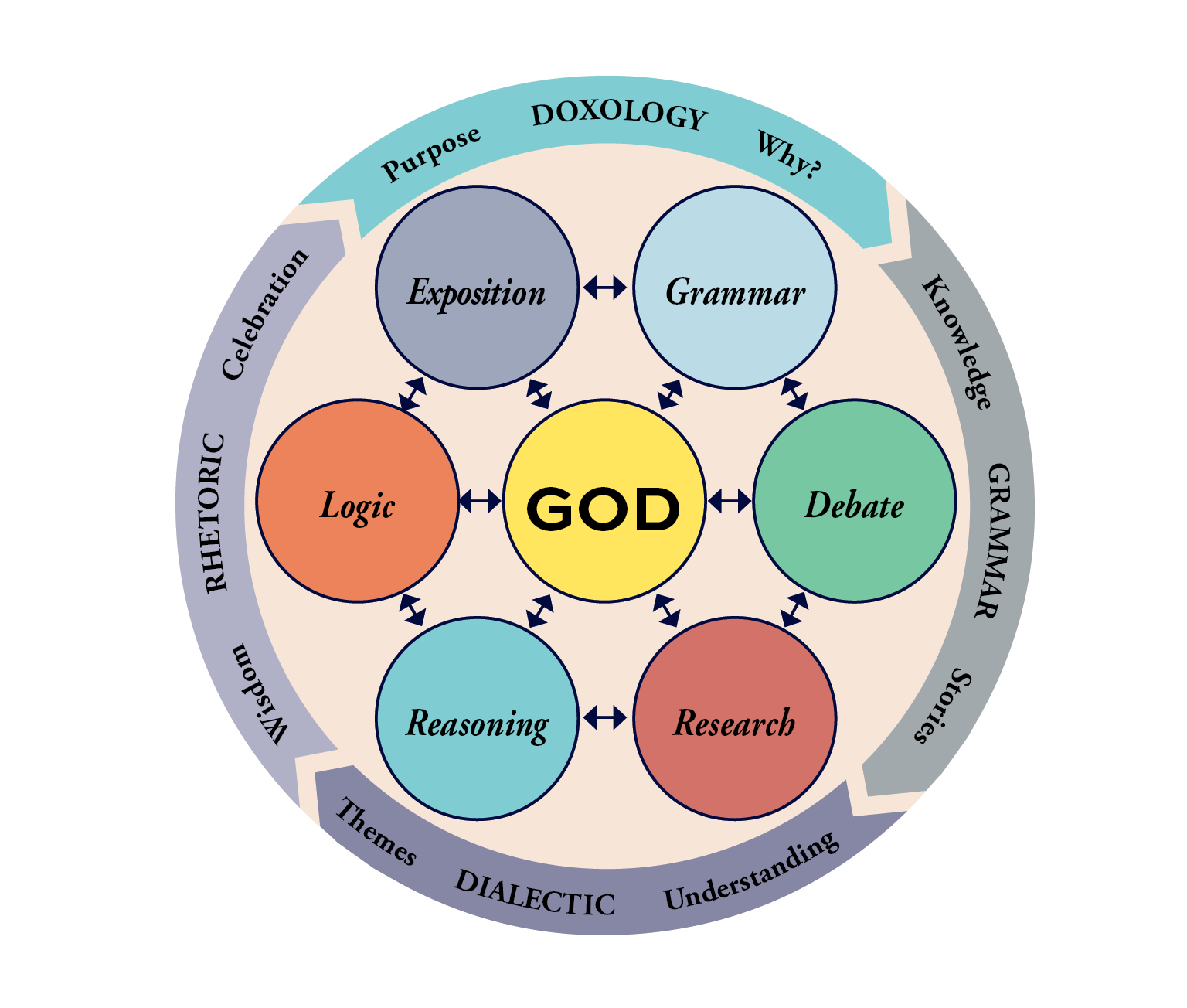
A robust classical, Christian education starts with a completely different model. If you again picture a solar system, God would be the center. In Classical Conversations, we call the different areas of study “strands” because they are not isolated subjects. Instead, they are woven together in the fabric of the universe. In the picture of a classical, Christian education, the strands would orbit around the center, but this time, there would be arrows going out to and from God, and there would be arrows going back and forth between each of the strands. Now, the student can see how God has ordained each of the strands, and how the study of each strand teaches students more about God and His attributes. In addition, the student is encouraged to make connections between the strands. In Classical Conversations communities, one Tutor remains with the student all day so that conversations can naturally explore the connections between poetry and music theory and math.
The Catechesis Wheel
To illustrate this idea, Classical Conversations has developed a visual called the Catechesis Wheel. The Greek word catechesis simply means oral instruction. People usually associate the word with church classes in which the teacher (the catechist) asks a question from the curriculum (the catechism), and the student (the catechumen) responds with a memorized answer. The goal of catechesis is to prepare the student for membership in the church. For example, one question from the Westminster Confession is “What is the chief end of man?” The catechumen responds, “Man’s chief end is to glorify God and enjoy Him forever.”
It has been said that there are two ways to know God, through His word and through His world. We can begin to know God through His world by extending the idea of catechesis to oral instruction in any field of knowledge. In the Classical Conversations Foundations program, students practice catechesis with history sentences and science facts. For example, the parent or Tutor says, “Tell me about the Magna Carta.” The child or community answers, “English King John signed the Magna Carta in 1215, limiting the king’s power. Later, England’s King Edward III claimed to be king of France and began the Hundred Years’ War in 1337.” The parent or Tutor asks, “What are some parts of the food chain?” The student or community answers, “Some parts of the food chain are producer, consumer, and decomposer.” A community of Christians around the world now has a unified set of knowledge about God’s world.
On the outside edge of the Catechesis Wheel, there is an arrow showing how the process of education begins. It begins with building a storehouse of knowledge, both facts and stories about God’s world and people. This is the art of grammar. Then, students move beyond facts and begin to wrestle with ideas and notice repeated themes. Here, they can begin to see how the subjects teach them more about who God is. The arrows pointing back and forth between God and the subjects begin to make sense. This is the art of dialectic. Next, students move toward the art of rhetoric, toward wisdom and understanding. Students are now able to make connections between the different facts and ideas they have encountered in various seminars. Repeating the process again and again results in worship and service. The word doxology at the top of the wheel literally means “a word of God’s glory” or “speaking God’s glory.” The culmination of study should be to echo in celebration of God.
Integration in Classical Conversations Challenge Seminars
In Classical Conversations, we call our subjects strands because we are practicing skills over content. We call our weekly meetings seminars to emphasize the community focus on discussion, exploration, presentation, and debate instead of lecture. In the Logic seminar, we practice on math content. In Research we practice on science; in Reasoning on formal logic and philosophy; in Debate on history and cartography; in Exposition on literature and composition; and in Grammar on Latin.
To illustrate how our community days facilitate integration, I’ve gathered some examples from my own community over two decades of tutoring upper Challenges. Let’s take a peek into some of those discussions:
One day, in Challenge III, we compared the American and French Revolutions in the Debate seminar. Our discussion of the French Revolution led us to talk about the role of the French mob during the Reign of Terror. Unlike the American Revolution, in which the revolutionaries quickly established an orderly government based on written law, the French Revolution produced no clear Constitution. Instead, France devolved into a totalitarian state in which mobs roamed the streets arresting citizens and turning them over to be executed by guillotine. This led us back to Shakespeare as we discussed the role of the mob in his play Julius Caesar. Talking about the fickle and violent nature of mobs then prompted us to consider how the American Federalists, particularly John Adams, feared that the new United States democracy could quickly descend into mob rule. This led the Founders to write laws to protect against such an outcome.
In the poetry seminar, we read aloud a chapter called “Seeing” from Annie Dillard’s book The Pilgrim at Tinker Creek. I wanted to challenge the students to be still, to attend to nature, to reflect on their own souls as well as on God—in other words, to be poetic. Dillard’s essay is rich in similes and metaphors. We paused to examine some of these in detail and to discuss Jesus’ use of metaphor when He calls Himself the vine, the bread, and the wine. I asked them to consider why contemplation of nature and poetry are so often linked (think about the Psalms of David). How does knowing the names of particular trees, birds, and fish impact our understanding of who God is? How is naming things poetic? Why did God begin Adam’s education by having him name the animals (Genesis 2)? What does this say about our studies of biology or chemistry? What is the connection between science and poetry? If we are made in His image and we are poetic, is God a poet?
In Latin (Grammar strand), I asked students to share a verse or a word from the Gospel of John in Latin that stood out to them the previous week. My normally quiet daughter was the first to respond by saying that she was surprised to see the word “ratio” in Scripture. We looked up the word in our Latin dictionaries to remind ourselves that ratio is a third declension noun meaning “reason or explanation.” We discussed how this word is the root of both ratio in math and rational in logic. All day long, we returned again and again to this word. We set up ratios in both math (Logic strand) and chemistry (Research strand), we examined the ratios between the notes in chords in music theory (Reasoning strand), we talked about man being “noble in reason” in Shakespeare’s Hamlet (Exposition strand). We discussed how the French Revolutionaries, influenced by the spirit of the age of Enlightenment, erected statues to the goddess of Reason in French churches to show that they believed reason was more important than faith. This served as yet another contrast to the American Revolution in which Founders credited the hand of God for preserving the nation (Debate strand).
Because Classical Conversations students are together with one adult mentor for all strands for thirty weeks a year, they are able to see the connections between history, literature, Scripture, poetry, music theory, math, chemistry, and Latin. These discussions lead to a deeper understanding of the beauty of God’s universe and of God’s attributes. Knowledge leads to understanding, which leads to wisdom, which leads to worship.
Listen to the founder of Classical Conversations, Leigh Bortnis, as she explains the Catechesis Wheel for classical learning:
Written by: