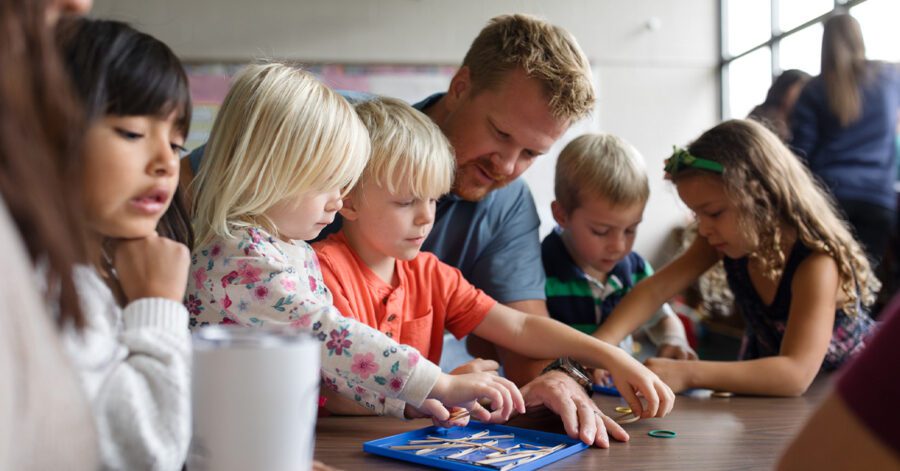
Part of every Community Day in Classical Conversations consists of hands-on science experiments and demonstrations in the Foundations programs. Find out why these thirty minutes of homeschool co-op make lasting memories for students and parents alike.
On the morning of community day, right after the buzz of greeting friends and settling in, a magical moment in Foundations descends as tables are covered in bowls of water, balloons, magnets, plants, or perhaps something mysteriously wrapped in foil. Kids lean in. Parents lean in, too. And suddenly, the room gets wonderfully, delightfully curious.
That is the beauty of hands-on science in Foundations. It isn’t about mastering big scientific ideas in community or turning your dining room at home into a laboratory. It is about letting children touch the world they are learning about, attend to the day’s new wonder, and discover that God’s creation is both wild and orderly, and endlessly interesting.
Getting Ready for Foundations
Why We Do Hands-On Science in Foundations
Classical Conversations’ Foundations program is focused on building strong memory pegs, and Hands-on Science gives those pegs a little extra staying power. When a child sees pepper scatter across the surface of water or watches a magnet pull a paperclip across the table, it is as if someone flipped on a light switch within his or her mind. Concepts that felt abstract suddenly have shape, movement, texture, and wonder.
Because Foundations supports the art of grammar in classical learning, these simple activities fit perfectly. Students are not required to write lab reports or provide complicated explanations. Rather, they are collecting memorable experiences that will simplify more difficult concepts later. Simply put: Exposure now will open doorways to future understanding.
Integrating Math and Science in Homeschool: Practical Counting Activities
What Foundations Science Experiments Are (and Aren’t)
As a homeschool parent, you may hear the words “experiment” or “project” and quietly panic. Be assured, however, Foundations hands-on science isn’t about professional precision. Instead, it is about simple demonstrations with equally simple goals.
Hands-on science is:
- An introduction to God’s creation
- An opportunity to see, hear, smell, and touch
- A chance to attend, inquire, and connect discoveries
Hands-on science is not:
- A test
- A performance
- A place where Tutors or parents are required to be experts
If a balloon pops early or a plant sample is mangled halfway through, that is still scientific data. Students learn that sometimes things do not go as planned, and curiosity continues to move forward.
Homeschool Science: Data Collection & Analysis Starts with Attending
A Simple Framework for Talking About Science at Home
Parents often ask, “What do I say during Hands-on Science?” By using the classical tools, you will never lack questions. Below is a consistent script you can use, no matter the activity, using the classical tools of Attending, Comparison, Relationship, Circumstance, and Authority:
ATTEND to the details: “What do you notice?”
COMPARE what you see: “What looks the same or different?”
Predict with RELATIONSHIP: “What do you think will happen next?”
Repeat the CIRCUMSTANCE: “What happens if we try it again?”
Connect to AUTHORITY: “Does this remind you of a science fact we’ve memorized?”
When an experiment or project has been completed, seek out creative ways for students to EXPRESS what was observed with a sketch or perhaps tell a STORY about the experience. No lectures are needed. Instead, simply encourage and engage your child through guided curiosity.
Science Through Sketching: Cultivating Observation with Drawing in Homeschool
Small Activities, Big Thinking in Hands-on Science
Some of the most familiar Foundations experiments and projects pack serious mental habits inside of them. Below are three examples of experiments from Janice VanCleave’s 201 Awesome, Magical, and Bizarre Experiments by Janice VanCleave, one of Classical Conversations’ research resources available for in-home and in-community use:
- Oil and water (Experiment #60: Oily Feathers): Students learn that different properties lead to different behaviors and apply this principle to pollution.
- Sound frequency (Experiment #164: Bottle Organ): Students sort, classify, and look for patterns in sound frequency by tapping water-filled bottles of differing levels.
- Pepper floating on water (Experiment #171: Pepper Run): Students see invisible forces at work and learn to draw conclusions from observed changes.
And three example projects from the pages of the Foundations Curriculum:
- Crayfish identification (p. 120): Students identify the parts of a crayfish in a hands-on demonstration.
- Layers of the Geosphere (p. 125) : Students craft a geosphere model with playdough, demonstrating the different parts of the geosphere.
- Straw bridge construction (p. 196): Students use supplies to design and build a bridge from straws, rubber bands, and playdough, testing it to see how much weight it can bear.
Each activity quietly trains future researchers by providing hands-on opportunities to explore, question, and test. It is impossible to build a scientist without a hearty dose of wonder. When students see something surprising or beautiful happen under their own hands, that spark encourages more curiosity. Wonder is what keeps future scientists in the lab long after the novelty has worn off, building the mindset, instincts, and habits that they depend on.
Discover Uncle Paul: Amazing Science Stories by Henri Fabre
Embracing the Mess and the Questions During Foundations Science Experiments
If there’s one thing children bring to science, it’s full-tilt enthusiasm. They want to touch everything, repeat everything, and ask wildly unrelated questions such as, “Do magnets work on frogs?” “Does oil float on orange juice?” “If this plant is dead, is everything dead inside it, too?”
Instead of shutting questions down, consider them to be doorways. You don’t need to know the answer. A simple “Let’s see what we can find out together” is all it takes to walk through the portal to wonder.
Remember: The mess is also part of the fun. Water spills, seeds scatter, and food coloring migrates. That little bit of chaos, however, pays big dividends in capturing attention, cultivating memory, and multiplying joy.
Science from a Biblical Perspective
A Few Practical Helps for Homeschool Science
If you want to set up your at-home hands-on science extensions to run smoothly, try keeping a small science bin with some practical tools, including:
- a compass
- a magnifying glass
- a ruler
- binoculars
- graph paper
- colored pencils
- a notebook or lab journal
- a small tray to contain the “creative splashing”
Many tools can be found in your kitchen pantry (salt, flour, straws, food coloring, coffee filters, funnels, tongs, etc.), in your medicine cabinet (tweezers, eyedroppers, shaving cream, gloves, etc.) or in your tool shed or garage (trowel, rake, hoe, etc.).
You will also want to access reference resources that help pursue truth, knowledge, and wisdom, such as the Classical Acts & Facts Science Cards. With these tools in hand, invite students to sketch what they see. You can help them get started by asking a comparison question and tying the experience to a memory fact if it fits naturally.
Playing the engaging songs from the Lyrical Life Science series while dancing in your living room might also launch some spontaneous investigations while serving to commit fun facts to memory. The possibilities are endless– just enjoy the process.
The Bigger Story
When we let our children handle God’s world up close, something deep and good happens. They begin observing that creation is full of patterns worth noticing and mysteries worth exploring. They learn patience, attentiveness, and courage to try again when something goes awry. And underneath it all, they cultivate a more important, lifelong habit: the habit of wonder.
That is the heart of Hands-on Science in Foundations. Not perfect experiments. Not polished explanations. Just children discovering that the amazing world God has created is a place definitely worth paying attention to.
Find out all the Community Day Foundations activities with these helpful resources:
- From Root to Fruit: Cultivating Growth in Foundations with New Grammar
- Training Voices for Truth: Why Presentations Matter in Foundations
- Classical Education Fine Arts: The Four Essential Elements Explained
- Foundations Memory Work Review: How to Master Grammar Review at Home and in Community
Written by: