I am new to tutoring Challenge I, so I am learning as I go. However, isn’t that always the case? I am always learning.
I love literature, so I pour a lot of passion into the subject naturally. It is also one of the best seminars during which to learn how to engage in a classical conversation. I have found a trick that really helps conversations to start well and I want to share it with you so that you can try it at home with your own children or in your Challenge seminar. It works great with my fourteen-year-olds in a group and with my ten-year-old at home.
I have to admit that this was not originally my idea. I learned it from Adam Andrews. You can watch his DVD series, Teaching the Classics, and glean even more great ideas!
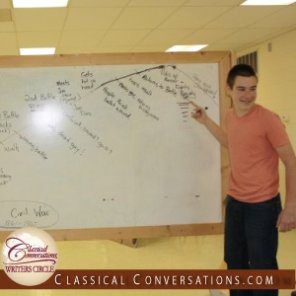
I use Mr. Andrew’s plot diagram to get my class discussions started. I draw a large, wide triangle on the whiteboard. The tip of the triangle is where the climax will go, and that is usually found toward the end of the book, so draw your triangle with the tip of the triangle over towards the top right of the whiteboard.
The events will be written on the upward slope toward the climax, helping your students clearly see the “rising action” and how it all builds toward the climax. I begin the discussion by asking the quietest person to tell me what happened at the beginning. This is the easiest question; you cannot go wrong. Even if the answer is not what you think is the very first event, put it on the timeline where you think it should go and allow the quiet student to experience success. Hopefully, after several successes the quiet person will begin to speak up more. Ensure success for the quiet students and be very affirming of whatever they say.
If you are discussing The Three Bears with your younger students, they may identify the first event as the “Bears tasting porridge and discovering it’s too hot.” This would go at the bottom of the triangle on the left side. “Bears take a walk,” would be the next event. “Goldilocks enters the house,” would be next, and so on up the slope.
I ask the next most quiet student for their input and proceed through the class adding events to the timeline. Through this exercise, lots of discussions will be sparked as students chime in with their thoughts about events or characters as we go. We may have a difference of opinion about which event is the real climax, which is a good conversation to have. I often end up saying, “Why do you think that?” which helps the students clarify their own thinking.
Along the bottom of the triangle, I add the setting. In the case of The Three Bears, the whole story takes place in the Bear’s house in the woods. (It is probably an old pine forest in northern Europe, but this depends on the storyteller.) If the setting changes, I put the new setting along the baseline, too. In Billy Budd, Sailor for example, the first part of the story takes place on one ship and the rest on another, so I put both ships’ names at the bottom, roughly lining up with the corresponding events.
The climax of the story is the most exciting moment. In The Three Bears, that would be the moment when the Bears wake up Goldilocks and she runs screaming from the house. In Billy Budd, the climax would be the moment of Billy’s death or the moment he is given his verdict. Some students may find one or the other event more emotional, so I might take a vote to decide which goes at the climax spot.
After you put the climactic moment on the tip of the triangle, put any “wrap up” information on the downside of the triangle: the bears clean up, learn to lock the door, and live happily ever after.
My Challenge I students and I have done these plot diagrams for Billy Budd, The Red Badge of Courage, and other difficult readings. Drawing a plot diagram has definitely helped to review the story and “warm up” for deeper discussions on characters and themes.
Try it with a bedtime story or whatever your students are reading and begin a classical conversation. Then, your children will be well prepared for Challenge work and you will be well prepared to be a Challenge tutor!