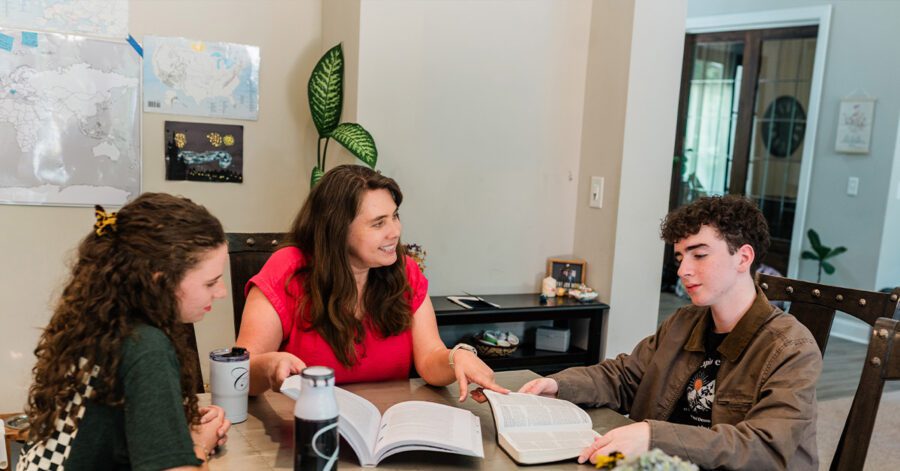

Common Latin is an integrated homeschool Latin curriculum from Classical Conversations. Families learn the language together by translating Scripture from the Latin Vulgate, using the classical model of education. Parents and children study the same passages, memorize the same vocabulary, and build mastery side by side.
Most Latin programs hand you grammar drills and a workbook. Common Latin starts somewhere else. It treats Latin as a window into language, faith, and the meaning behind the words your family already loves.
Here is what makes it different, how it works, who it is for, and when you can start.
What makes Common Latin different
Three things set Common Latin apart from a standard Latin textbook.
It is built around Scripture. The curriculum uses the Latin Vulgate as its primary source. Your family translates the actual words of God’s Word and discovers the connections between Latin roots and English meaning along the way.
It is built for families, not just students. Parents and children learn together. You are not assigning Latin and walking away. You are sitting down and doing it as a household.
It is built on the classical model. Common Latin follows the same grammar, dialectic, and rhetoric progression that shapes the rest of a classical, Christ-centered education. Latin is not a side subject. It reinforces everything else.
How Common Latin works
Families translate passages from the Latin Vulgate together. As you work through the text, you memorize a shared vocabulary and build a common foundation of grammatical concepts.
The learning is collaborative by design. In a Classical Conversations community, students discuss what they discovered in their translations. They share insights. They help each other work through the hard passages. Nobody studies alone.
This is what makes the program multigenerational. A parent, an older student, and a younger sibling can all engage with the same Scripture at their own level. The vocabulary is common. The text is common. The progress is shared.
Who Common Latin is for
Common Latin serves the full span of a Classical Conversations family.
Challenge A through Challenge III students, typically ages twelve through eighteen, work with the core curriculum. This is the formal Latin study at the heart of the program.
Foundations students, typically ages four through eleven, participate through preparatory flashcards and by listening to the readings from the Vulgate. They are building the ear and the vocabulary that the Challenge years will draw on.
The result is a household where everyone is pointed at the same language, at the same Scripture, at the same time.
Do parents need a Latin background?
No. You do not need any previous Latin experience to guide your children through Common Latin.
The curriculum is written to equip parents from the start. It gives you clear instruction to lead with. Your community gives you the support that builds confidence naturally. Many parents learn the language right alongside their children, and that shared effort becomes part of the gift.
The community piece
Latin can feel isolating when you do it alone at a kitchen table. Common Latin is designed to be done in community.
When students read the same Scripture, memorize the same words, and build mastery together, something more than language happens. They form genuine connection. They learn to discuss ideas, defend a translation, and sharpen each other. The community is not a bonus feature. It is part of how the learning works.
When can your family start?
Common Latin is rolling out in phases. Flashcards are scheduled to be available in April 2026. The complete curriculum launches in phases beginning in the 2027 to 2028 academic year.
That means families can begin building a Latin foundation now, before the full program arrives. The flashcards give Foundations and Challenge students an early on-ramp into the vocabulary and the sound of the language.
How Common Latin fits the classical model
In the classical model, language is foundational. Latin trains the mind in grammar, sharpens vocabulary in English and beyond, and lays the groundwork for any language a student studies later.
Classical Conversations lays that foundation early. Children ages four to twelve sing noun and verb endings and memorize vocabulary. Older students move into formal translation in the Challenge years. Common Latin connects those stages around a single, Scripture-centered thread.
If you are still deciding whether Latin belongs in your homeschool, start with the reasons it is worth the effort, then look at how to teach it well at home.
Bring Latin into your homeschool
Common Latin gives your family a way to study the language together, rooted in Scripture and supported by community. Explore Classical Conversations programs and connect with a local community to learn how Common Latin fits your family’s classical, Christian education.
Frequently asked questions
Common Latin is an integrated homeschool Latin curriculum from Classical Conversations. Families learn Latin together by translating the Latin Vulgate using the classical model of education.
No. The curriculum equips parents with no previous Latin background. Clear instruction and community support help you learn alongside your children.
Challenge A through III students, typically ages twelve through eighteen, use the core curriculum. Foundations students, ages four through eleven, take part through preparatory flashcards and Vulgate readings.
The curriculum uses the Latin Vulgate as its primary source, so families translate Scripture as they learn the language.
Flashcards are scheduled for April 2026. The complete curriculum launches in phases beginning in the 2027 to 2028 academic year.
Yes. Common Latin is multigenerational by design. Parents and children study the same vocabulary and Scripture at their own levels.