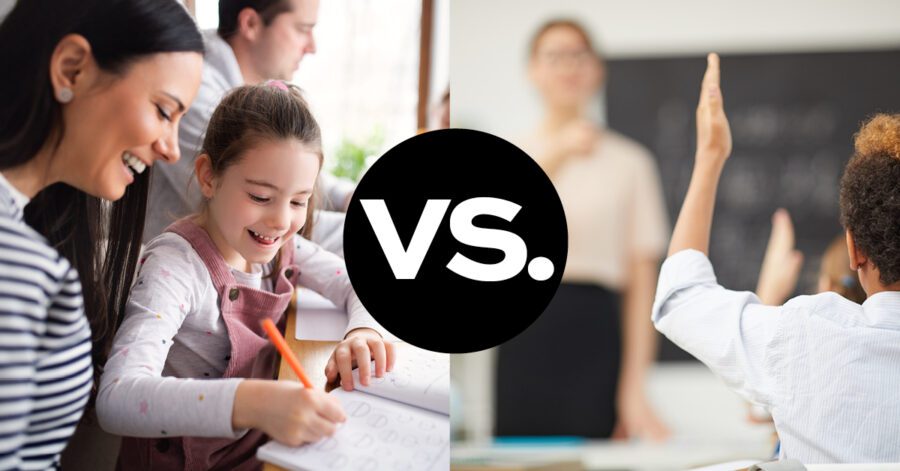
At some point, you’ve probably heard the question asked (or maybe you’ve asked the question): why homeschool when your child can go to a public school funded by the government?
But perhaps we should flip that question around. Homeschooling has grown in popularity with families throughout the United States. Several studies suggest that between 5 and 6 percent of school-age children are homeschooled (that’s about three million kids), and this number increases year by year. During the COVID-19 pandemic, many parents found themselves homeschooling either outright or de facto—and that hands-on experience only increased the popularity of homeschooling!
Why is homeschooling more attractive than public schools and traditional schooling to these parents?
Why Homeschool?
There are more reasons to homeschool than ever, but here are five reasons in particular why parents are choosing to homeschool their children in increasing numbers. If you are weighing the decision for the first time, learning how to start homeschooling is more straightforward than most parents expect.
1. Religious Freedom
Religious freedom is one of the most repeated answers offered by parents when making the decision to homeschool their child. Public schools don’t incorporate religious studies into the classroom. Public school curricula may teach a different set of values and beliefs than what parents believe and want to instill in their child.
Homeschooling, on the other hand, affords parents the opportunity to incorporate Bible studies, prayers, and values throughout the lesson plan.
Interested in homeschooling freedom?
Bookmark the Homeschool Freedom Action Center.
2. Academic Excellence
Parents also often choose to homeschool because public education severely underwhelms them. These parents pursue homeschooling as a means to academic excellence.
Homeschools by definition have better teacher-to-student ratios than public schools, which means that homeschooled students benefit from more frequent one-on-one attention. Also, in a home school, the parents control the curriculum, which means parents can ensure the content is worthwhile. Parents who choose a classical education curriculum can build a coherent course of study year after year, and many families keep a homeschool transcript ready well before college applications begin.
3. Safety and Security
Concern over a child’s safety is another reason why so many parents choose to homeschool. Some children are subjected to negative influences such as bullying, unhealthy social dynamics, and the presence of drugs and alcohol in public schools.
However, in a homeschool environment, parents are able to monitor their development without those unhealthy stressors and dangers.
4. Personalized Learning
In a homeschool setting, parents are able to offer more personalized learning for their child. Public school teachers have a classroom of students with different abilities and levels of learning. The lesson plans won’t be tailored for each individual student.
Homeschool allows for the parents to assess their child’s strengths and weaknesses and help build lessons around their needs. This type of teaching provides flexibility to give the child what he or she needs to learn and skip ahead if they grasp the subject. This same flexibility makes homeschooling special needs students easier to support well, since lessons can move at whatever pace each child needs.
5. Family Time
Homeschooling is a family effort. There is collaboration between children and parents to come together and share knowledge and experiences. This level of connectedness goes beyond what can be provided in public schools.
The opportunity to reinforce family values and beliefs while developing a stronger sense of self is why many families choose homeschooling over public schooling.
Want more reasons to homeschool?
Read: “The Benefits of Homeschooling: A Graduate’s Perspective”
Why Not Public School?
These are a few reasons why homeschool parents often decide to homeschool their children rather than send them to public school. Here are four such reasons:
1. Lower Academic Outcomes
Studies have revealed that homeschool students typically score higher than public school students on standardized tests. Parents’ level of education do not change the student’s success.[1]
Homeschool students also typically do better in college. Homeschool students have a higher rate of graduating college than students who attended public school. One study revealed that homeschooled students graduated with an average GPA of 3.46 while their public school peers graduated with an average of 3.16. The same study also showed that homeschooled students graduated from college at a higher rate (66.7%) than their peers (57.5%).[2]
2. Poorer Social Environments
Contrary to the popular misconception, homeschool students are often better socialized than their public school counterparts. They are more likely to participate in political drives, sports teams, church ministries, and community work.[3]
Public schools, meanwhile, often present challenges for social development, such as bullying, discouragement, and negative peer influences. For example, according to one study, 5% of students between the ages of twelve and eighteen reported that they had been afraid of attack or harm at school in 2019.[4]
That’s 1 out of 20 students, and the average class size in the USA is 20.3.[5]
3. Lack of Individualized Attention
Public schools often have large class sizes (in fact, the average elementary class size is 21.1, and the average secondary school class size is 26.8)[6], making it challenging for teachers to provide individualized attention to each student. In particular, students with specific learning needs may not get the support they require.
4. One-Size-Fits-All Approach
Public education adopts a “one-size-fits-all” approach. The curriculum is standardized and advances forward with no regard to the student’s development, following fixed schedules and often either ignoring specific learning needs or creating new problems and further inflexibilities with Individualized Education Plans.
5. Lower Cost for Families
Public education is often called free, but it is funded by an average of nearly $17,000 per pupil in local, state, and federal tax dollars each year.[7] Homeschooling costs families directly, yet most spend only a few hundred to a few thousand dollars per student each academic year on curriculum and materials. Programs like Classical Conversations help many families stretch that further by sharing resources and community. Take a look at our CC programs overview to see which fits your family.
Frequently Asked Questions: Homeschool vs Public School
Is homeschooling better than public school?
Research shows homeschool students typically score 15 to 25 percentile points higher than public school students on standardized tests. But the right fit depends on a family’s goals, values, and desired pace of learning. Classical homeschooling programs like Classical Conversations offer a structured, community-based path that brings the benefits of homeschooling together with weekly in-person connection.
What are the main advantages of homeschooling over public school?
The clearest advantages are personalized pacing, room to integrate faith throughout the day, closer family relationships, and the freedom to shape curriculum around a child’s needs. Homeschooled students also tend to score higher on college entrance exams and graduate college at higher rates than their public school peers.
Is homeschooling cheaper than public school?
Public school is funded through taxes, but homeschooling costs vary by family, from a few hundred to a few thousand dollars per academic year depending on curriculum choices. Co-op programs such as Classical Conversations help many families keep costs manageable by sharing resources and community.
How do homeschool students do socially compared to public school students?
Socialization is one of the most common questions parents ask, but research consistently shows homeschool students are well socialized. Programs built around a weekly community day, like Classical Conversations, give children regular peer interaction, group learning, and cooperative work alongside their academic growth.
Homeschool Compared to Public School
The evidence is abundant and the collective experience of homeschoolers shows that homeschooling works. Public schools, on the other hand, afford poorer outcomes all around.
Why send your child to public school when you can homeschool?
Learn how homeschool differs from other education models with these resources:
- Is Homeschooling Better Than Public School?
- Public School Exit: Helping Christian Families Find Educational Freedom (podcast)
- Classical vs Modern Education
Citations
[1] National Home Education Research Institute. “Academic Achievement of Home School Students.” Accessed July 2026. https://www.nheri.org/academic-achievement-homeschool-students/.
[2] National Home Education Research Institute. “Research Facts on Homeschooling.” Accessed July 2026. https://www.nheri.org/research-facts-on-homeschooling/; O’Shaughnessy, Lynn. “Can Homeschoolers Do Well in College?” CBS News, July 22, 2010. https://www.cbsnews.com/news/can-homeschoolers-do-well-in-college/.
[3] “Homeschooling and Social Skills Study.” Journal of School Choice, Taylor & Francis. Accessed July 2026. https://www.tandfonline.com/doi/full/10.1080/15582159.2017.1395638.
[4] National Center for Education Statistics. “Fast Facts: School Crime and Safety.” Accessed July 2026. https://nces.ed.gov/fastfacts/display.asp?id=49.
[5]National Center for Education Statistics. “National Teacher and Principal Survey: Class Size.” Accessed July 2026. https://nces.ed.gov/surveys/ntps/tables/ntps1718_fltable06_t1s.asp.
[6]Organisation for Economic Co-operation and Development. “TALIS: Figures and Tables.” Accessed July 2026. https://www.oecd.org/education/school/talis-excel-figures-and-tables.htm.
[7]National Center for Education Statistics. “Fast Facts: Expenditures.” Accessed July 2026. https://nces.ed.gov/fastfacts/display.asp?id=66.