

What comes to mind when you hear the words home library? Hardwood bookcases and leather sofas? The earthy vanilla aroma of paper and the ridged spine of a hardback under the pad of your finger? Steaming tea and quiet afternoons spent leafing through pages populated by great and sad and odd and awful and wonderful figures?
Maybe, but do the words family culture leap to the tip of your tongue when you think of home libraries? Probably not, and yet, they should.
Copper Lodge Library is a series of classic books and literature curated by Classical Conversations with a mission to build a family culture of virtue through conversations about the world’s greatest stories.
If that sounds lofty, don’t worry. We’ll unpack that statement, look at the design philosophy behind CLL, and discuss how these books can support your home school.
I. The Why of Copper Lodge Library
Once upon a time, there were two very clever brothers.
When they were children, the brothers had received a Christ-centered education at home. At the time, that sort of education had fallen out of fashion, but the books they read, the skills they learned, and the faith they cultivated would serve them well later in life.
You see, after their father died of winter fever one sad year, their family was plunged into deep poverty. They were forced to scrimp and save. They only ate once a day. But the brothers were both very clever, like I said, and they’d received a Christian education, and so they both managed to get into law school. Things were looking up!
Then their mother passed away.
Life only became harder. The brothers had younger siblings to support, and law school was expensive. The elder brother quit his studies to support the family. The younger brother was in poor health and could only work from time to time. And, alas, there were no whimsical merchants selling magic legumes of any variety to be found anywhere in the country to save them from a life of hardships.
But the brothers were very clever, and they’d received a Christian education. They spent their days hard at work in the library, studying stories and poems and music from the past and developing theories.
One day, they devised a plan.
They would go out into the land. They would travel fen and field and forest and visit farm and village. They would search out the forgotten corners of their country, and they would uncover good stories—no, great stories. Then, they would publish a collection of these tales, escape the clutches of poverty, and provide a better life for their family.
Well, they succeeded, and in succeeding, accomplished more than they could have ever dreamed, reaping the rewards not only for themselves but for everyone who ever heard their stories.
The Stories We Know, The Stories We Love
This is not a fairy tale. The two very clever brothers were none other than Jacob and Wilhelm Grimm—better known as the Grimm Brothers—and today, we’re all familiar with the stories they collected in Grimms’ Fairy Tales.
Rapunzel. Hansel and Gretel. Snow White. Little Red Riding Hood. The Frog Prince.
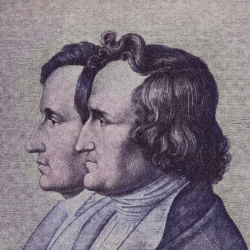 Jacob and Wilhelm saved the stories we all know and love from extinction at the hands of modernity. The Grimms’ efforts led to the preservation of their heritage, the development of new fields of study, and significant advancements in historical linguistics.
Most importantly, the stories they preserved would eventually prove to be a profound source of wonder and an education in virtue for generations of families.
The stories they collected teach timeless lessons that are good and beautiful and true in their own way (not, of course, in the literal sense, but in the transcendental sense). The stories teach right from wrong, virtue from vice, and wisdom from folly in a way that’s accessible to everyone, from children to adults, from the uneducated peasant working the field to the aristocrat studying philology at university.
And, hey, they’re also fun!
The world would be a greatly impoverished place without the hard work of the Brothers Grimm and others like them. Modernity would’ve killed a deep source of childhood’s moral imagination.
Unfortunately, we face a similar situation today.
The Vanishing Classic
Modern education has a problem. (Well, modern education has problems, plural, but let’s start with one problem at a time!)
Classic stories are vanishing.
No, they’re not going into shredding machines. They’re not being deleted from hard drives and servers. They’re not slipping away in the dead of night with their suitcases stuffed full of crocheted booksleeves and colorful bookmarks.
(Although that would be adorable.)
But they’re vanishing.
For the past few decades, public schools have been removing classic literature from the curriculum, and the consequences have been tragic. Here’s a sad statistic: In the 1970s, 60 percent of high schoolers read from a book or magazine at least once a day.
By 2016, that number had dwindled down to a mere 16 percent.
Instead, students are reading books of their own choosing or hyper-political books of no literary merit. (The less said about these books, the better.) And while there’s certainly room for student choice in the course of a language arts curriculum, growth demands exertion. Students cannot grow without exertion. Students cannot grow on a diet of graphic novels written several notches below their reading level, nor can they grow on modern-day agitprop.
Students need wise, beautiful, challenging stories.
The Classic Solution
Here’s the good news: there’s a solution to the vanishing classic, and that solution is found at home. More specifically, in your home library.
That’s right. We don’t need to reform the public school system—talk about a Sisyphean task!—or even develop a brand-new reading curriculum that will “totally work this time, pinky promise,” to loosely paraphrase every administrative progressive ever.
We simply need to read. We need to read great stories together as families, and we need to reform our family culture (there’s that phrase again!) around meaningful conversations drawn from great literature.
Family Culture
Let’s define our terms—the classical way! What do we mean by “family culture”?
Let’s start with the word “family”. Merriam-Webster has a few definitions. This one is particularly relevant:
Family (noun): the basic unit in society traditionally consisting of two parents rearing their children.
Family—not the state, certainly not the public school—is “the basic unit in society.” This is very much the biblical understanding of the family (see Genesis 2:21–24), and so we can accept Merriam-Webster’s definition for now.
How about “culture”?
Culture (noun): the set of shared attitudes, values, goals, and practices that characterizes an institution or organization.
Sounds straightforward. A family culture is a set of shared attitudes, values, goals, and practices that characterize the basic unit in society, which consists of two parents rearing their children.
So, when we’re talking about building a family culture around literature, what we’re really talking about is building up family attitudes, values, goals, and practices through reading.
Why should we build our family cultures around literature? Here are three reasons:
- To strengthen the family! Families bond through meaningful discussions and shared experiences. Great stories help families cultivate shared values and visions.
- To “train a child in the way he should go” so that “even when he is old he will not depart from it” (Proverbs 22:6). Great stories teach lessons. They’re an invaluable tool for teaching character.
- To cultivate virtue (those skills and traits that enable us to live our lives according to the good) and especially the greatest of virtues—wisdom. Wisdom comes from God, but classic books can provide safe grounds for exercising wisdom.
II. The How of Copper Lodge Library
Copper Lodge Library is designed with these objectives in mind. Following in the footsteps of the Grimm brothers, the Copper Lodge Library team has gathered some of the best stories ever told to strengthen the family and inspire a lifelong love of reading.
These stories are selected according to a number of criteria. Here are a few.
- They need to be great—not just good. Sure, good stories may very well delight a generation, but great stories transcend time and space. They say something that just speaks to us at a fundamental level. Which brings us to the second criterion.
- They need to say something worth saying. The stories need to speak to the moral imagination and help to shape the reader’s character. Too many books contained in the children’s sections of libraries are inappropriate, or worse yet, nihilistic. CLL’s stories—though sometimes containing dark themes, much like Grimms’ Fairy Tales—are chosen for their message. Which brings us to the third criterion.
- They need to offer a channel for families to have meaningful conversations about difficult subjects. Again, we can look to Grimms’ Fairy Tales for illustration: these stories, though accessible to children, cover topics ranging from stranger danger to the perils of envy. Likewise, the stories chosen for CLL can serve as a launching platform for real talks about real issues from the safety of a great book.
These criteria were ultimately developed with the purpose to know God and to make Him known. Through great stories that speak to the human condition, through moral imagination and virtue-building, through meaningful conversations with each other, parents might just help set the table for that one conversation of eternal substance that matters most.
A Word on the Books Themselves
We’ve looked at the stories, but what about the books? What makes a Copper Lodge Library book, well, Copper Lodge Library?
One word: quality.
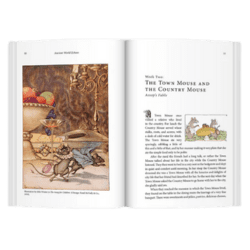
Copper Lodge Library books are a shared experience. While Copper Lodge Library is beautiful for the sake of beauty, the books are also beautiful for a more practical reason: to facilitate group readings. They’re made for read-alouds and for discussions. That’s why the team selected beautiful illustrations to accompany the text. That’s also why the team selected the font for readability and deliberately planned for plenty of white space (tired eyes, rejoice!).
Copper Lodge Library books are also built to take enthusiastic readings by energetic students. (Right now, someone, somewhere, is reading this sentence, and their child is stomping on, drawing on, dancing on, chewing on, clawing on, gnawing on, fighting on, crying on, and/or biting on their reading material. We’ve all been there, right? We can’t promise that CLL books will survive the worst beatings—really, what book can?—but hey, they’ve got a fighting chance, at least.)
Pretty but tough. That’s Copper Lodge Library.
Finally, the books also include introductions and footnotes that provide helpful context for readers. These annotations provide the grounds for meaningful conversations by explaining historical references, detailing cultural settings, providing important information about the authors’ lives, and more.
In essence, these books are meant to give the great stories they share—and the families reading them—the support they deserve.
III. Build Your Family Culture with Copper Lodge Library
Which brings us back to the mission of Copper Lodge Library.
We believe, like the Grimm Brothers, that classic literature has the power to shape who we are and connect us across generations. Great books empower us to build family cultures of virtue even when school systems and public libraries fail us.
Now, let’s look at some practical ways that you can use CLL to build up your family culture.
Read Together, Read Together, Read Together.
This is the heart of the Copper Lodge Library philosophy. Read together as a family as much as possible, especially when your kiddos are younger, but also even when they’re older.
You can approach your reading time a few different ways. (Note: Classical Conversations members will also use these books in community. We’ll just focus on family here.)
The Bedtime Story
This age-old family institution works well with littles. Grab short stories from Copper Lodge Library and introduce your littlest ones to classic literature the natural way.
The advantage of this approach is that the bedtime atmosphere is cozy, lending itself to family bonding and generating comforting feelings toward reading.
And CLL’s high-quality illustrations lend themselves well to bedtime read-alouds! Because what’s a bedtime story without pictures?
(Also, dads, dive in! Bedtime stories aren’t just for moms. Sharing a CLL classic with your child is a wonderful way to connect before bedtime. Not only will your child benefit from hearing your voice, but you’ll also create lasting memories together.)
The Family Book Club
This approach works well with older kids and teenagers. You can set up a successful family book club in any number of configurations, but this way works particularly well.
First, dedicate a specific time each week or two for family reading and discussion.
Next, select a story that aligns with your family’s interests and reading levels.
Then, take turns reading aloud—or have everyone read silently—and follow up with a group discussion. Use the book’s themes and characters as springboards to talk about important life lessons, values, and challenges. CLL’s introductions and footnotes can act as discussion prompts.
Create Your Own Reading Activities
Activities are a great way to extend the conversation beyond the text. Here are just a few ideas to get you started:
Bring the stories to life with creative activities like drawing, writing, or acting out scenes.
Connect your readings in Copper Lodge Library to other subjects. (For example, the Uncle Paul series and the Rome series are easy as pie to connect to your studies in science and history, respectively.)
Learn through play: incorporate your reading’s themes into board games, scavenger hunts, and sports. Get your children to think about books even at play to create positive associations and form creative connections between reading and other aspects of life.
Remember, the key is to make reading enjoyable! After all, the goal is to build a family culture of reading that lasts.
So, there you have it.
Copper Lodge Library isn’t afraid to say it: stories matter. They have the power to strengthen families, teach valuable lessons, and ignite a lifelong love of reading. In a world that often prioritizes fleeting entertainment over timeless wisdom, Copper Lodge Library offers a path to something deeper.
Will building a family culture of reading be easy? Probably not. There will be nights when getting everyone settled with a book feels like an uphill battle. But those moments when a story sparks a meaningful conversation, or a child’s eyes light up with wonder at the adventures unfolding on the page—those moments make it all worthwhile.
Explore the Copper Lodge Library collection and start building a family culture that will enrich your lives for generations to come.