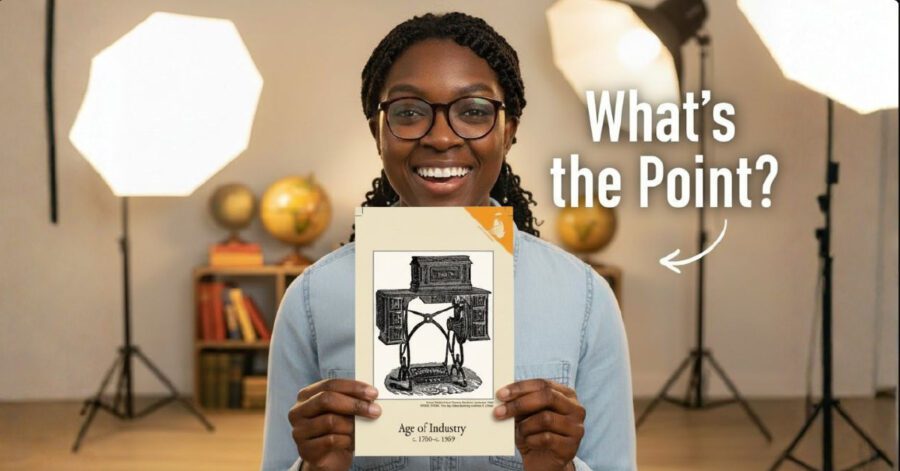
Classical education gives children a rich store of knowledge in their earliest years, then trains them to reason with it and express it wisely as they grow. To help families see that design unfold week by week, Classical Conversations created What’s the Point?, a new YouTube series that walks Foundations parents through each week of Cycle 3 memory work.
Every episode uncovers surprising connections between subjects and shows where each fact will reappear in Challenge, offering a vivid picture of why classical education shapes students so well. In this article, we share how the series works, how it brings the arts of the trivium to life, and where to watch each new episode. Every fact has a future. This series helps you see it.
Why Classical Education?
Classical education follows a pattern as old as learning itself: knowledge first, then understanding, then wisdom. Young children delight in names, numbers, songs, and Scripture, and they absorb all of it with remarkable ease and joy.
The Week 1 episode describes this season of childhood as a storehouse with its door wide open, a time to fill the shelves while gathering still feels like play. Later, when students are ready to think deeply and argue well, they will have something real to think and argue with. As the episode puts it, “You can’t analyze a fact that you were never given.”
Classical Conversations joins this time-honored method to a biblical worldview. In that same episode, the hosts point to this week’s science fact, the four types of tissue, and linger on connective tissue, whose whole job is to hold the body together. In a classical Christian education, God is the connective tissue of every subject, uniting history, math, Latin, geography, and science in one story for His glory. “He is before all things, and in him all things hold together” (Colossians 1:17, ESV). The purpose of it all is to know God and to make Him known.
Classical education also flourishes in community. Families chant together on Community Day, Tutors draw arrows between subjects on the whiteboard, and parents learn right alongside their children. For a deeper look at how faith and the classical model work together, read Seven Ways a Classical Education Works with a Christian Worldview, or listen to the Everyday Educator episode Why Memorizing Matters.
The Trivium in Plain Words
The trivium is the framework at the heart of classical education. The word is Latin for “three ways,” often described as the place where three roads meet, and it names three arts that carry a student from knowledge to understanding to wisdom.
Picture a well-stocked pantry. Grammar fills the shelves with names, facts, and definitions. Dialectic learns what each ingredient is for and how ingredients work together. Rhetoric prepares a meal worth sharing, expressing what is true with clarity and grace. Classical Conversations often summarizes the three arts with three biblical pictures: name like Adam, question like Jesus, and persuade like Paul.
Students practice these arts through 15 skills. The Five Core Habits of Grammar (naming, attending, memorizing, expressing, and storytelling) build the pantry. The Five Common Topics of Dialectic (definition, comparison, relationship, circumstance, and testimony) teach students to ask good questions. The Five Canons of Rhetoric (invention, arrangement, elocution, memory, and delivery) shape how they speak and write. You’ll hear these terms throughout the series, and you can explore them further in What Is the Trivium? and 15 Classical Education Skills.
How the What’s the Point? Series Works
Each week, a new episode walks through the Cycle 3 Foundations memory work subject by subject: history, science, English, Latin, geography, math, timeline, and fine arts. Along the way, it uncovers the threads that tie one subject to another and then looks ahead to where each fact will appear again in Challenge.
Those threads explain why Foundations students memorize across so many subjects at once. As the Week 9 episode observes, the conditions surrounding a historical event rarely live in the same subject as the event itself. That week, students skip count by 15s in math, and in 1850 the nation held exactly 15 free states and 15 slave states, with California’s request for statehood about to break the tie. A child who knows only the history sentence can tell you what happened. A child who also holds the math, the geography, and the timeline can begin to see how it was possible.
Each episode closes with simple ideas for review at home and a gentle reminder that learning is a lifestyle. For more ways to review between episodes, see Foundations Memory Work Review.
In the opening episode of Cycle 3, the series answers the question many new parents are asking: why do we ask children to memorize so many facts? The episode compares memory work to an infinitive, full of potential and waiting for its job, and follows Columbus, ships and all, from a Foundations history sentence to primary sources in Challenge. It closes by inviting families to set sail on the academic year, one fact at a time.
A Journey Through the Trivium, One Week at a Time
Watch a few episodes and a pattern emerges. Each week’s memory work belongs to the art of grammar, yet every episode quietly previews the dialectic and rhetoric that lie ahead.
Grammar: Stocking the Pantry
The series delights in showing what it means simply to hold a fact. In the Week 1 episode, the definition of an infinitive becomes a picture of all memory work: unconjugated, full of meaning, and waiting for the day it is put to work. Columbus, too, set sail without knowing what his voyage would become.
The Week 4 episode adds a striking idea: a memorized fact is the only knowledge with no travel time. Imagine two children setting up seven rows of eight chairs. One simply knows there are 56. The other adds eight seven times and arrives at the same answer, his attention spent on arithmetic. Only the first has attention left to notice the wobbly chair that needs replacing. The same episode reminds families that Homer and Confucius left no books of their own, and their words outlasted fallen kingdoms because someone memorized them exactly. For encouragement in this habit, listen to the Everyday Educator episode The Habit of Memorizing.
Dialectic: Learning What Each Fact Is For
The series also models the questions students will learn to ask. In the Week 4 episode, the principal parts of a verb become a lesson in honesty. Children discover early that “It’s broken” reports the damage and quietly leaves the speaker out of the story. Walking the verb back to “I broke it” restores the order of events, the cause, and a story that can be judged.
The Week 9 episode introduces circumstance, the common topic that asks what made something possible. When gold was discovered in California in 1848, shopkeeper Sam Brannan had already filled his shelves with picks, shovels, and pans, while John Sutter, who owned the land where the gold was found, eventually lost nearly everything. The same gold yielded very different results for two men in very different circumstances. Even a musical note shows the principle: a quarter note placed on the bottom line of the treble staff is called an E, but the same quarter note on the top line is called an F. The circumstances of its placement give it a completely different sound.
Families can practice dialectic at the kitchen table too. The Week 1 episode offers a delightful question for the math chart: are the ones skip counting or simply counting? Defend your answer.
Rhetoric: When the Answer Is Called Upon
Finally, the series points toward the day when knowledge becomes conviction, spoken and lived. The Week 6 episode tells the story of Davy Crockett, the only member of the Tennessee delegation to vote against the Indian Removal Act of 1830, standing apart from his president, his peers, and many of his own constituents. Crockett never fully explained the conviction behind that vote. Someone had instilled this conviction in him long before he could read, and it held firm when it mattered most.
That episode also draws attention to a small line on every Foundations page: the reflection question beneath the word Memoria. Everything above it pairs a question with an answer. That final question hands students nothing to chant back, and it quietly reveals what all the memorizing is preparing them for.
Where Foundations Memory Work Leads in Challenge
One of the series’ greatest gifts is a clear view of the road ahead. Here are a few of the Challenge connections parents will discover across the episodes:
- Challenge A: Students draw the world freehand in cartography, study anatomy, and meet the common topic of circumstance in persuasive essays.
- Challenge B: Students argue cause and circumstance in Mock Trial and read about Harriet Tubman.
- Challenge I: Students memorize portions of the Declaration of Independence and read primary sources from Columbus, John C. Calhoun, Roger Taney, and Abraham Lincoln.
- Challenge II: Students study biology, read Robinson Crusoe, and compete in Lincoln-Douglas debates.
- Challenge III: Students study US history, beginning with the Age of Exploration, and debate again in the Lincoln-Douglas format.
- Challenge IV: Students read The Discoverers and translate the Gospel of John from the Latin Vulgate, the very passage Foundations students recite in Cycle 3.
The facts your student chants this week are the very facts they will reason with in Challenge. To see what that harvest looks like, read Laying the Foundations and Challenge: The Moment You’ve Waited For.
Watch the Full Series
New episodes of What’s the Point? release each week throughout the fall semester. Subscribe to the Classical Conversations YouTube channel and bookmark the What’s the Point? playlist so you can watch each week’s episode as it arrives. Many families enjoy watching before Community Day to preview the week ahead, while others save it for review at home. Afterward, share in the comments what stuck with your family. The series hosts love hearing what your children say.
Frequently Asked Questions about What’s the Point?
What is classical education?
Classical education is a time-honored approach to learning that moves students from knowledge to understanding to wisdom through the three arts of the trivium. It emphasizes great books, careful questions, and clear expression.
What does trivium mean?
Trivium is Latin for “three ways.” It names the three arts of grammar, dialectic (sometimes called logic), and rhetoric.
What is the trivium?
Grammar gathers the names, facts, and rules of a subject. Dialectic asks questions to understand how those facts relate. Rhetoric expresses truth clearly and persuasively.
What is classical Christian education?
Classical Christian education joins the classical model to a biblical worldview. Students study every subject as part of God’s creation, with the aim of knowing God and making Him known.
Why classical education?
Classical education builds knowledge while children love gathering it. It trains students to reason and speak well through the 15 skills of the trivium. It unites every subject under God. The What’s the Point? series shows all three at work each week.
Why do classical students memorize so much?
Memory work stores knowledge now so students can reason with it later in Challenge. When facts are automatic, a student’s attention is free for deeper thinking, and the answer is already in place when the question finally arrives.
Stocked for the Years Ahead
The Week 9 episode offers a simple way to see the whole journey: memory work makes wisdom possible, years of practice make it probable, and then your student chooses. As the series reminds parents, growing wisdom is God’s work, and your joyful calling is to set the conditions for it through faithful memory work, good books, thoughtful questions, and conversations around the table. Each week’s episode is an invitation to see that work with fresh eyes. One fact at a time. One week at a time. One full pantry, ready for the years ahead.