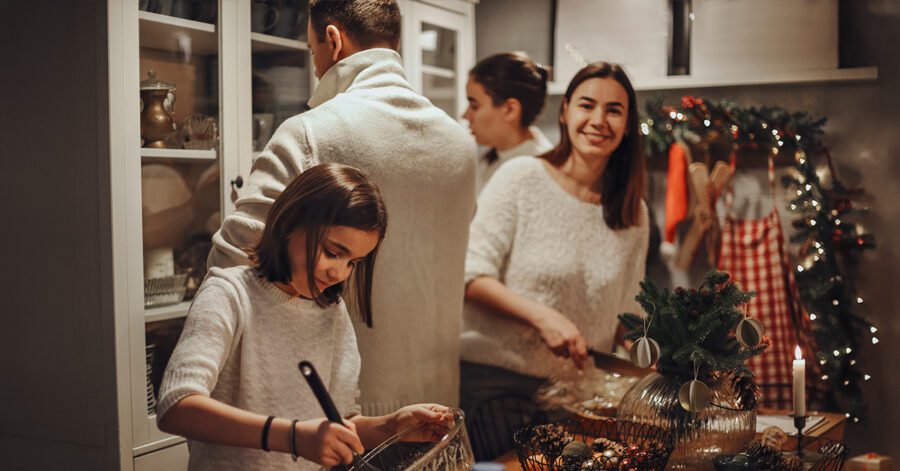
Holiday recipes are some of the richest homeschool lessons of the year, as measuring, stirring, and giving thanks become lessons in math, history, and worship. From Stir-Up Sunday to Epiphany, the same habits that shape memory work on community day can shape a holiday kitchen, turning Thanksgiving activities for kids and Christmas baking into practice in the classical arts.
In this article, you’ll find five traditional recipes, each paired with one of the Five Core Habits of Grammar, along with activities for every age and a simple holiday schedule. The table is already set. Here is how to gather around it.
Why Holiday Recipes Make Natural Homeschool Lessons
Every holiday recipe holds a lesson. A recipe asks children to read carefully, measure precisely, and follow steps in order. A family story told over dessert carries history across generations. A blessing spoken before the meal turns ordinary bread into an occasion for worship. This is why the most meaningful Thanksgiving activities for kids so often begin in the kitchen.
Classical Conversations rests on three pillars: classical, Christian, and community. Holiday recipes infuse all three at once.
Classical. When children cook, they practice the Five Core Habits of Grammar, the habits that clothe young minds for a lifetime of learning. The kitchen gives each habit a natural place to grow.
Christian. The feasts of the season tell the story of Christ. Children learn to wait with hope during Advent and to celebrate with joy when Christmas arrives.
Community. Holiday baking draws people together, from grandparents and cousins to neighbors and fellow homeschool families. CC families know the gift of learning alongside other families, and the holiday table carries that fellowship home.
Long after the dishes are washed, children remember who stood beside them at the counter, the smell of cinnamon in the air, and the prayers spoken around the table. These moments bind a family together, and each one is an invitation to learn, to give thanks, and to wonder.
Classical: The Five Core Habits in the Holiday Kitchen
The Five Core Habits of Grammar (naming, attending, memorizing, expressing, and storytelling) describe how children learn best when encountering new things. Each habit finds a natural partner in the kitchen. The five recipes below are simple enough for little hands and rich enough to spark real learning.

Naming: St. Nicholas Speculaas Cookies
Naming is the first act of knowing. Adam named the animals before he understood them, and children learn the world the same way, one word at a time.
Speculaas, the spiced cookies of the Netherlands, are the classic treat for St. Nicholas Day on December 6, traditionally pressed into wooden molds shaped like the saint himself. They are also a feast for the senses. Before you bake, set out small bowls of cinnamon, cardamom, cloves, and nutmeg. Let children smell each spice, name it, and guess which one is which with their eyes closed.
Older students can go further. Each of these spices traveled thousands of miles to reach European kitchens. Cloves and nutmeg came from the Spice Islands of Indonesia, cinnamon from Sri Lanka, and cardamom from southern India. Trace the routes on a map and connect them to the Age of Exploration in your history memory work. Students learning Latin can practice the scientific names, such as Cinnamomum verum for cinnamon and Elettaria cardamomum for cardamom.
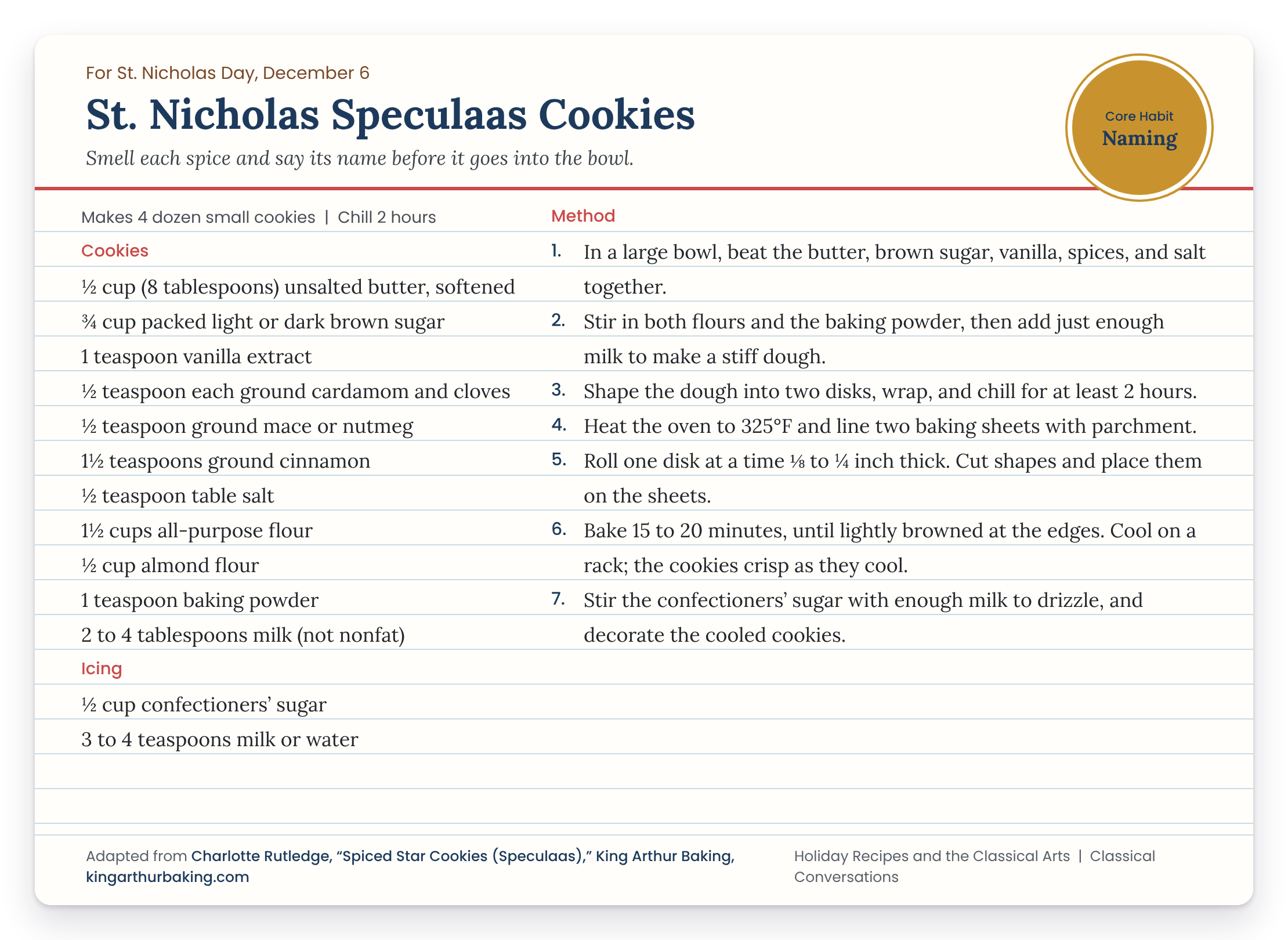
Speculass Snapshot: Thin, crisp spiced cookies rolled out and cut into shapes, finished with a simple drizzled icing. Young children measure spices and cut shapes. Older children research the spice trade.
Family Activity: Read a short account of the life of Nicholas, the fourth-century bishop remembered for his secret generosity, and talk about how your family might give quietly this Advent. For gift ideas that fit a classical home, browse The Ultimate Homeschool Holiday Gift Guide for Classical Learners.
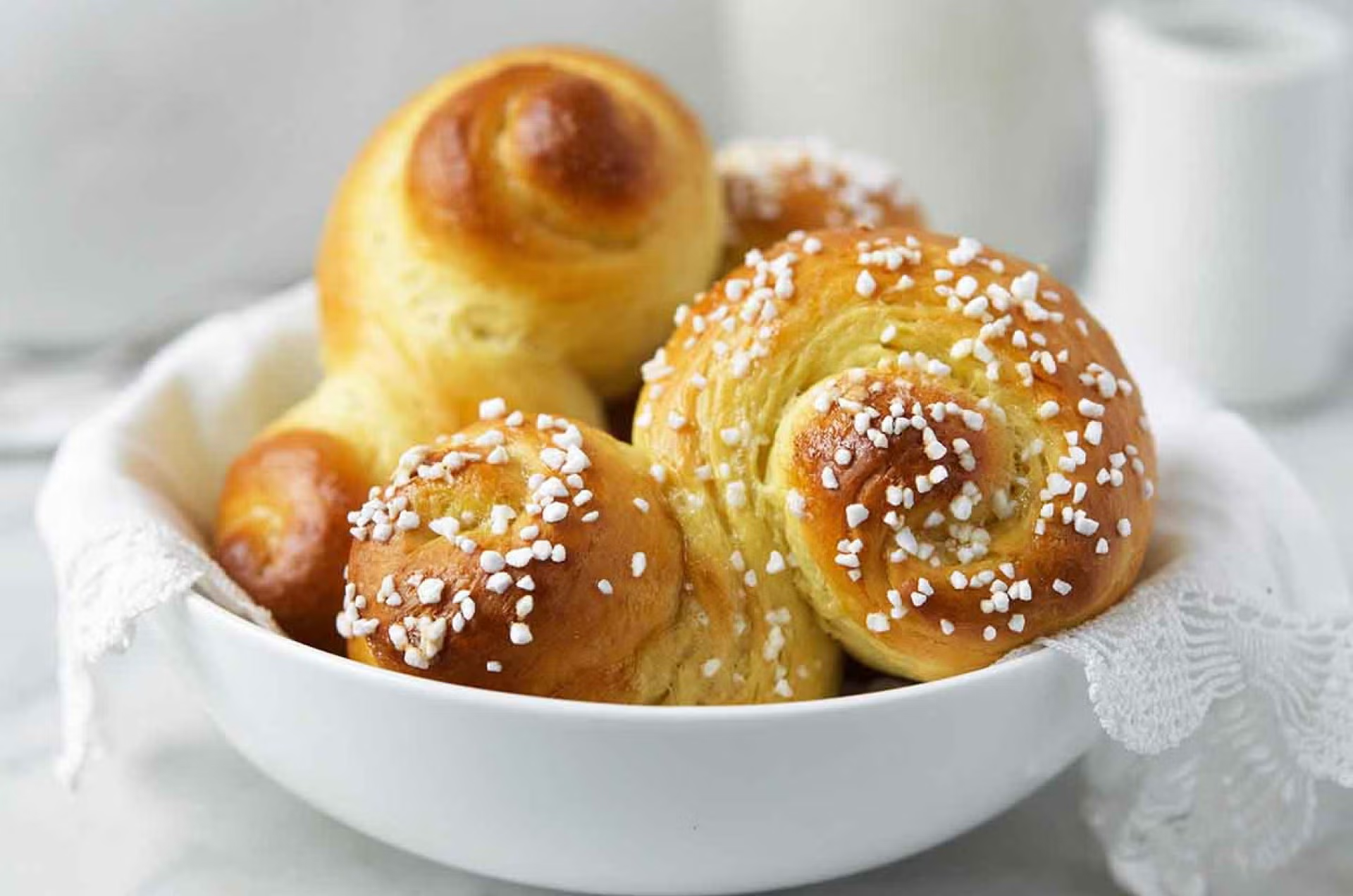
Attending: St. Lucia Saffron Buns
Attending means giving full attention to one thing at a time. In a world of quick answers, yeast dough is a patient Tutor. It cannot be rushed, and it rewards the child who watches closely.
In Sweden, families eat saffron buns called lussekatter on St. Lucia Day, December 13, a celebration of light during the darkest days of winter. By tradition, young girls wear a crown of candles and wake their families by bringing them these golden buns. The buns are twisted into an S shape with a raisin tucked into each curl.
This recipe invites careful observation. Have children check the dough every twenty minutes and sketch what they see. How much has it grown? What does it smell like? Why does it rise at all? The answer opens a small science lesson: yeast is a living organism that feeds on sugar and releases tiny bubbles of carbon dioxide, which stretch the dough like balloons.
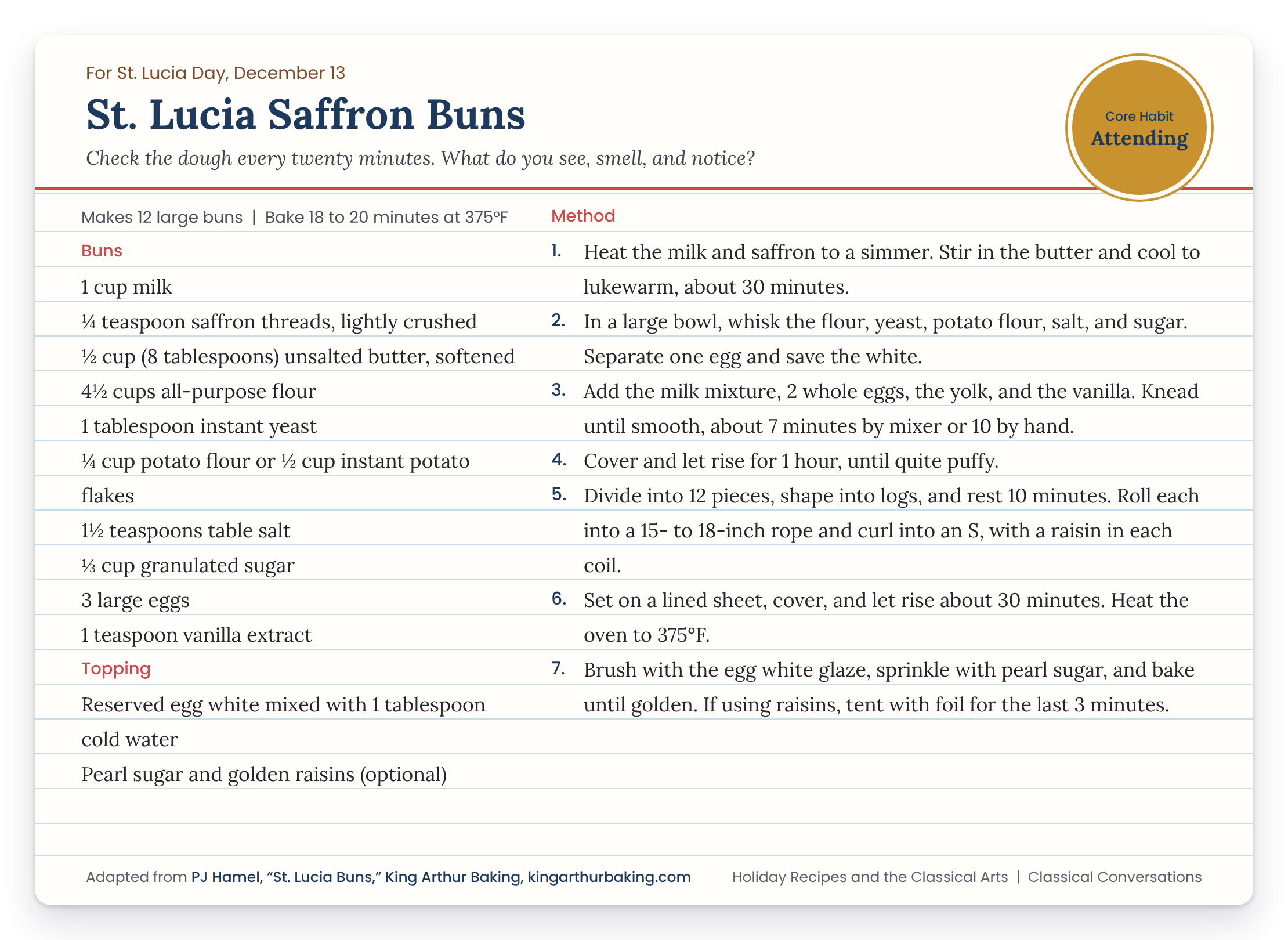
Lussekatter Snapshot: A soft, golden yeast dough flavored with saffron and shaped into spirals. Young children shape the S-curves and press the raisins. Older children manage the timing and temperature.
Family activity: Read John 1:5 together by candlelight before breakfast. Talk about how the light of Christ shines in the darkness, and how the darkness has not overcome it.
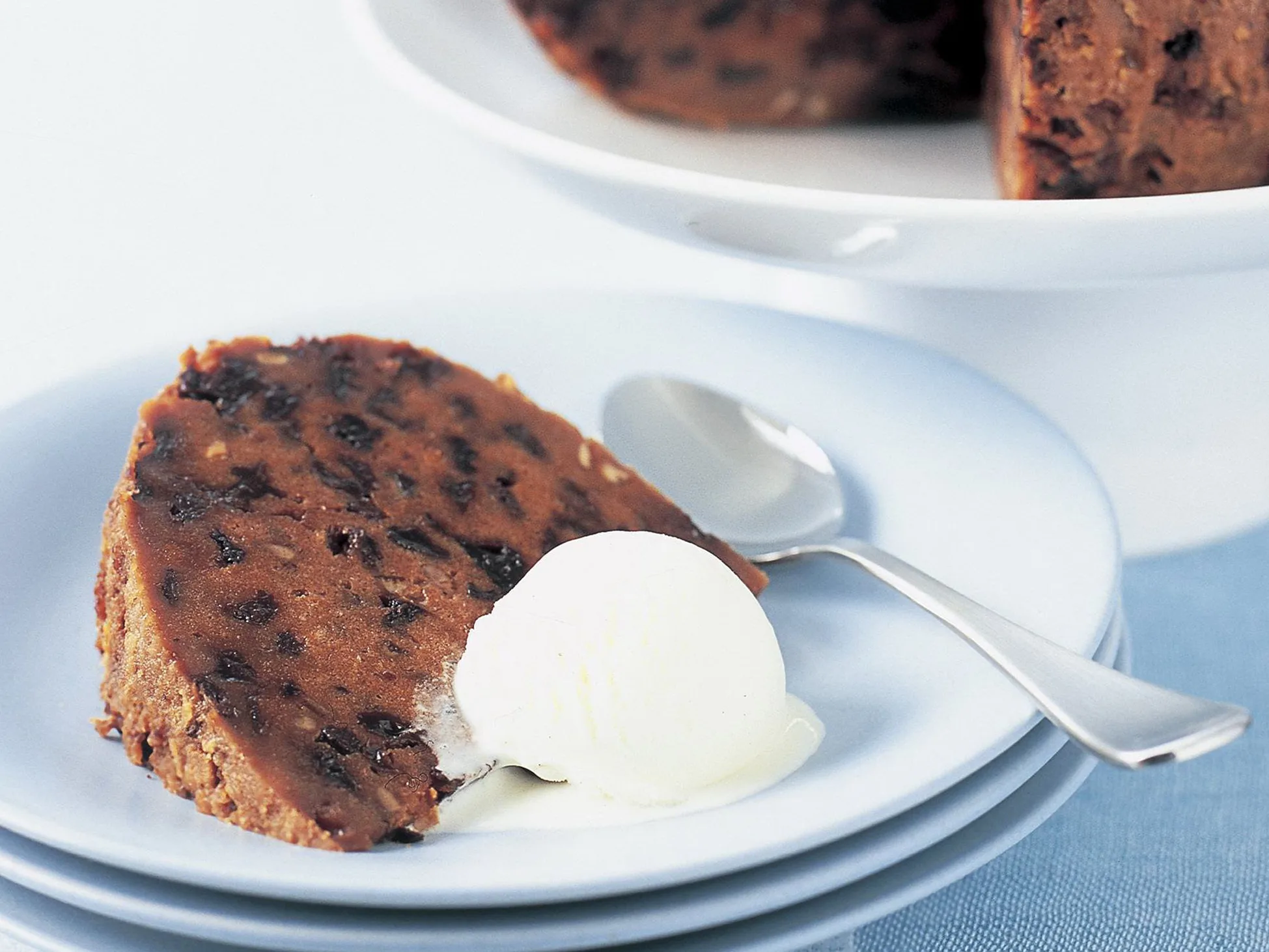
Memorizing: Stir-Up Sunday Christmas Pudding
Memorizing gives children a storehouse of truth and beauty they will carry for life. The best memory work is spoken aloud, repeated often, and tied to something the body remembers.
Stir-Up Sunday is a gift for this habit. The name comes from the Book of Common Prayer, which assigns a short prayer, called a collect, to the Sunday before Advent. That prayer begins with the words “Stir up.” Tradition holds that worshippers heard that phrase and remembered to start mixing their Christmas puddings, which need weeks to mature before the holiday.
Here is the collect from the 1662 Book of Common Prayer:
Stir up, we beseech thee, O Lord, the wills of thy faithful people; that they, plenteously bringing forth the fruit of good works, may of thee be plenteously rewarded; through Jesus Christ our Lord. Amen.
Let each family member take a turn stirring the pudding while the family recites the prayer together. By the time everyone has stirred, even the youngest children will know the opening line. Revisit it each Sunday of Advent, and the whole prayer will be theirs by Christmas.
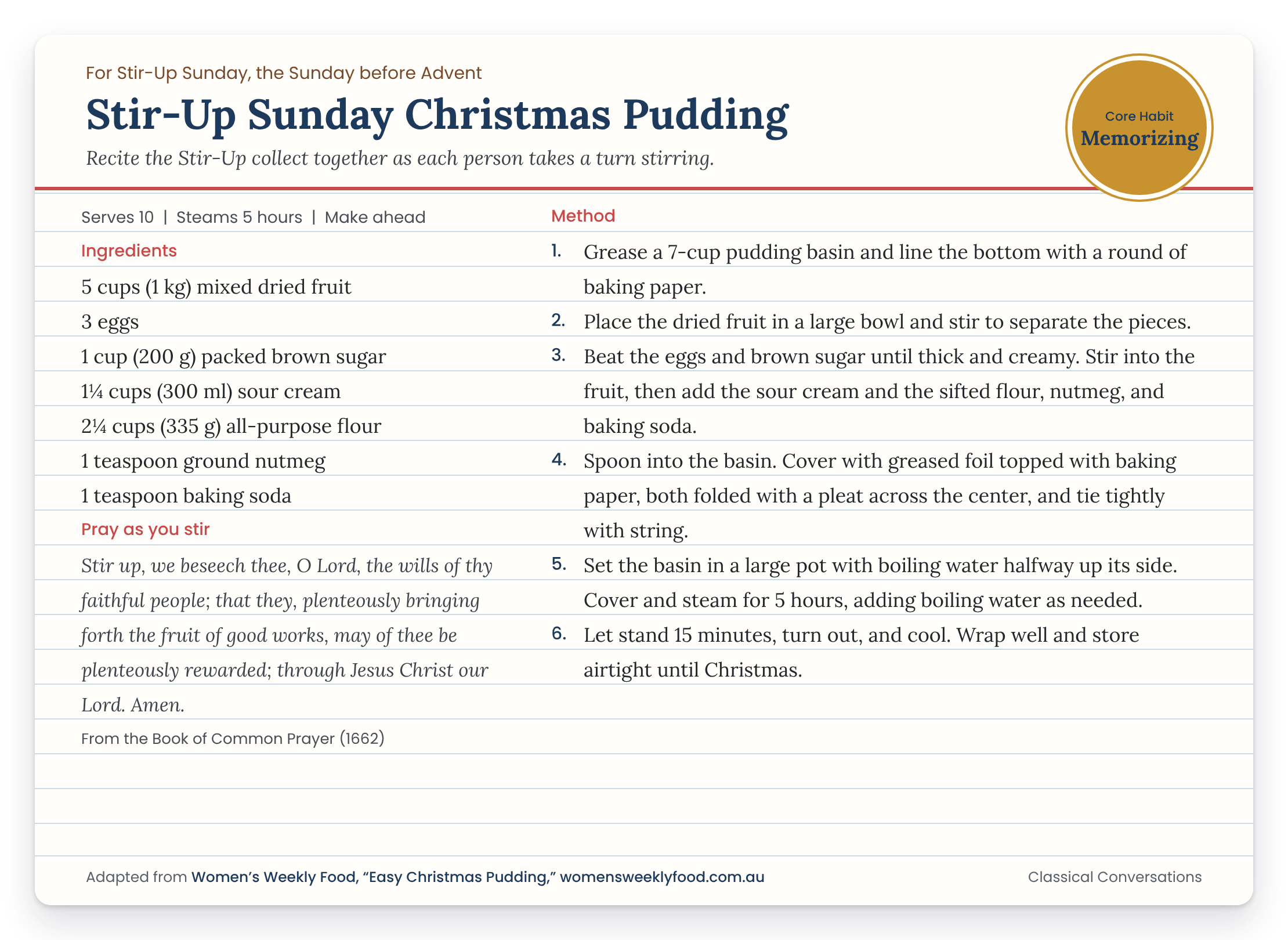
Stir-Up Sunday Pudding Snapshot: A no-soak, alcohol-free fruit pudding, mixed on Stir-Up Sunday and steamed for five hours, then stored until Christmas. Young children add the fruit and stir. Older children measure and manage the steaming
Family Activity: Write the collect on an index card and tape it inside a kitchen cabinet. Let it become part of your family’s memory work for the season.
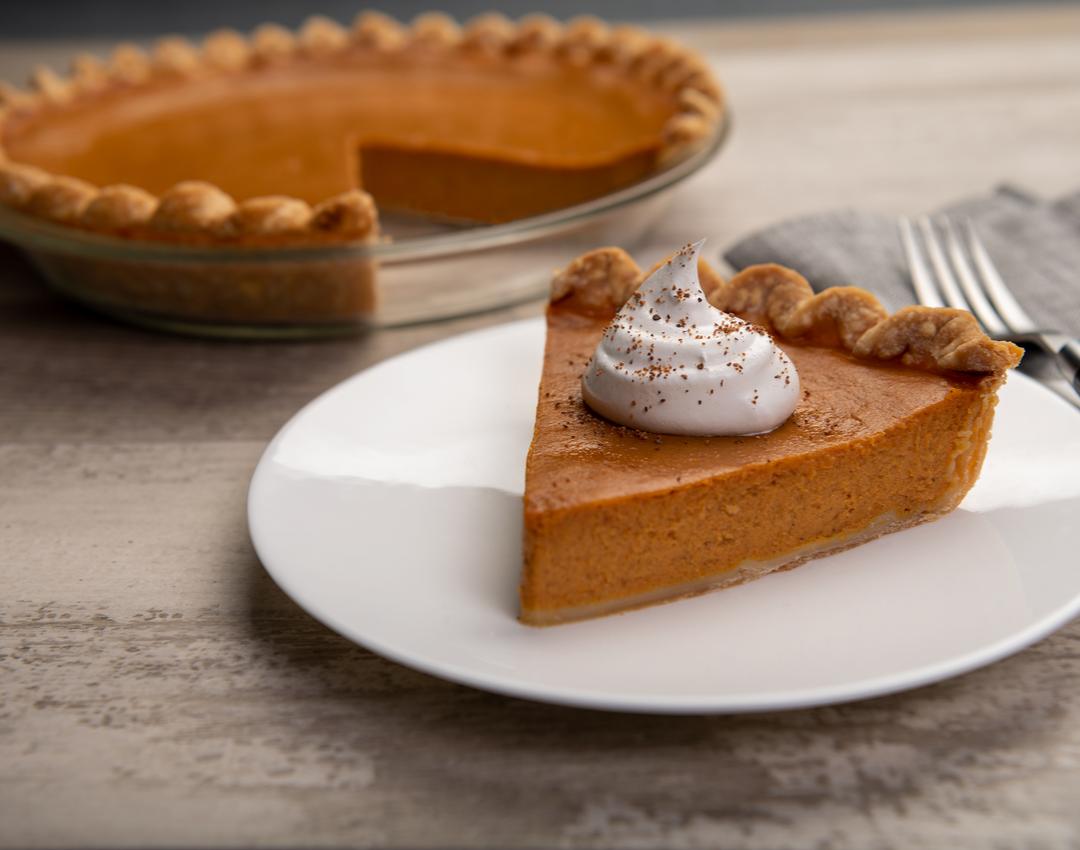
Expressing: Thanksgiving Pumpkin Pie and a Child’s Blessing
Expressing allows children to give back what they have received. This often looks like drawing, dancing, or crafting a presentation.
Pumpkin pie gives children a meaningful job on Thanksgiving Day, and it is also a math lesson. Ask your students to double the recipe for a larger gathering. How much is twice three-quarters of a cup? How many teaspoons make a tablespoon? Fractions become friendly when the answer is dessert. Of all the Thanksgiving activities for kids, few are as simple or as satisfying as baking the pie the whole family will share.
While the pie bakes, invite each child to create a short Thanksgiving blessing in their best handwriting. Younger children can sing Psalm 100:4: “Enter his gates with thanksgiving, and his courts with praise.” Older children can compose their own prayer of gratitude and read it aloud before the meal.
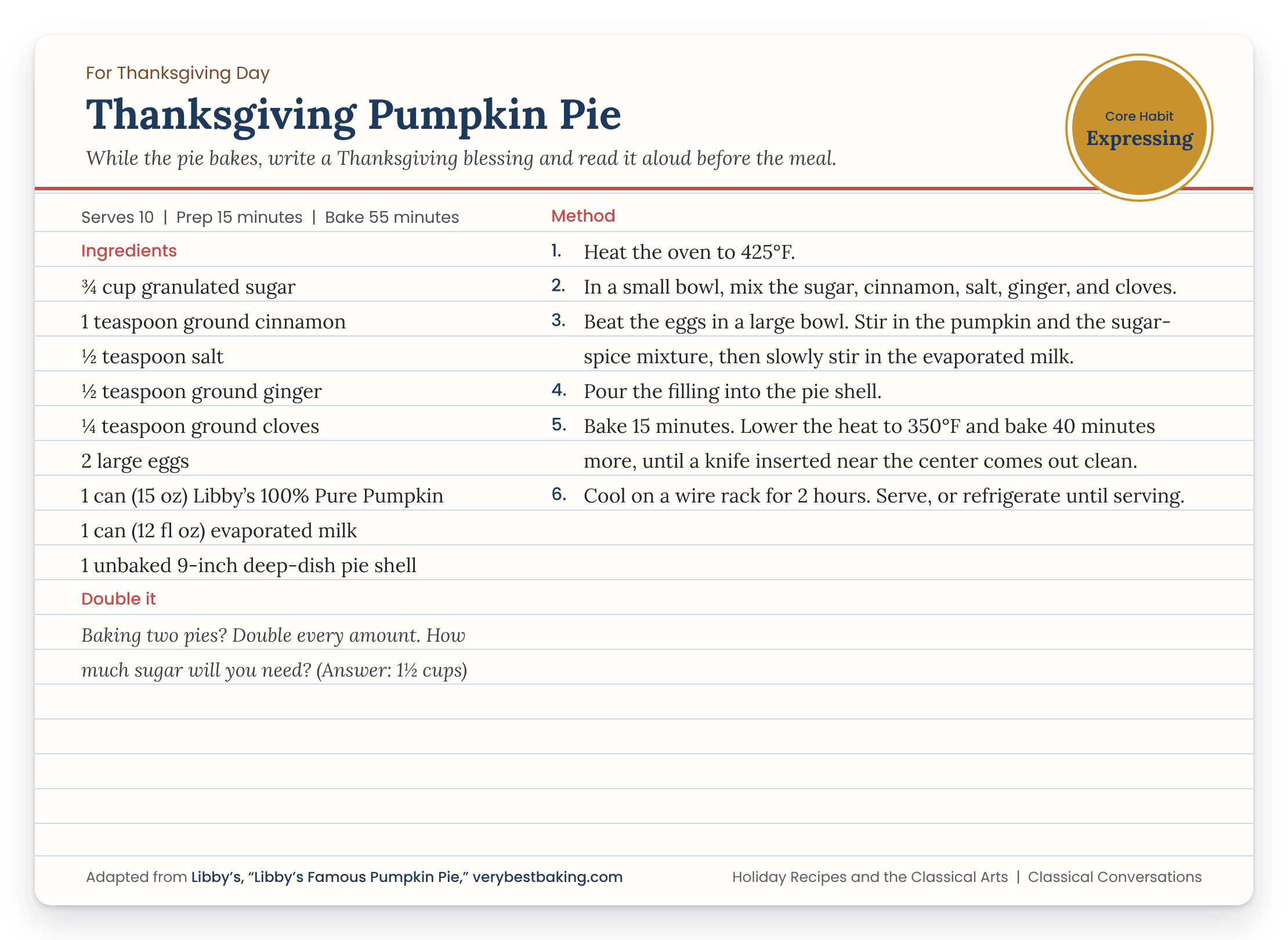
Spiced Pumpkin Pie snapshot: Libby’s classic spiced pumpkin pie, baked in a store-bought or homemade pie shell. Young children whisk and pour. Older children double the recipe and calculate the measurements.
Family activity: Create a Thanksgiving play or express gratitude through family worship and singing.
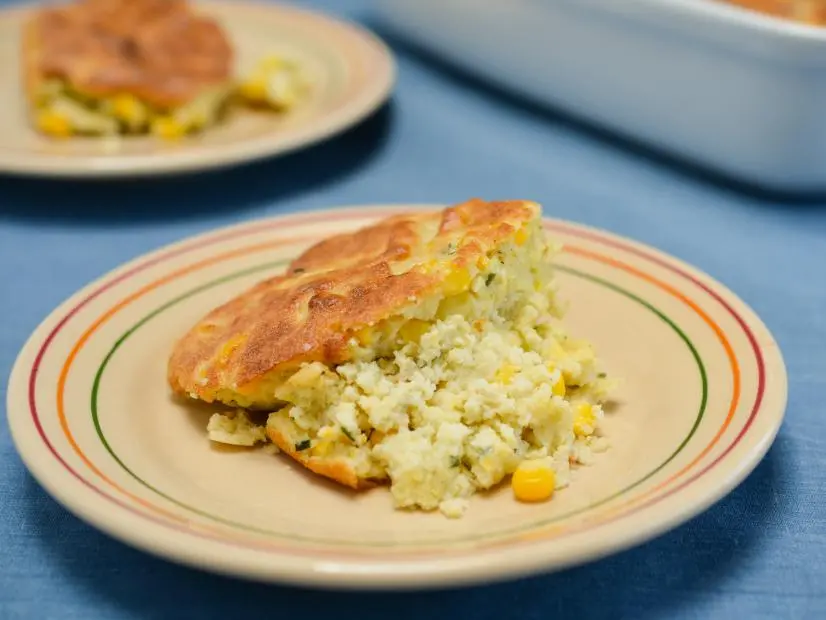
Storytelling: Harvest Corn Pudding and the Five Kernels
Storytelling binds a family to its past and to the larger story of God’s faithfulness. It is also how children first learn history: as a story worth telling again.
Corn belongs at the Thanksgiving table. In his account of the first harvest at Plymouth, Edward Winslow wrote that the colonists had planted some twenty acres of Indian corn, along with barley and peas. He also recorded that four men brought home enough fowl in a single day to feed the company for almost a week, and that Massasoit’s men killed five deer for the gathering. Reading Winslow’s letter aloud is a wonderful primary source lesson for Cycle 3 families and one of the simplest Thanksgiving activities for kids.
Corn also carries a beloved legend. Many families place five kernels of corn beside each plate and name five blessings before the meal, remembering a story that the Pilgrims once survived on five kernels a day. Historians consider the story a legend, since it does not appear in Governor William Bradford’s journal or other primary sources, and the custom itself began on Forefathers’ Day in 1820. Telling children the difference between a primary source and a legend is a lesson in itself, and the tradition still points hearts toward gratitude.
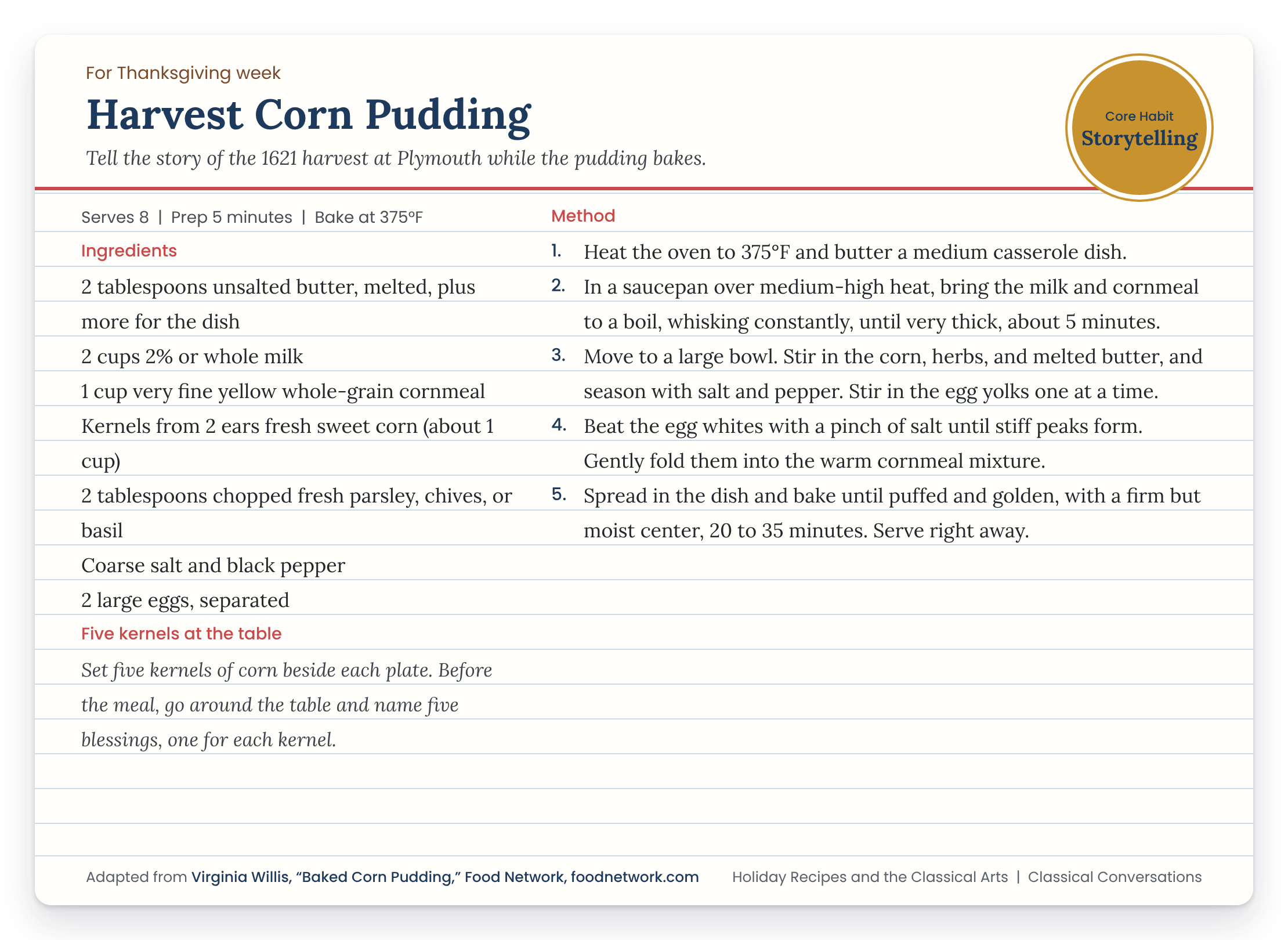
Harvest Corn Pudding Snapshot: A soufflé-like pudding made with cornmeal and sweet corn, lightened with whipped egg whites. Young children stir and help fold. Older children read Winslow’s account and compare it with the legend.
Family Activity: Ask a grandparent to share the story behind a dish your family serves every year. Record it, write it down, and add it to the blank “Our Family Recipe” card in the printable.
Thanksgiving Activities for Kids of Every Age: The Trivium Arts at the Table
One of the gifts of a family kitchen is that every age can work side by side. The three arts of the trivium (grammar, dialectic, and rhetoric) offer a natural way to give each person a meaningful role, no matter what age they are.
Students practicing Grammar gather the facts. They name ingredients, measure, stir, and recite the blessing.
Students practicing Dialectic ask the questions. They can lead table conversation with prompts such as “Why do you think the Pilgrims celebrated a harvest?” or “What makes a feast different from an ordinary meal?”
Students practicing Rhetoric lead and serve. They can plan the menu, manage the cooking schedule, carve the turkey, or offer a short toast of thanksgiving. Challenge students preparing for Protocol can practice formal place settings, table manners, and the art of hosting.
When each child has a role, the holiday becomes a family effort, and the table becomes a place where every voice matters.
Christian: Feasting Through the Church Calendar
God has always taught His people through feasts. Israel’s Feast of Booths was a harvest celebration, a week of rejoicing over God’s provision in the wilderness and in the fields (Leviticus 23:39-43). Moses told the people that when they had eaten and were full, they should bless the Lord for the good land He had given them (Deuteronomy 8:10). Thanksgiving carries that same spirit of grateful remembrance.
Christmas deepens the meaning of the table. Jesus was born in Bethlehem, whose name means “house of bread” (Micah 5:2), and He was laid in a manger, a feeding trough (Luke 2:7). Years later He would declare, “I am the bread of life” (John 6:35). Throughout His ministry, Jesus taught, forgave, and revealed Himself at tables, from the home of Zacchaeus to the road to Emmaus. Scripture’s great story ends at a table, too, with the marriage supper of the Lamb (Revelation 19:9).
The church calendar gives families a rhythm for the season. Advent is a time of waiting and preparation, and Christmas is a twelve-day feast of celebration. The season closes on Epiphany, January 6, which commemorates the arrival of the Magi in Bethlehem and marks the twelfth day of Christmas. When families keep this rhythm, children learn that celebration follows patient preparation, and that every feast points toward the One who invites us to “taste and see that the Lord is good” (Psalm 34:8).
Community: Opening Your Table to Others
Hospitality is one of the clearest ways families live out their faith. Paul urged believers to practice hospitality (Romans 12:13), and Jesus told His followers to invite those who cannot repay them (Luke 14:12-14). The holidays give children countless chances to practice this kind of open-handed love.
Consider hosting a cookie exchange with families from your local CC community, with each family bringing a batch of speculaas or another treat tied to their history studies. Invite a widow, a new family, or a neighbor who will be alone for the holiday. Let children help prepare and deliver a meal to someone in need.
Epiphany offers one more beautiful custom. The king cake, also called an Epiphany cake or Twelfth Night cake, became tied to the Feast of Epiphany in medieval Europe. In France, the host traditionally cuts one extra slice for an unexpected visitor or a poor person who might come to the door. Few traditions say so much with so little. An empty place at the table is an invitation, and children learn to expect the guest God might send.
Making It a Family Learning Tradition: Your Holiday Table Schedule
Traditions take root when they return each year. This schedule follows the church calendar, so it works every year, whatever the dates. Download the free printable for all five recipe cards and the schedule.
| When | Feast | Recipe | Core Habit | Family Activity |
| Sunday before Advent (usually the weekend before Thanksgiving) | Stir-Up Sunday | Christmas pudding | Memorizing | Recite the collect while stirring |
| Thanksgiving week | Thanksgiving | Harvest corn pudding | Storytelling | Read Winslow’s account; five kernels |
| Thanksgiving Day | Thanksgiving | Pumpkin pie | Expressing | Write blessings and place cards |
| December 6 | St. Nicholas Day | Speculaas cookies | Naming | Spice tasting and map work |
| December 13 | St. Lucia Day | Saffron buns | Attending | Dough observation and John 1:5 |
| January 6 | Epiphany | King cake | Community | Cut an extra slice for a guest |
A few tips will help these traditions grow with your family:
- Keep a family recipe binder. Date each card when you make it, and add notes about who helped and what you learned.
- Give children new responsibilities as they grow. A child who stirs the pudding at five can measure it at ten and lead it at fifteen.
- Watch the calendar each year. In most years, Stir-Up Sunday arrives just before Thanksgiving and opens the whole season with prayer.
Frequently Asked Questions About Holiday Recipes
How can I turn Thanksgiving cooking into a homeschool lesson?
Recipes teach math through fractions and measurement, history through the story of the 1621 harvest at Plymouth, and language arts through copywork and written blessings. Pair each recipe with one of the Five Core Habits, such as storytelling with corn pudding or expressing with pumpkin pie, for a simple framework.
What Thanksgiving activities work well for multiple ages?
Kitchen tasks scale naturally across ages. Grammar students can measure and stir, dialectic students can lead table discussion questions, and rhetoric students can plan the menu, manage the schedule, or offer a toast.
How do you connect holiday meals to classical education?
Classical education trains habits of naming, attending, memorizing, expressing, and storytelling. Each holiday recipe offers practice in one of these habits, and the church calendar adds a Christian framework of waiting, celebrating, and giving thanks.
What are some easy Thanksgiving activities for kids at home?
Baking a pumpkin pie together, writing blessings on place cards, setting five kernels of corn beside each plate, and reading Edward Winslow’s account of the 1621 harvest are all easy Thanksgiving activities for kids. Each one pairs a simple task with a lesson in math, history, or gratitude.
What are good Christmas recipes for kids to make?
St. Nicholas speculaas cookies and St. Lucia saffron buns are wonderful Christmas recipes for kids to make. Both are hands-on, steeped in history, and full of opportunities to learn about spices, yeast, and the saints who inspired them.
Gather, Learn, and Give Thanks
Holiday recipes offer homeschool families a natural way to keep learning through Thanksgiving and Christmas.
Five traditional recipes, each paired with one of the Five Core Habits, give children practice in naming, attending, memorizing, expressing, and storytelling. The church calendar provides a rhythm from Stir-Up Sunday through Epiphany, and hospitality turns each feast into an opportunity to serve. With the trivium arts guiding each child’s role, every age can learn together at one table.
The holiday table is where truth is spoken, stories are told, and children learn that every good gift comes from the Father of lights (James 1:17). This season, let your kitchen be a place of learning and your table a place of worship, from Thanksgiving activities for kids to Christmas baking together. Set the table. Tell the story. Give thanks.
Hungry for more ways to learn through food and celebrate the season? Explore these articles from Classical Conversations:
- 24 Cycle 1 Meal Ideas That Make Ancient History Come Alive
- 50 State Recipes for Homeschool: Cycle 3 American History Meals and Activities
- Quick and Easy Meals for Homeschool Community Day
- Thanksgiving, Advent, and Christmas Traditions for Homeschool Families
Written by: