In this article, music instructor John Futch of First Frets muses over the transformative power of music and the ways in which a musical home can become a house of worship.
Enjoy!
Worship as a Family with Music in Your Homeschool
I love listening to my wife sing.
When we were engaged, we would often worship together, and almost weekly I’d ask Julie to sing the Nettie Dudley Washington song, “I Bowed on My Knees and Cried Holy,” while I accompanied on guitar.
The lyrics were powerful, and I loved how Julie easily handled the melody.
I don’t think we’ve played that one for years, but to this day, worshipping together is still one of our favorite things to do. The music-worship tandem actually works wonders at every level: alone, as a spousal duet, or with the whole family.
Now our kids are getting to the age where they can start worshipping on their own instruments, and for the whole family to worship and play and sing together? Well, it just takes all of this to another level.
Jesus was always partial to children, because of their simple faith and innocence. Just watch your kids teach you something about worship as you play and sing to Jesus together. Watch how they don’t take themselves too seriously. Watch them trust God and not try to refine some secular-sacred compartmentalization the way we adults do, and so they’ll joke and laugh and sing and dance and so easily experience all of it as time with God.
Homeschool Music Practice as Worship
Practice Alone
I love worshipping with my wife and kids, but over the years, I’ve also felt the presence of God in my practice time. It’s actually a great way get more comfortable with your instrument while opening your home to the peaceful, joyful, holy presence of God.
Inviting Him into your practice time, and consciously, intentionally consecrating that time to Him will enhance your practice experience and make it even more fruitful and enjoyable.
If you’re already a musician, if you’re thinking about taking up an instrument, or if you have aspiring musicians in the family, I’d highly encourage you to invite God into the life of practice.
Consecrate it to him. I’ve found that conscious, verbal invitations work well. Something like this:
Jesus, thank you for this gift of music. Thank you for this opportunity to practice and improve on my instrument. Guide this time and fill it with joy. Show me what to practice and how to practice. I love you and thank you.
Resilience in Practice
If you’ve been struggling or feel stuck at a certain juncture—say, you’re having a hard time with barre chords on the guitar, or you can’t seem to stay with a metronome when playing a melody or chord progression, or you can’t find the right lyrics to finish the song you’re writing—invite Jesus into this, too, something like:
Jesus, part of me doesn’t even want to play or practice any of this. I feel stumped and frustrated. I give this to you, and ask that you help me through it. I ask for patience as I tackle this. I also ask for new ideas and strategies for success. I receive this challenge as an invitation and a gift to improve as a musician. I love you and thank you.
The goal is to remove the practice/play/worship boundaries and borders, so that all of it is worshipful and therefore deeply meaningful.
This new way of worshipping while practicing, or perhaps better put, seeing practice as worship, will equip you with a whole new level of emotional and mental resilience and excitement.
With this new perspective, even times or seasons when we feel musically stagnant will become meaningful, because we’ll see Jesus working alongside us and discipling us through them.
Practice Together
Join with others to experience new possibilities. New musical challenges and rewards emerge that are simply absent when playing or worshipping alone.
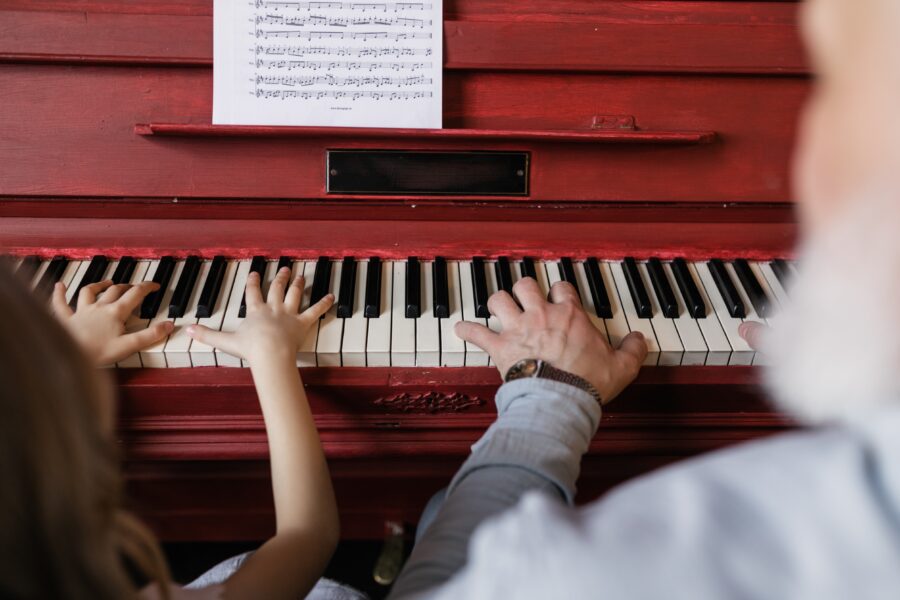
Think about everything that’s happening during a great family worship session, starting with all the things you’ll get to practice and learn on your instrument.
Take a song like “Way Maker,” in the key of E. If, say, you’re learning piano, then you’re learning many things all at once . . .
You’re learning the most important and common chords in the key of E. The four chords—A, E, B, C#m—loop through the whole song, so it’s not too demanding, but it’s extremely helpful for your musical development.
Because they really are so common, you’ll be playing those chords throughout your entire musical life.
Internalization in Practice
While learning and playing this song, you’ll also get valuable practice feeling and internalizing the most common rhythm you’ll ever learn: a simple rock-style groove in 4/4, with accents on beats two and four.
On the piano, a great place to start is to just hammer out the quarter notes, playing each chord four times (1-2-3-4) before moving to the next. (Four really is a magical number in music!)
Sooner rather than later, you’ll get comfortable counting this rhythm and internalizing it, which is great, because most songs you’ll learn bear the 4/4 time signature.
Beyond this, most songs have verses, choruses, bridges, intros, outros, interludes, or codas in four-measure groupings. When playing “Way Maker,” you’re training your ear and body to master this magic number four in music.
Practice with Musicians
You’re also learning how to listen and play with other musicians.
In this case, it’s the family and friends in your home. There happens to be no substitute for playing music with others. It’s just not something you can get better at while alone in your room. There are some skills you can develop in solitude to prepare for playing with others, but again, there is no substitute.
Playing alongside family and friends, you train yourself to really listen to, sync with, respond to, and support the music that others are playing.
You’ll start to realize the power and influence of your own instrument. Changing one chord—or even one note in one chord—can completely change the feel of the song. It can even change what the other musicians sound like.
They say that great athletes have the ability to make their teammates better. The same happens with music. Depending on what you play and how you play, you can actually make the musicians around you sound great . . . or awful!
The more you collaborate with family and friends, the more you’ll learn how to make them sound amazing, and before long you’ll notice that they really want to play alongside you.
Lift Up Your Voices
My advice? Do it all.
Practice and play alone and together. Worship alone and together.
As your home becomes a musical home, full of practice sessions and jam sessions, it can also become a house of worship, where everyone enjoys the wonders of God through music and song, shouting and dancing.
So take up your instruments, lift up your voices, watch heaven come down.
P. S. I teach online music lessons! Interested in learning guitar or ukulele? We’ve worked out a deep discount for all CC families: firstfrets.com/cc.
Further Reading: “The Power of Community”