If you’re a parent looking for ways to move beyond rote memorization and spark real curiosity, introducing art integration into your studies will make an impact. Many homeschool families are looking for creative, lasting ways to help their students love learning—not just study facts for a test.
As a veteran homeschool mom and art educator, Courtney Sanford discovered that blending art with academic subjects transforms how students engage with history, science, language, and even math. In this post, she shares how a simple tool—the blank book—can bring subjects to life through notebooking and reignite the joy of discovery in your homeschool.
When A’s Don’t Mean Understanding
A study from a top university revealed something I had long suspected: short-term learning doesn’t stick. Students who earned As on their final exams were given the same tests just one month after graduation. They all failed. Why? Because they had crammed the information to pass the test, and promptly forgot it.[1]
This confirmed what I had observed in my own education and again while homeschooling my children: cramming doesn’t cultivate lasting knowledge.
From Curiosity to Cramming—and Back Again
In our early homeschool years, my children thrived on real books and wonder-filled exploration. But when high school approached, I followed what I thought was the “right” path and bought a traditional science textbook with study questions and weekly tests.
Almost instantly, our learning rhythm changed. The questions were no longer genuine. They were guesses—an attempt to predict what might be on the test. We spent hours every week going through study guides and test-taking… and the spark was gone.
A Better Way: Inspired by Bowditch and Da Vinci
Everything changed when I discovered how Nathaniel Bowditch, an indentured servant in the 1700s, taught himself Latin, algebra, calculus, and astronomy. Without formal schooling, he used a private library, asked good questions, and kept notes in blank books. He eventually authored The American Practical Navigator, a cornerstone of navigation for over 150 years.
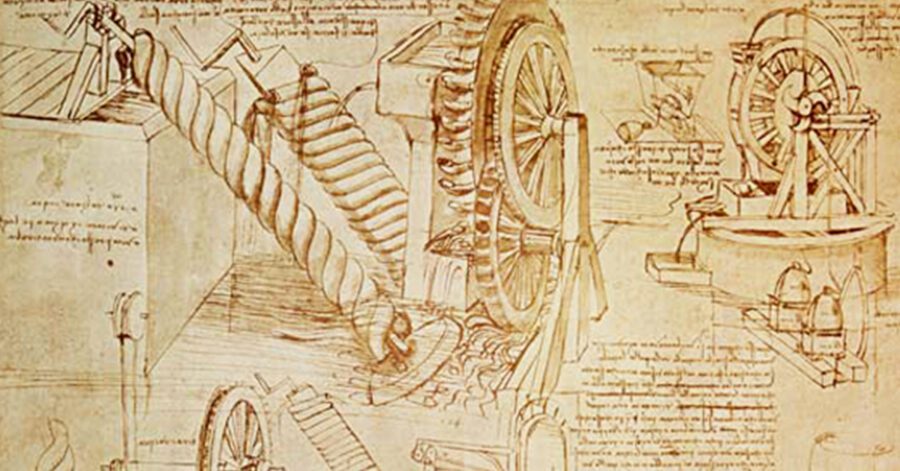
Leonardo da Vinci did the same. He filled pages with questions, sketches, and observations on subjects such as botany, anatomy, mechanics, flight, architecture, and more.
Their blank books were living records of learning. I wondered—could this notebooking method work in our homeschool?
Dive into Discovering Great Artists
Using Blank Books in High School Science
I decided to try. I had already bought the expensive science textbook, but added something better: a blank book.
Here’s how it worked:
- My high schooler would read a section of the text.
- He summarized it in his own words in the blank book.
- He redrew diagrams and illustrations, naturally integrating art into science.
- If something wasn’t clear, he looked it up or watched videos to deepen his understanding.
To my surprise, summarizing was harder, but much more rewarding. He had to slow down, ask questions, and truly understand the material before writing. And he loved choosing colors and styles for his diagrams.
Every few weeks, we’d sit together and he’d share what he learned, walking me through his summaries and drawings. I didn’t need a test—his explanations showed deep retention and understanding.
The love of learning returned.
Bringing Art Integration into Every Subject
If Bowditch and Da Vinci used this notebooking method in every subject, why couldn’t we?
I began using blank books throughout our homeschool, and now I integrate them into every subject at my online art school, too.
For example:
- In history, we draw and paint scenes that create a visual timeline in memory.
- A red poppy for WWI, remembering Georgia O’Keeffe’s brother.
- A recreation of Picasso’s Guernica, reflecting on the Spanish Civil War.
- In science, students sketch biological structures and label watercolor plant studies, complementing the Challenge A Research strand.
- In poetry and literature, we illustrate key scenes or emotions.
- In Latin, students pair vocabulary and translation with classical-inspired artwork.
- In geography, we use pastels, clay, and maps to make the world tactile.
By combining art and academic content in a blank book, students engage their senses and retain far more.
How do you use the five senses in the Habit of Attending?
Learning Through Wonder, Not Worksheets
As our classes have grown, I’ve had the joy of collaborating with other artist-educators:
- A history major teaches history and art to Foundations-age students.
- An English and art major teaches poetry through visual expression.
- A Latin-loving friend leads an arts-integrated Latin course.
- A nature artist teaches biology through watercolor.
New this year: classes on world religions with art and design, and geography through pastel landscapes and 3D clay animals.
To make these experiences even richer, I’m compiling class materials into beautiful books. These books allow families to enjoy the art outside of class and help busy homeschool moms easily integrate art with other subjects.
Ready to Learn Like Leonardo?
If you’re curious about bringing this creative, cross-disciplinary art integration into your home, visit:
www.delightfulartco.com
You’ll find arts-integrated blank book classes for students ages 6 through high school and even adults. Whether your child loves science, history, nature, or literature, there’s a class that will inspire curiosity, creativity, and a love of learning.
We’d be delighted to learn alongside you.
[1] Leslie Hart, as cited in Gelb, Michael J., “How to Think Like Leonardo da Vinci.” (Page 65.)
Written by: