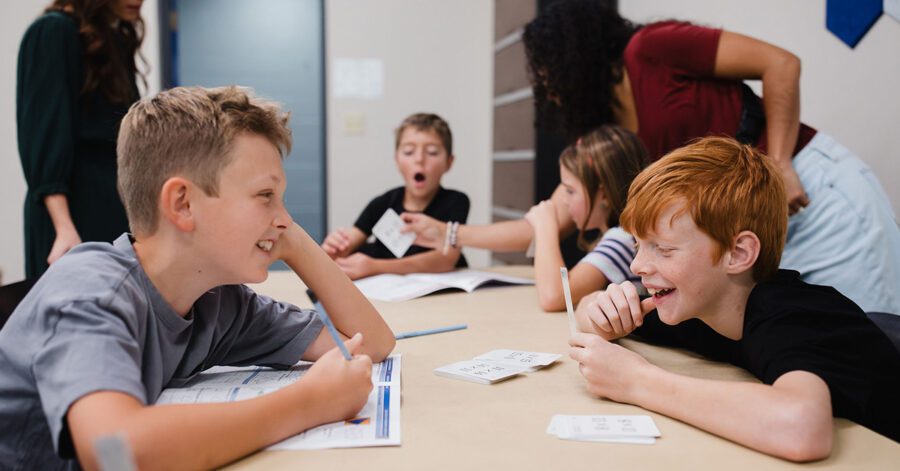
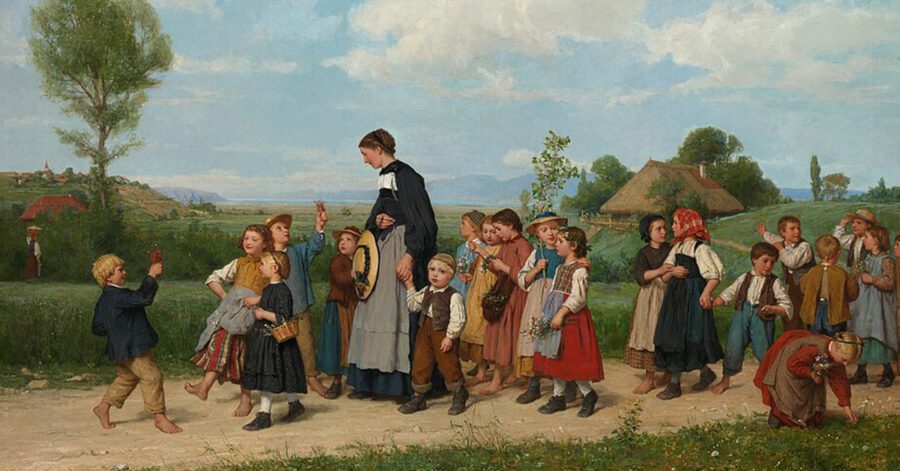
The one-room schoolhouse is an excellent model for homeschool learning because it provides a multi-age, multi-level learning environment that encourages God’s design for community and sanctification.
As a homeschool parent, you’re often searching for a simpler, more connected way to learn. Many families discover that homeschooling, while deeply rewarding, can also feel isolating.
But what if your homeschool could feel less like you’re doing it alone and more like the collaborative, multi-age learning of the historic one-room schoolhouse?
For over 25 years, Classical Conversations has been building communities where families learn together, supporting one another through the challenges and celebrating the joys of classical, Christian education.
The one-room schoolhouse model isn’t just a nostalgic memory of Little House on the Prairie. It’s a proven approach that thrives when combined with classical pedagogy, Christian community, and the natural rhythms of family life.
When you join a homeschool community, you’re stepping into a place where learning comes alive through relationship, where older students mentor younger ones, and where parents discover they don’t have to carry the teaching load alone.
What Is a One-Room Schoolhouse Homeschool?
If you’re a fan of Little House on the Prairie, you already know what a one-room schoolhouse looked like: one room, one teacher, and students of different ages learning together.
But what you might not know is that the one-room schoolhouse was remarkably successful by every measure, even becoming a treasured symbol of education in American history.
What Made It Work:
The one-room schoolhouse approach was grounded in necessity and transformed into effectiveness through community. So cooperative learning came to define these classrooms:
- Everyone worked together
- Older students assisted younger students
- The teacher circulated through the room, helping one student at a time
- Students broke into groups for focused learning
This created an environment where students learned not only from the teacher but from each other, where responsibility was shared, and where the classroom itself became a miniaturized community reflecting the very nature of God’s kingdom.
How Your Homeschool Mirrors This Model
Homeschoolers immediately spot the similarity between homeschooling and the one-room schoolhouse. In your home, you already have children of different ages gathered in one space.
Younger siblings naturally absorb what older ones are learning. A twelve-year-old at the chalkboard explaining math concepts to younger siblings is practicing the same cooperative learning that defined those historic schoolhouses.
Picture a Tuesday Morning:
Math books are strewn across the table. Your oldest child helps a younger sibling sound out words while you work one-on-one with the middle child on fractions.
The youngest plays quietly nearby, soaking in vocabulary and patterns that will serve as memory pegs for future learning. You, like that sixteen-year-old teacher in rural Texas, introduce lessons and concepts, then remain close to your children as they do the hard work of pursuing truth, beauty, and goodness.
What Solo Homeschooling Misses:
Your home is already a one-room schoolhouse. But when it connects with a broader community where families worship, learn, and grow together, something profound happens. Classical pedagogy deepens. Christian fellowship strengthens. Sustainable joy emerges.
The Classical Advantage of the One-Room Schoolhouse
Classical education and the one-room schoolhouse were made for each other. The classical model of grammar, dialectic, and rhetoric thrives in a community-based environment where students learn not just from a teacher but from each other.
Multi-Age Learning Reinforces Mastery
In your home, students can practice the skills of learning and the arts of the trivium at different levels of mastery. The youngest students work to flex those memorization muscles and practice naming well. Other students wrestle with ideas, asking defining and comparing questions, and learning what others have said about the topic at hand.
All the students polish their presentations of the knowledge that they have gained, some preparing for a simple explanation and others preparing a constructive argument for debate or an expository speech. Each student can learn by watching and hearing what the others are doing.
This isn’t accidental. God designed human learning to flourish in relationship. When we isolate students by age and ability, we miss the sanctifying work that happens when iron sharpens iron, which is why the one-room schoolhouse approach works so well.
How Classical Conversations Builds on This:
In Classical Conversations communities, families gather weekly for structured learning that honors both age-appropriate instruction and multi-age community. While students work in classes suited to their developmental needs (Foundations for ages 4-12, Essentials for ages 9-12, Challenge for ages 12-18), the entire community gathers like a one-room schoolhouse for family presentations, celebrations, and special shared experiences.
Parents sit in classes with their students, watching Tutors model classical teaching methods. Older siblings who have progressed to Challenge can help younger siblings at home with the same material they studied years before, now with greater depth and understanding.
Dialectic Requires Community
Classical education divides learning into three arts: grammar (inputting data), dialectic (processing data through logic and questioning), and rhetoric (outputting data through clear communication).
But here’s what’s crucial: dialectic cannot happen in isolation.
Dialectic is the art of reasoned discourse. Students learn to analyze arguments, ask the Five Common Topic Questions, and construct their own positions. This skill requires other people. You can’t practice Socratic dialogue alone. You can’t sharpen your thinking without encountering perspectives different from your own.
Scripture affirms this: “As iron sharpens iron, so one person sharpens another” (Proverbs 27:17). The friction of minds meeting, questioning, and refining ideas is part of God’s design for growth in wisdom.
Challenge: Where Rhetoric Comes Alive
In Classical Conversations’ Challenge program, students engage in student-led seminars where they’re active participants and leaders, posing questions to their peers, facilitating conversation, defending their positions, and learning to respectfully challenge each other’s thinking.
What they offer to the class is valuable and important:
- Absences affect the entire community
- Students are not passive listeners but active contributors to the shared pursuit of truth
- Each perspective adds to the body’s understanding
This is the body of Christ in microcosm. Each member contributes unique gifts, and when one suffers, all suffer. When one rejoices, all rejoice.
The Apprenticeship Model
Classical education has always relied on apprenticeship: learning from those who have gone before, watching a master at work, imitating good models. This reflects the biblical pattern of discipleship.
In Classical Conversations communities:
- Older students model for younger students
- Parents learn alongside their children
- Tutors demonstrate the 15 tools of learning in real time
This is discipleship in action. Paul told Timothy, “What you have heard from me in the presence of many witnesses entrust to faithful men, who will be able to teach others also” (2 Timothy 2:2). The one-room schoolhouse creates exactly this kind of generational teaching.
The Christian Foundation for Learning in Community
The one-room schoolhouse provides nothing less than an opportunity to practice living in community as God designed. Each schoolhouse embodies a miniaturized community where we discover that community is not merely beneficial but essential to bearing the image of God.
Created for Community: The Imago Dei
Scripture tells us that man is created in the image of God: “Let Us create man in Our image.”
Do you find it interesting that the Holy Trinity is a trinity and not a couple? The very nature of God is communal. The Nicene Creed states the relationships within the Trinity: Christ Jesus is begotten of the Father; the Holy Spirit proceeds from the Father. God exists in eternal community.
If we are made in God’s image, then we are made by Community to live in community. We are not designed for isolation. From the beginning, God declared, “It is not good for man to be alone.”
The Biblical Case for Community:
Cain’s fear of being a wanderer outside community was well-founded. Genesis tells us that after Cain took a life, God cast him out from the community as punishment. Cain recognized that the punishment was so great that the exile itself might end in his death.
Scripture and archaeology together suggest that living outside of community is inhuman. Your one-room schoolhouse, whether at home or in your Classical Conversations community, is where this truth is lived out daily as children learn they are members of a body, each contributing and each receiving.
Community as Sanctification
Once salvation is assured, community continues to provide opportunities for believers to work out their salvation. The classroom richly provides places to learn not just academics but virtue.
Dietrich Bonhoeffer captures this: “Even when sin and misunderstanding burden the communal life, is not the sinning brother still a brother, with whom I, too, stand under the Word of Christ?”
Community provides the opportunity to practice repentance and experience forgiveness. The need for salvation and the process of sanctification are worked out in community:
- When we sin, we experience the results and feel our need for Christ’s atonement
- When children or parents fail to meet expectations, they feel the weight of their actions
- Community becomes the forge where character is shaped and grace is learned
- Teachers discover humility and dependence on Christ
Many hours of time together can build love and mutual respect, or if allowed, may create bitterness. The difference lies in whether we approach community as a place to give, forgive, bear burdens, and grow together under Christ’s lordship.
Community as God’s Generous Provision
“Two are better than one,” Ecclesiastes tells us, “for if they fall, the one will lift up his fellow: but woe to him that is alone when he falleth; for he hath not another to help him up.”
Do you remember Moses? Worn and weary from judging a nation in the desert, his father-in-law, Jethro, instructed him to rely on other men in the community. Moses couldn’t sustain the work alone, and neither can we.
In the New Testament, the community of believers brought all their material resources together to care for one another. Our miniaturized communities practice this when children share resources, when parents swap curriculum, when one family brings a meal to another struggling through difficulty.
Perhaps the most potent way the one-room schoolhouse illustrates God’s provision is through corporate prayer. When families gather to pray before memory work, before Challenge seminars, in times of celebration and crisis, they experience God’s presence in a way that solo homeschooling simply cannot replicate.
Behold, how good and how pleasant it is for brethren to dwell together in unity! Community is God’s generous provision for His people, a gift that sustains us in the long obedience of education.
What Homeschool Community Looks Like in Practice
Classical Conversations emphasizes incorporating ideas from the one-room schoolhouse into both family routines and weekly community gatherings. While students work in age-appropriate classes during community day, the entire gathering reflects the one-room schoolhouse spirit.
What Community Day Includes:
- Foundations families (ages 4-12) gather for memory work, presentations, and hands-on learning
- Essentials students (ages 9-12) practice the skills of grammar and writing
- Challenge students (ages 12-18) engage in student-led seminars and dialectic discussion
- Parents participate, watch, learn, and support one another
The Tutor doesn’t lecture but facilitates, modeling classical methods and helping parents understand how to continue the work at home. This reflects the biblical pattern of equipping the saints for the work of ministry.
The Gifts Community Gives Your Family
For Parents:
Community provides accountability in the life-giving way that Moses experienced with Jethro. You’re not alone in curriculum decisions. Other families walk alongside you, sharing resources and bearing one another’s burdens as Scripture commands.
Tutors and directors validate your assessment of your students’ work. The unique partnership between tutor, parent, and student strengthens your relationship with your children, especially during the challenging rhetoric years.
Perhaps most importantly, community makes homeschooling sustainable. You’re surrounded by families who don’t just learn together but do life together, pursuing holiness and wisdom in community.
For Students:
Friendships deepen when students spend time with the same director and classmates every week. Sharing deepens, trust increases, and learning grows because of these committed relationships forged in the pursuit of Christ-centered truth.
Students practice virtue together: patience when a younger child takes longer to present, kindness when helping a struggling peer, courage when defending truth, humility when correcting error.
This social development is the natural fruit of doing life together, reflecting the body of Christ where each member has a role and the body suffers when one member is absent.
The Cost and Commitment of Community
Community requires presence and participation. Unlike modern education, where a student can miss class without affecting others, the one-room schoolhouse community depends on commitment as the body of Christ depends on each member.
Why Consistency Matters:
- Absences affect the entire community
- When families drop in and out, the whole body suffers
- Trust doesn’t deepen without regular presence
- Learning doesn’t grow exponentially without consistency
This is hard work. Relationships require dying to self, preferring others, and showing up even when inconvenient. But the reward is profound: members of little one-room schoolhouse communities see that community is a human need, sin is a reality, and community is God’s generous provision.
The challenges of community (conflicts, misunderstandings, the need for repentance and forgiveness) become the means by which God shapes us into the image of Christ.
A Question to Consider:
Do you view your one-room schoolhouse as a little community under God’s authority? Would that change your commitment level, your willingness to show up, your investment in other families’ sanctification?
Conclusion
The one-room schoolhouse captures something essential about how God designed humans to learn: together, across ages, in relationship, with shared resources and mutual responsibility.
When this model is grounded in classical pedagogy, it produces students who learn how to learn. When rooted in Christian theology, it reflects the image of God, a Trinity eternally existing in community. When lived out in Classical Conversations families, it becomes sustainable, joyful, and deeply formative.
Your home is already a one-room schoolhouse. The question is: will you connect it with a broader community where the classical, Christian, and communal elements can flourish together as God intended?
For over 25 years, Classical Conversations has been building these communities where families learn together, support one another, and discover that homeschooling reflects the body of Christ: many members, one body, each necessary for the others’ growth in grace and truth.
Community is at our core, with families doing life together as they learn. If you’re searching for a homeschool community where the one-room schoolhouse model thrives, where classical education is taught from a Christian worldview, and where you’ll find support for the long journey of home education, we’d love to hear from you.
Recap: The One-Room Schoolhouse Homeschool Model
The one-room schoolhouse homeschool model combines multi-age learning, cooperative education, and community support to create a sustainable educational experience that reflects God’s design for human flourishing.
Classical Conversations has built communities around this model for over 25 years, integrating the classical arts of grammar, dialectic, and rhetoric with Christian worldview and community-based learning.
The classical advantage includes multi-age learning that reinforces mastery, dialectic discussion that requires community, and apprenticeship-style mentorship reflecting biblical discipleship.
The Christian foundation recognizes that humans are created in God’s image for community, that sanctification happens through relationships, and that community is God’s provision for His people.
In practice, CC communities function as modern one-room schoolhouses where families gather weekly for age-appropriate instruction within a multi-generational community context. Parents receive support, accountability, and pedagogical training while students develop deep friendships, practice virtue, and learn to think critically in community.
Success requires commitment and consistent participation as members of Christ’s body, but the reward is sustainable homeschooling where families pursue truth, beauty, and goodness together.