Do we live in a “uni-verse” or a “multi-verse?” If we agree we live in a universe governed by God’s providence, and not in a random cosmos made up of disconnected parts, how do we reinforce this idea with our children as we homeschool them and study with them?
When I went to my first parent practicum, one set of slides during the presentation particularly captured my imagination. I am sure some of you have seen them (if not, they have been reproduced in Classical Conversations’ Classical, Christian Education Made Approachable). These were the slides which demonstrated a progression from a modern education to a classical, Christian education. The final slide illustrates the clear connections between philosophy, science, history, math, poetry, and so on. At first, I was excited about this idea, which was fairly new to me. Then, at home, I began to wonder how on earth to put it into practice.
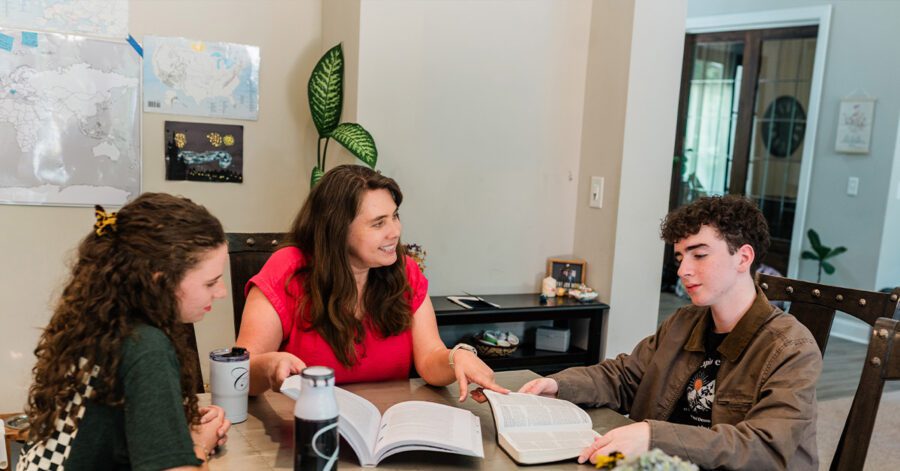
Now, in my second season as a Challenge III director, the idea has exploded into my Challenge seminars. Each week, the students and I have been able to make connections between science and poetry, connections which have then led us back to philosophy. This is the integration of subjects. We have explored historical events which have drawn us into contemplating political theories (philosophies about government). In turn, that has taken us back to Shakespeare’s plays. Does this sound too good to be true? Step inside some of my seminars to see the minds of teenagers in action, doing exactly that.
On our first day, we examined the philosophies of Plato during our rhetoric seminar. Plato’s attempt to define man as a “featherless biped” struck us as funny, just as it did in his own day when his students gave him a plucked chicken in response to his inadequate definition. After a little laughter, we tried to come up with a better definition of a person. So far, we have come up with the following working definition: “man is a being composed of body, mind, and soul, who is capable of rational thought and able to use language.” (We will continue to add to it as the year progresses). This definition allowed us to differentiate between humans and other created beings. Considering the differences between men and animals also led us to think about the theory of evolution, and that brought us to the subject of how to define matter (the basic “stuff” from which all things evolve according to the theory). This drew us back to the chemistry we have been studying in our research seminar. Our definition also prompted us to consider the Renaissance ideal of a man as it is expressed in Shakespeare’s plays. Then, because we are reading Shakespeare’s Much Ado About Nothing, we decided to explore the differences between men and women.
We have also been practicing rhetorical devices such as definition and circumstance.
Definition allows students to form precise arguments (see our definition of man above). Focusing on circumstancehelps students to consider “What else relates to the question at hand?” So, as we discussed Washington’s presidency this week, we analyzed his Proclamation of Neutrality in which the newly formed United States decided to remain neutral in European politics. In order to really appreciate Washington’s position, we had to think about what was going on in the world at the time. We talked about tensions between Britain and France. In addition, we had to consider the French Revolution. This led us to the rhetorical device of comparison, so we spent a few minutes comparing and contrasting the American Revolution to the French Revolution. Our discussion of the French Revolution caused us to talk about the role of the French mob during those years. Unlike the American Revolution in which the revolutionaries quickly established an orderly government based on law, the French Revolution produced no clear Constitution, but instead, devolved into a totalitarian state in which mobs roamed the streets arresting citizens and turning them over to be executed by guillotine. This led us back to Shakespeare once again as we briefly touched on the role of the mob in Shakespeare’s Julius Caesar. Talking about the fickle and violent nature of mobs then prompted us to consider how the Federalists, particularly John Adams, feared that the new U.S. democracy could quickly descend into mob rule.
In our poetry class, I had my students read an essay called “Seeing” from Annie Dillard’s book The Pilgrim at Tinker Creek. I wanted to challenge them to be still, to see nature, to reflect on their own spirits as well as on God—in other words, to be poetic. Her essay is rich in similes and metaphors. We paused to examine some of these in detail and to discuss Jesus’ use of metaphor when He calls himself the vine, the bread, and the wine. I asked them to consider why contemplation of nature and poetry are so often linked (think about the Psalms of David). How does knowing the names of particular trees, birds, and fish impact our understanding of who God is? How is naming things poetic? Why did God have Adam begin his “education” by naming the animals? What does this say about our studies of biology or chemistry? What is the connection between science and poetry? If we are made in His image and we are poetic, is God a poet?
How can you begin making these connections—integrating your students’ studies at home? Here are some recommendations. First, being able to see these connections begins with the simple step of reading widely. The Challenge program provides plenty of quality reading to spark these kinds of thoughtful discussions with your children. Second, next to reading widely, making connections between the subjects requires an ever-deepening understanding of the character of God. Often, our minds begin to make the connections simply by asking “Why should Christians read this book or study this subject?” Third, just spending some time with bright young people who are eager to ask big questions (such as “If God is perfect, what is the source of evil in the world?”) will allow you and your students to quickly begin to see how theology governs all knowledge and connects all subject areas. Indeed, you will soon see how they are connected intricately and intimately. . . like a beautiful and well-designed puzzle.