
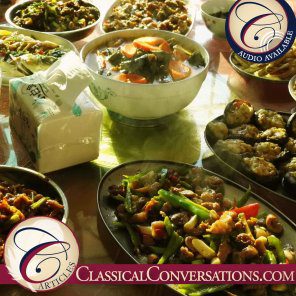
When my daughter was young, church potlucks marked the high point of her month. She eagerly anticipated these gatherings for the sheer number of choices, the novelty of getting to try dishes that didn’t normally appear on our table at home, and most of all, the allure of the many desserts. As we crowded around the heavily laden tables together, her face just barely high enough to peer into the crock pots, casserole dishes, and baskets, I would serve her plate as she offered input. We had a few ground rules: there had to be veggies, a protein, and some fruit. And we had to leave at least a few rolls in the basket for the rest of the church.
Even though I had never tasted some of the dishes offered, and occasionally had to guess at some of the ingredients, I didn’t struggle with my choices as I dished up her meal. Even though my good friend, a trained dietician, was often in line right beside us, I didn’t wonder anxiously if she thought I was making poor decisions about my child’s nutrition. In fact, I didn’t feel a particular need to ask her opinion. I felt comfortable with my general knowledge of nutrition; I had established our ground rules; I knew my daughter’s needs, likes, and dislikes; I was willing to accept her input; and I knew we could always come back.
Recently, faced with what to serve my daughter from the buffet of curriculum choices available, I was challenged to fill her plate with the same freedom and joy. As homeschooling parents, we so often compare our “plates” to those of others, afraid that our children will be malnourished or overfed. We second guess our selections because there might be a more inviting version of the same dish a little further down the table. We are concerned what others might think of the choices we have made. Can I share some reminders from the humble church potluck that have helped me serve up our homeschool plates with confidence?
We bring a decent knowledge of nutrition to the table.
We have a lifetime of experience feeding ourselves and our families. We were making decisions about our nutrition long before we got in line for this potluck. We grocery shop, we cook three meals a day, we might even garden, preserve, and can. We are at least somewhat familiar with a variety of cuisines from around the world.
Similarly, even for those of us who didn’t receive the perfect education—and who did?—we have been learning for a lifetime, and we have already been teaching our children every day, even if only informally. We possess at least a basic proficiency with reading, writing, and arithmetic. We are probably at least somewhat familiar with various educational methods even if we can’t necessarily name them; we know how we learn best, and we have likely observed how our children like to learn as well.
We have goals and ground rules.
Every household has some ground rules about meals—things like no dessert until after dinner, you have to at least try everything on your plate, or my potluck rule: there has to be at least a protein, a veggie, and a fruit. Even though the specific rules may look a little different from family to family and the exact dishes or proportions on each plate may vary from meal to meal or from child to child, we are aiming at similar goals: meeting our children’s immediate hunger, honoring the efforts of those who created the meal, and cultivating in our children a lifelong positive relationship with food. Eventually we hope our children will begin to wisely serve their own plates, cook for themselves and others, and someday even do their own shopping or gardening.
Classical homeschoolers have some shared non-negotiables for our children’s educations. We want our children to love learning and to have the courage and virtue to live out what they have learned. We want them to be proficient in certain skills, to be able to share their knowledge and abilities with the world around them and someday with their own children. We may use a different method or a different combination of ingredients based on the varying needs of our family and each child, but if we keep the big picture—the ground rules—in mind, even a haphazard smorgasbord can be a feast.
We know our children best.
As we serve our children’s plates, we consider their allergies, their likes, and their dislikes. We know when they have eaten doughnuts for breakfast, and are heading to a birthday party that evening. We avoid foods that have given them an upset stomach in the past. We might give them a small sampling of a food we hope they will grow to enjoy or we might add an extra dollop of a favorite dish just to make them feel loved. No one else, not even a dietician or your child’s pediatrician, is more qualified or more prepared to serve your children’s plates because you know them best.
And no one is better prepared or equipped to teach our children either. We know their interests and their preferences, their proclivities and their quirks. We know how to draw our children into a story or get them excited about discovering something new. We know which words they think just sound funny, which animal is their favorite and why. We know that they went to bed late last night, and that they could use some extra snuggles today.
This intimate knowledge helps us be better teachers for them. We know what to emphasize and what to save for another day. For instance, although my daughter was curious and eager to learn from a young age, she would have struggled in kindergarten. She hated the number five. Absolutely hated it. And refused to say it. We had no idea why. I let her skip it when she counted because I was confident that she knew where it belonged; she just couldn’t bring herself to name that dreadful number. Along the same lines, for years she sang the alphabet, ABCDEFGHIKJLMNOP…. At the end, she would announce, “I know, I inverted K and J.” I was pretty sure that the ability to identify and explain what she had done wrong was as good as or possibly better than remembering on the first pass that J comes before K. She could recite and act out the story of Theseus and the Minotaur well before she could reliably tell the difference between the colors yellow and blue—and not from lack of effort on my part, let me assure you! She could dictate stunningly beautiful poetry to me to help herself fall asleep, but she couldn’t tie her shoes to save her life. And that was okay. Because I witnessed her growing and learning day by day, I knew I didn’t need to be concerned when she was “ahead” in some areas or “behind” in others.
We need to be open to our children’s input.
Your child doesn’t have to love everything on their plates, but if they actually hate something, there’s probably a better option out there. That might mean letting them substitute kale for spinach or carrots for beets. Or maybe it just means serving something up a different way. For years we thought my daughter hated eggplant, but then we discovered a particular Indian dish with pureed eggplant that she loves; it turns out the texture not the vegetable was the issue.
Just as we try to honor our children’s preferences where possible when it comes to food, we should be looking for ways to honor the unique and wonderful way that God has created them as we select and implement curriculum. That doesn’t mean that we neglect the fundamentals; our children do need to be able to read, write, cipher and so much more. But even as we insist on mastery of the multiplication tables, we can offer skip counting songs to ease the burden and we can invite our students to dance as they sing to work out some wiggles. Even as we require daily handwriting practice, we can provide special pens or pencils to use or offer beautiful and engaging copywork sentences—perhaps even from a book or poem our student has enjoyed. If our students express a preference about how to tackle a subject, whenever possible, honor it!
We can always go back.
One of the best things about potlucks—and a big reason I wasn’t anxious as I served our plates—is you don’t have to eat something if you just plain don’t like it. If what looked like chocolate chips turned out to be raisins, if that potato salad was a little too sweet, you can just set it to the side and leave it alone. If that curriculum you bought looked amazing, but it just never suited your family, it’s okay to give it away, or even turn it into a door stopper!
As a wonderful flipside, if you want a little more of a dish that looked sketchy but turned out to be delicious, you can jump right back in line for another helping. If your child needs a larger serving in order to understand something or simply to satisfy their curiosity, that’s okay! You can always supplement as your child’s needs and interests dictate.
Even though I was quite capable of serving up our plates at the church potluck, I was certainly open to conversation if my friend the dietician wanted to point to the fruit salad and mention, “Hey, did you know that papaya offers more vitamin C than oranges?” I was also more likely to encourage leafy green vegetables when I had recently read up on the importance of adequate folate in the diet, and more likely to discourage certain desserts after I learned about the possibility of negative side effects from food dyes. Continuing education is important! But it shouldn’t be a source of fear or anxiety. Just as you wouldn’t stop feeding your family until you had completed a course in nutrition, you don’t have to be an expert in education—or in anything—to begin to teach your child well.
So, come boldly to the potluck! Grab a plate and join us around the table. It’s going to be a feast!