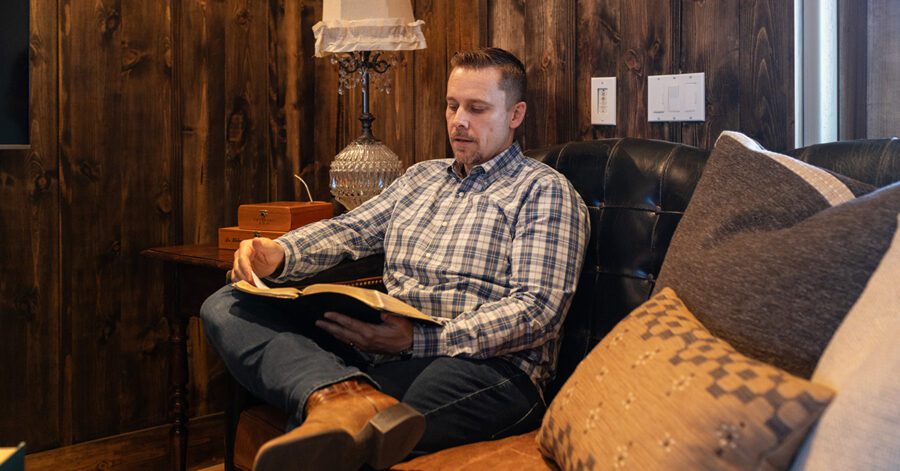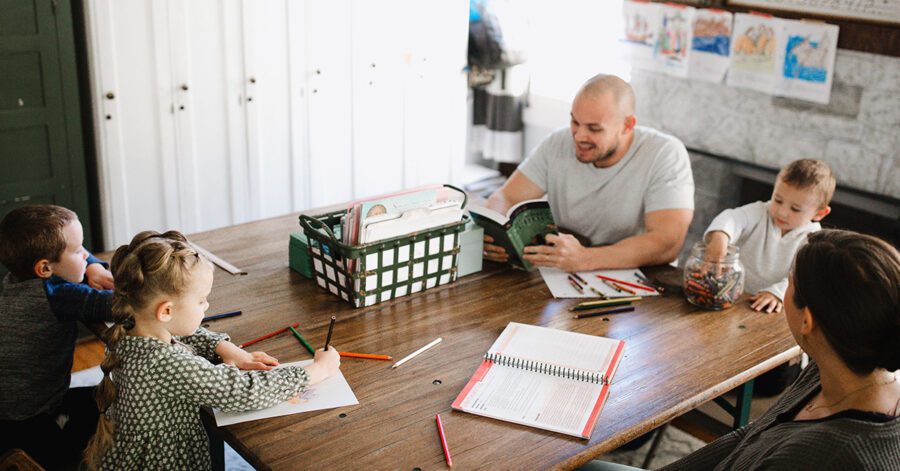

Every homeschool dad shapes his children’s future, whether he intends to or not. Alex Newman is a journalist, author, and Classical Conversations father of six whose work has taken him across continents, but whose most consequential assignment has always been at home.
In this article, Newman draws on Scripture, research, and years of lived experience in the CC community to make the case for why father involvement in classical Christian education is not a supporting role. The legacy a father builds, one evening, one conversation, one chapter of Scripture at a time, is the one his children carry forward.
Why Every Homeschool Dad Belongs at the Center
In the world of homeschooling, dads frequently think of themselves as the financial providers and perhaps the semi-present “principal” of the home-based academy at best. Mom is supposed to handle the bulk of the teaching and most of the day-to-day decisions on her own, we say to ourselves.
There is nothing inherently “wrong” with that model. But taking into account Scripture’s clear teaching on the role of fathers, and looking at the data, it is becoming more and more obvious to me that fathers should ideally have a much more active role in education and discipleship. The more years of home education we have (our oldest is 16 now; YIKES!), the more I see how important dads really are.
Early on in our homeschooling journey, after returning to the United States from Scandinavia, my wife and I made the decision to enroll our children in Classical Conversations. Knowing there was a solid community for my family to connect with was huge. But as a father whose work often takes me across the globe, I wondered where I would fit into the daily rhythm of home education.
The answer, I’ve discovered, is that we dads fit right at the center; not as replaceable helpers or distant overseers and financial providers, but as the God-ordained leaders, protectors, providers, and vision-casters for our families. Classical Christian education isn’t just “academics”; it’s discipleship. And fathers have a vital, irreplaceable role in that process.
I’m not here to shame anyone. Far from it. In fact, my wife and I are still learning as we go, too. This is really an invitation to step up, lean in, and experience the profound joy and blessing that comes when dads actively engage in their children’s education. As one CC dad among many, I want to share what I’ve learned from Scripture, from real life, and from the timeless principles that make home education thrive.
Read How to Be a Good Father: Living, Learning, and Leading
The Sobering Reality of Father Absence
We live in a culture that downplays or even demonizes the unique contribution of fathers. “Toxic masculinity” and “patriarchy,” we are told by academics, entertainers, and politicians, might just be the root of all evil. Yet the data paints a very different story: dads are unique and essential.
A U.S. Department of Justice report highlighted the stark consequences of fatherless homes: children from such environments account for nearly two-thirds of youth suicides, 90 percent of homeless and runaway youths, 85 percent of children with behavioral disorders, 71 percent of high school dropouts, and 70 percent of juveniles in state institutions.[1]
This has reached crisis levels. U.S. Census Bureau figures show that in 1970, only about 11 percent of children lived in homes without their fathers. In recent years, that figure has climbed toward one in four overall, with even higher rates in some communities. Less than 40 percent of Black children live in two-parent homes, according to some estimates.[2]
These aren’t just statistics. They’re warnings. Fathers matter profoundly.
A well-known Swiss study on religious transmission drives the point home for faith formation. When fathers attend church regularly, roughly two-thirds to three-quarters of their children grow up to do the same, regardless of the mother’s habits. When fathers do not attend, even if mothers are faithful, only about 2 percent of children become regular worshippers, with over 60 percent drifting away entirely. The father’s example carries extraordinary weight. Never forget that.[3]
God’s Word: The Only Reliable Guide
The world offers plenty of opinions on parenting and manhood. It seems like every year, some psychologist with a bunch of letters behind his name or some new “peer-reviewed” study emerges to undermine traditional parenting. But we must not look to the world or academic credentials for wisdom. As Proverbs 1:7 reminds us, “The fear of the Lord is the beginning of knowledge.” God’s Word is our starting point.
Ephesians 6:4 speaks directly to fathers: “Fathers, do not provoke your children to anger, but bring them up in the discipline and instruction of the Lord.” This is our commission — not optional, but central.
Psalm 127:4 paints a beautiful picture: “Like arrows in the hand of a warrior are the children of one’s youth.” Our children are arrows we sharpen and aim for God’s glory. Colossians 3:23 adds urgency: “Whatever you do, work heartily, as for the Lord and not for men.” That certainly includes education and parenting!
Joshua 24:15 declares the leadership we’re called to: “But as for me and my household, we will serve the Lord.” That means insisting on faithful church attendance, family prayer, worship, and Bible study. It means modeling what it looks like to love God and neighbor. And that must not be some afterthought. Rather, this focus on discipleship must permeate everything we do.
Jesus Himself redefined authority as service: “Whoever would be great among you must be your servant… even as the Son of Man came not to be served but to serve” (Matthew 20:25-28). Our leadership in the home is not meant to be domineering or tyrannical; it is sacrificial, just as Christ loved the Church and died for her.
The Team: Mom + Dad, United
Moms and dads should not be in competition. One is not more important than the other. We are a team, and unity is non-negotiable. Proverbs 1:8-9 celebrates both: “Hear, my son, your father’s instruction, and forsake not your mother’s teaching, for they are a graceful garland for your head and pendants for your neck.”
In our home, like in most homeschooling homes, my wife carries much of the daily teaching load — a common pattern among CC families, too. But I do feel enormously blessed to serve as the “headmaster” of our little “Newman Academy.” Together, my wife and I choose curricula, review progress, and more. What a blessing it is when I am able to grade some assignments, teach reading to the little ones, and lead family Bible reading and worship almost every night.
Every evening I’m home, we read at least one chapter from the Old Testament and one from the New, and we discuss what God is trying to tell us. We sing at least three worship songs together with me on guitar and our children on various instruments. Then we pray as a family: each child shares what they’re thankful for, what they need to confess, what’s causing anxiety, and how we can love God and others more. Sometimes we watch a solid educational video or devotional. This rhythm builds consistency and discipleship. Dads, it is up to you to lead the way here!
I also stay involved in our co-op and our CC community as much as I can. I’ve taught world history and U.S. history in one of our co-ops, and we remain active in Classical Conversations because, in addition to the wonderful education, the local CC community sharpens everyone. Even when moms handle the bulk of lessons, dads who show up make a difference. We see it all around us.
Discover For Dads: 20 Ways to Support Your Wife in Your Home School
Protect, Provide, Lead, Guide
The core calling is clear: dads must protect, provide, lead, and guide. Let’s examine each one in more detail.
Protect
We guard our families from the world, the flesh, and the devil. “Be sober-minded; be watchful. Your adversary the devil prowls around like a roaring lion” (1 Peter 5:8). We understand the human heart is desperately wicked (Jeremiah 17:9), so we don’t outsource discipleship. Home education itself is discipleship, echoing Psalm 78‘s call to tell the coming generation about “the glorious deeds of the Lord.”
We are careful with media—always limiting it and often prohibiting TV altogether. Occasionally, we choose wholesome options like Little House on the Prairie, Answers in Genesis science, or Torchbearers missionary stories. But there is no reason for us to waste the precious time God has given us with our children on worldly or degenerate propaganda masquerading as “entertainment.”
Discipline, of course, is part of protection, done in love. Proverbs 13:24 states, “Whoever spares the rod hates his son, but he who loves him is diligent to discipline him.” Hebrews 12:9-11 reminds us that loving discipline produces a harvest of righteousness and peace. This is another area where fathers are essential.
Naturally, as citizens of a self-governing constitutional Republic where ‘We The People’ are sovereign, we must defend our God-given freedoms from those who would seek to undermine them. That means we teach our children and join with others in organizations like HSLDA and our state homeschool associations to protect our freedoms. And it means we remain vigilant and active.
Our children know well what 2 Timothy 3:12 states: “All who desire to live a godly life in Christ Jesus will be persecuted.” For years, I have taught my children to understand the potential for persecution. From reading Foxe’s Book of Martyrs to my older ones to going through Voice of the Martyrs publications, I make sure they understand what our brothers and sisters are facing around the world.
Provide
Naturally, fathers are called to provide for the physical needs of their families to the extent that it is in their power to do so. “If anyone does not provide for his relatives, and especially for members of his household, he has denied the faith and is worse than an unbeliever,” warns 1 Timothy 5:8.
Provision includes financial stability, yes. And we should be training our children to work hard and have the skills needed to eventually provide for their own families. But provision also includes presence. It does not mean that our children must have the newest video games, expensive vacations, and designer outfits like the Joneses across the street.
Balance matters here. We do not want our children to go hungry, and we certainly do not want to teach them that it is OK to turn to the government for provision. But being there for your children and providing love and attention is generally far more important than extra income. You can always earn more money. You can never buy more time with your children once they are grown. Plus, our first ministry must always be our family.
Lead and Guide
There are many ways that fathers can lead and guide their families in homeschooling. It does not necessarily mean we need to micromanage everything. In our home, I cast vision for why we homeschool: to raise children who fear the Lord, think critically, communicate clearly, and stand firm in truth. As the leader, I help keep us on track.
Leading by example cannot be overemphasized: I do my best to love my wife visibly and sacrificially, as Ephesians 5:25 commands: “Husbands, love your wives, as Christ loved the church and gave himself up for her.” Children notice. Never argue with or disrespect her in front of them. We stay united. It is one thing to tell your children to love and honor their future spouses. It is far more important for them to watch it every day.
For my sons, I lead by example as much as I can, working diligently (“Six days you shall labor”), taking responsibility, and traveling together when possible. Whenever I can, I bring one of them with me to help, learn, and keep me company. It is wonderful to teach them by doing, and one-on-one time is especially critical in a family with six children (so far!).
My sons will learn how to work and how to love their future spouses from my example. That is an enormous responsibility, and we need to always keep that in mind. Our daughters will learn how their future husbands should love and honor them, and how they should behave, from our example, too. I constantly strive to be the kind of man I hope my little girl will someday marry: godly, honest, kind, diligent, and faithful.
Always remember: your children will more than likely do what you do. As we read in Luke 6:40, “the student who is fully trained will become like the teacher.”
As a family, we do what we can together, too. We are building, raising cattle, planting vegetables, and finding new ways to do life and support ourselves on our little farm. We’ve also done multiple major road trips across the United States and Europe, homeschooling all the way, as I travel for speaking tours and journalism.
Not everyone can do that, of course. But being intentional about spending large amounts of time together and dealing with problems and challenges together is beyond valuable.
Learn about Dad the Dragon Slayer: Encouragement for Homeschool Dads
An Invitation to Engage
In Classical Conversations communities, I’ve seen the difference active homeschool dads make. Families thrive when fathers aren’t spectators but participants through teaching a class, attending presentations, praying with their kids, leading worship, and simply asking thoughtful questions at dinner.
This looks different in every home, obviously. In some cases, dads do the bulk of the teaching. And that is OK, too. In fact, the Bible repeatedly emphasizes the role of fathers in teaching their children. In other families, they support from the sidelines while working outside the home. In any case, the principle remains: engage according to your capacity, but engage.
Psalm 128:1-4 promises blessing for the man who fears the Lord: “Your wife will be like a fruitful vine within your house; your children will be like olive shoots around your table.”
Fathers, we have authority to serve (Matthew 28:18). Let’s use it well. That authority means we have tremendous responsibility, too. Seek first the Kingdom of God (Matthew 6:33). Build a legacy like Jonadab’s, whose obedient descendants stood and will stand before the Lord for all generations (Jeremiah 35).
Your children are watching. Make sure your household can declare with you, “As for me and my house, we will serve the Lord.” The classical Christian education journey is richer, stronger, and more fruitful when dads step fully into their God-given role. It changed everything for our family. It can for yours, too.
Uncover how Dads are Transformers
Frequently Asked Questions
What is the dad’s role in homeschooling?
A father’s role in homeschooling goes beyond finances. Scripture calls fathers to be the primary disciplers of their children—protecting them from harmful influences, casting vision for the family’s direction, leading family worship, and modeling faithfulness. In classical Christian education, this means a father actively shaping what his children believe, how they think, and who they are becoming.
How can working dads be involved in homeschooling?
Father involvement in homeschooling does not require being present for every lesson. Working dads can engage by leading a consistent evening rhythm of Bible reading and prayer, asking questions about what children are learning, reviewing assignments, attending CC community days and presentations, and being intentional about one-on-one time. Presence and consistency, even in small doses, make a measurable difference.
Does dad involvement improve homeschool outcomes?
Research consistently shows that father involvement improves outcomes across every dimension of a child’s life, academic performance, behavioral health, faith formation, and long-term flourishing. The Swiss study on religious transmission found that a father’s church attendance is the single greatest predictor of whether children carry their faith into adulthood. The principle applies directly to education: when fathers are engaged, children take their learning more seriously.
How does Classical Conversations involve fathers?
Classical Conversations is built around the family as the primary educational unit, which means there is a natural and intended place for fathers. CC dads can serve as co-op leaders called Tutors, attend weekly community gatherings, participate in student presentations, and provide spiritual leadership at home as their children work through classical curriculum. Many CC communities have dad-specific resources and gatherings as well. Visit classicalconversations.com/dad/ to learn more.
Lead Well: The Homeschool Dad’s Lasting Legacy
The father absence crisis is real. The data is sobering. But for the homeschool dad who fears the Lord and is willing to step fully into his calling, the opportunity is extraordinary. Classical Christian education gives fathers a framework for exactly the kind of discipleship God has always called them to—not as a program, but as a way of life. Lead your family. Protect what matters. Provide not just with income but with presence. Guide your children toward wisdom, faith, and truth.
Your children are arrows. Sharpen them well.
Continue the encouragement for fathers with these insightful resources:
- Why More Dads Are Choosing Classical Conversations to Homeschool Their Kids
- A Dad’s Guide to Classical Education (free ebook)
- Raising Resilient Sons: Faith, Fitness & Fatherhood for Christian Dads (podcast)
[1]U.S. Department of Justice, Office of Justice Programs. “Fatherlessness and Its Effects on American Society.” America First Policy Institute, 2023. https://www.americafirstpolicy.com/issues/issue-brief-fatherlessness-and-its-effects-on-american-society.
[2]U.S. Census Bureau. “Historical Living Arrangements of Children.” Updated 2025. https://www.census.gov/data/tables/time-series/demo/families/children.html; see also N-IUSSP, “America’s Single-Parent Households and Missing Fathers,” January 2025. https://www.niussp.org/family-and-households/americas-single-parent-households-and-missing-fathers/.
[3]Werner Haug and Phillipe Warner, “The Demographic Characteristics of the Linguistic and Religious Groups in Switzerland,” in The Demographic Characteristics of National Minorities in Certain European States, Vol. 2, Population Studies No. 31 (Strasbourg: Council of Europe Directorate General III, Social Cohesion, 2000). Summarized by Robbie Low, “The Truth About Men and Church,” Touchstone: A Journal of Mere Christianity. https://www.touchstonemag.com/archives/article.php?id=16-05-024-v&readtherest=true.
Written by: