Homeschool art activities tied to American history build technique, and give children a language for the story their country is still telling. Writer and educator Kelli Wilt explores how four distinctly American artists featured in Classical Conversations Foundations Cycle 3 illuminate different facets of the American experience, each paired with a hands-on project your family can try at home or at Community Day. These are the artists who help children understand what it means for America to turn 250 years old.
Art as History: Why the 250th Is the Perfect Time to Create
As the United States of America approaches its 250th anniversary, Classical Conversations communities nationwide are preparing to celebrate the people, ideas, and stories that have shaped America’s history.
For families participating in the Foundations program, the study of great artists each cycle offers a unique opportunity to reflect not only on artistic skills but also on the character, imagination, and cultural movements that have influenced nations throughout generations.
Among the artists featured in our resources, four stand out as distinctly American voices: Grandma Moses, Georgia O’Keeffe, Norman Rockwell, and Roy Lichtenstein. Together, their works paint a patriotic portrait of America itself, with its landscapes, people, traditions, and dreams.
What Foundations Hands-on Art is all About
The study of art in Foundations is not simply about memorizing names or identifying paintings. Instead, it is an invitation to attend and imitate carefully, delighting in beauty. Through simple drawing techniques and guided study, children learn that art is one way in which people can cultivate and communicate truth.
As America marks 250 years since the signing of the Declaration of Independence, these four artists remind us that art also preserves memory. Paintings become windows into the values and experiences of the past, and also into the people who created them.
Read Learn Like Leonardo: Art Integration Through Notebooking
Grandma Moses: Folk Art and the Faithful, Ordinary Life

Photo credit: Bennington, 1953
Anna Mary Robertson “Grandma” Moses (1860-1961)
Oil on pressed board
Copyright © 2016, Grandma Moses Properties Co., New York
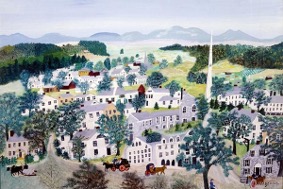
Few artists capture the warmth of Americana more lovingly than Grandma Moses. Born Anna Mary Robertson Moses in rural New York, Grandma Moses did not begin painting seriously until she was in her late seventies. Her works portray snowy farms, quilting bees, harvest festivals, and children skating across frozen ponds.
There is something both immediately recognizable and incredibly comforting in her folksy scenes. They celebrate ordinary life, reminding us that the story of America is not only found in famous speeches or battlefields, but also around kitchen tables, in family traditions, and in the faithful daily labor of families.
For lifelong lead learners, Grandma Moses offers an important lesson: meaningful work can begin at any age. Her paintings encourage children to notice the beauty in the familiar. In contrast to this modern age, her art slows us down long enough to appreciate community, hospitality, and home. Grandma Moses reminds us that a nation’s strength is built not only through grand achievements but also through generations of ordinary people living faithfully together.
Try It: A Grandma Moses-Inspired Community Scene
Supplies: Watercolor or tempera paint, white paper or cardstock, pencil
Instructions:
- Ask your child to sketch a familiar scene from their own life: a neighborhood gathering, a family meal, a seasonal tradition.
- Encourage them to fill the scene the way Moses filled hers, with neighbors, children, and the quiet rhythms of ordinary days.
- Use soft, layered color with a simple horizon line and folk art perspective.
- When the painting is finished, ask: What does this scene say about your family, your home, your community? What will someone understand about your life 250 years from now?
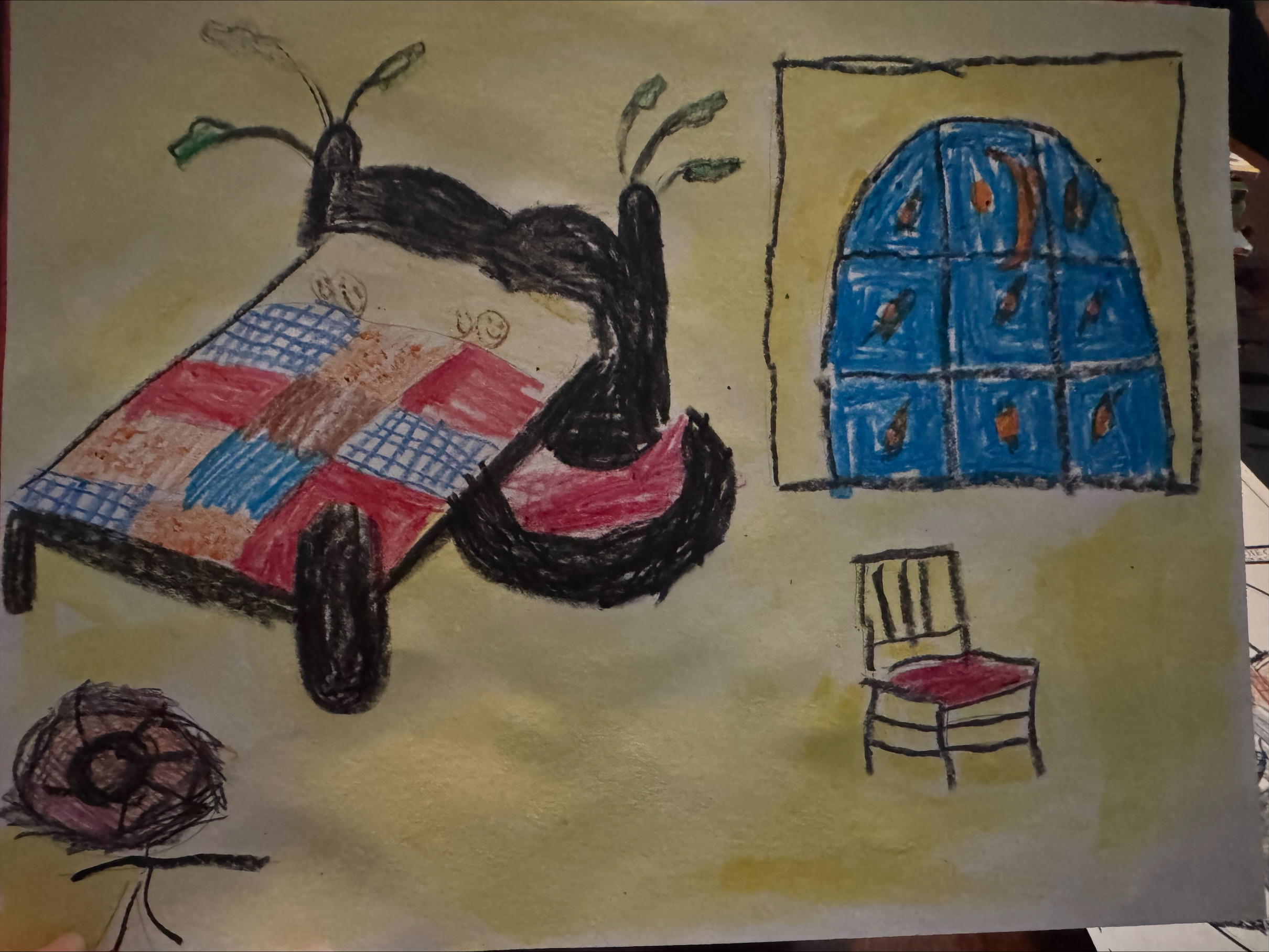
Grandma Moses student art
Discover Classical Education Fine Arts: The Four Essential Elements Explained
Georgia O’Keeffe: Attending to the American Landscape
Photo Credit: Bella Donna, 1939
Georgia O’Keeffe
Oil on canvas, 36 1/4 x 30 1/8 inches
Collection: Georgia O’Keeffe Museum
Extended loan, private collection
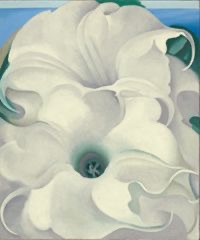
Where Grandma Moses painted the closeness of community, Georgia O’Keeffe painted the vastness of the American landscape. Her still life paintings of flowers, desert bones, and vast vistas of southwestern skies transformed the way many people viewed American art. Rather than imitating European traditions, she developed a distinctly American artistic voice rooted in the open spaces of New Mexico and the bold, yet beautiful forms of nature.
Her paintings teach our children to look carefully and attend deeply. She is quoted as having once said that
‘Most people rush through life too quickly to truly see what is around them.’
Her enlarged flowers and simplified landscapes invite viewers of her artwork to both pause and ponder. In many ways, this habit of careful attending mirrors the practice of the classical model of education itself. Classical learning encourages our children to slow down, notice patterns, ask questions, and wonder at creation before rushing toward conclusions.
Her artwork also reminds us of the extraordinary beauty of the land itself. From purple mountain ranges to quiet desert valleys, the American landscape has shaped America’s imagination from the very beginning. Her art celebrates the grandeur of God’s creation while encouraging children to cultivate attentiveness, a virtue increasingly rare in the modern world.
Try It: A Georgia O’Keeffe-Inspired Close-Up Painting
Supplies: Watercolor paints, white paper, pencil, a single flower or natural object
Instructions:
- Place a flower, leaf, or simple natural object in front of your child.
- Ask them to draw only a portion of it, enlarged so that it fills the entire page.
- Slow them down before they begin: look before you draw. Notice the colors within the colors, the subtle shift from shadow to light.
- Paint using soft, blended watercolors, layering from lightest to darkest.
- When finished, ask: What did you notice when you truly looked? What had you been missing?
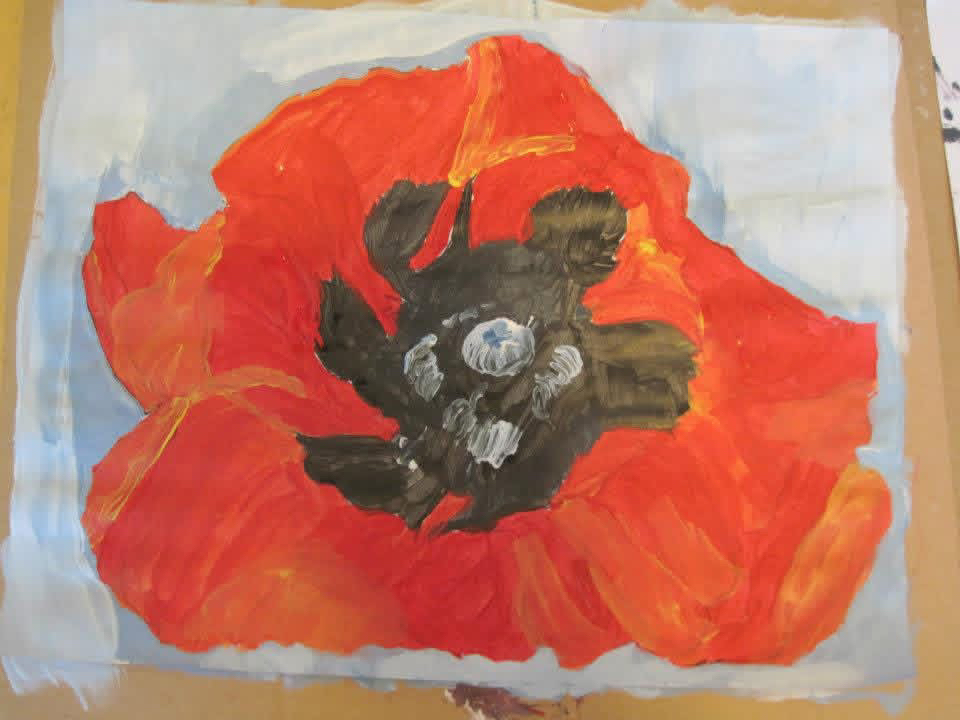
Georgia O’Keeffe student art
Listen to Outside the Museum: Fine Arts at Home on the Everyday Educator podcast
Norman Rockwell: Community, Citizenship, and Everyday Life
Photo credit: Norman Rockwell
Liberty Bell (Celebration), 1976
Cover illustration for American Artist
Oil on canvas
Norman Rockwell Museum Collection, NRM.1988.01
Licensed by the Norman Rockwell Family Agency. All rights reserved.
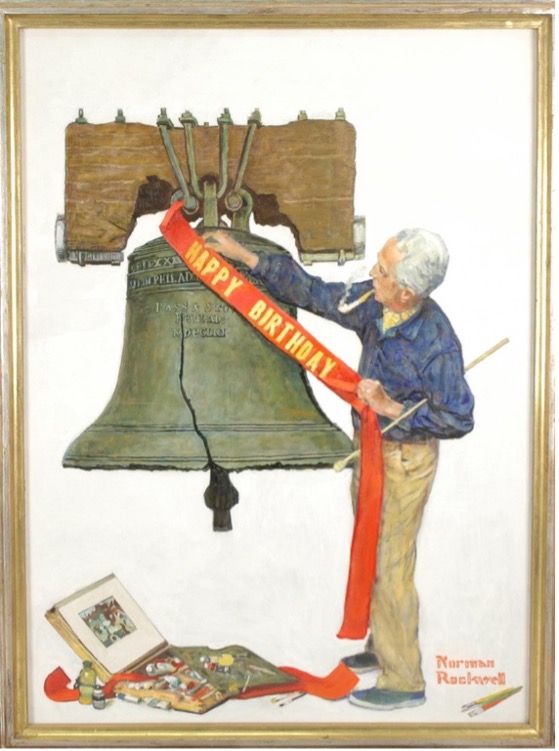
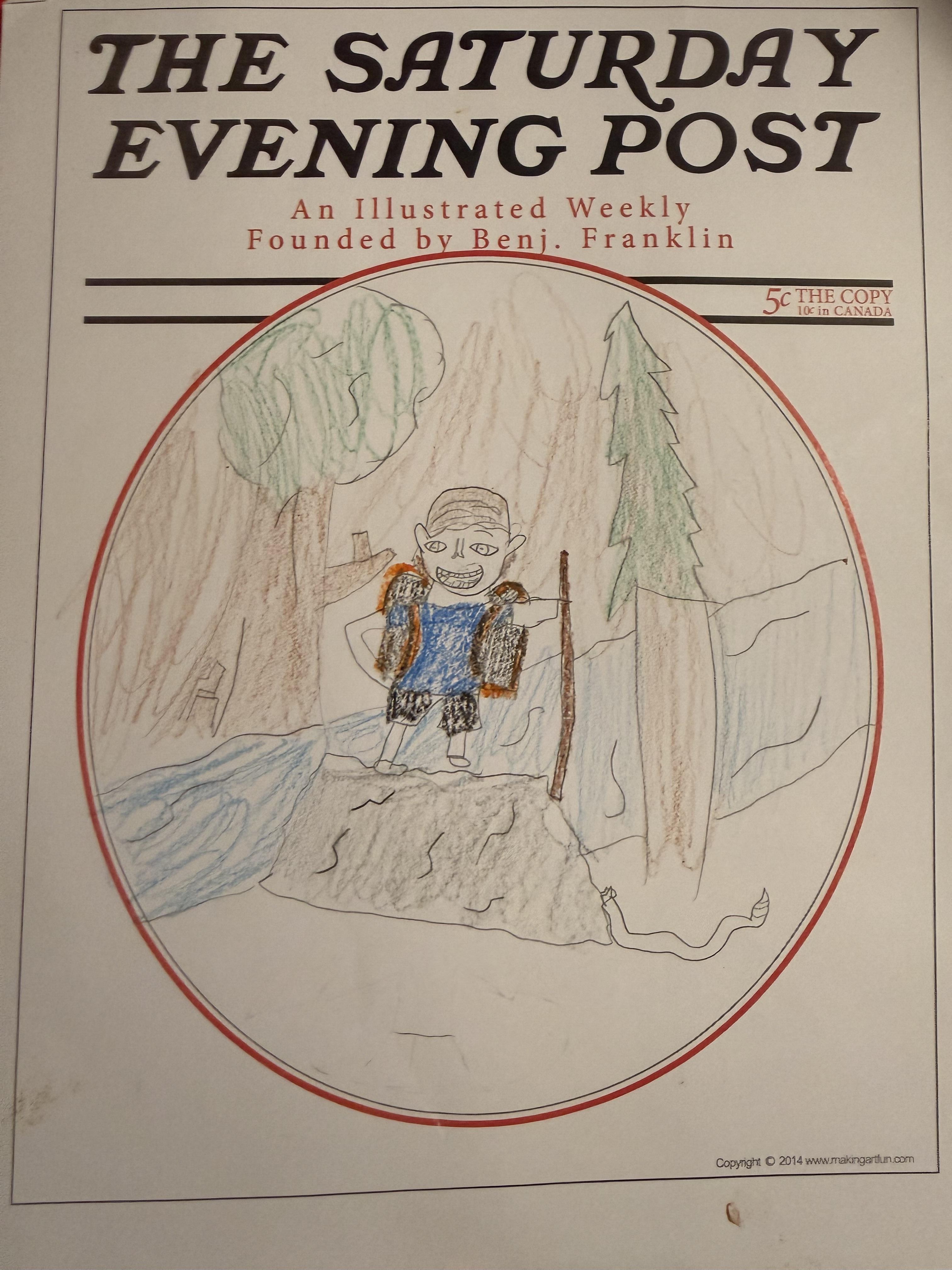
If Georgia O’Keeffe captured the landscape of America, Norman Rockwell captured its people. For decades, his illustrations appeared on magazine covers, portraying barbershops, schoolchildren, soldiers returning home, and families gathered around holiday tables. His paintings often feel nostalgic because they present shared humanity at its most memorable, depicted by moments of kindness, humor, and even sacrifice.
His work was not, however, merely sentimental in nature. Some of his later paintings courageously addressed difficult issues in American society, including civil rights and freedom. This balance is part of what makes his work endure even today. He loved America so deeply that he sought to celebrate its goodness while also acknowledging its need for growth and the cultivation of virtue.
Viewing Rockwell’s paintings often sparks meaningful conversations for families. Children recognize scenes that resemble their everyday lives, such as siblings teasing one another, children learning new skills, and neighbors helping neighbors. His art demonstrates that the everyday moments truly matter. It also provides an opportunity to discuss citizenship, service, and the responsibilities that so necessarily accompany the preservation of freedom.
One of the most powerful elements of Rockwell’s work is that it invites Americans to reflect on the kind of people they hope to become. Strong communities are formed not merely by laws or institutions, but by habits of compassion, honesty, courage, and responsibility practiced in daily life by their citizens.
Try It: A Norman Rockwell-Inspired Everyday Illustration
Supplies: Pencil, paper, colored pencils, or ink pen
Instructions:
- Ask your child to choose a moment from recent family life: a sibling helping with a difficult task, a parent teaching a new skill, a meal shared with a neighbor.
- Ask them to sketch the scene as if it were a magazine cover illustration, paying attention to expression and simple, clear composition.
- Give the piece a title in Rockwell’s style.
- When finished, ask: What moment from your family’s story is worth preserving? What does it say about the kind of people you are becoming?
Norman Rockwell student art
Learn The Beauty of Fine Arts
Roy Lichtenstein: Pop Art and the Practice of Discernment
Photo Credit: Reverie
Roy Lichtenstein
portfolio 11 Pop Artists, Volume II, 1965
color screenprint on paper
Smithsonian American Art Museum, 1966.29.15
© Estate of Roy Lichtenstein

Roy Lichtenstein offers a striking contrast to the other artists mentioned above. Known for his bold, comic-book-inspired paintings, Lichtenstein became one of the leading figures of the Pop Art Movement in the twentieth century. His work explored the growing influence of advertising, media, and mass production in American culture.
At first glance, his bright colors and dotted patterns may seem playful or humorous. Yet his art also asks important questions. What shapes our imagination? How does popular culture influence the way we think and communicate? What happens when entertainment and commercialism begin to dominate the lives of a nation’s citizens?
These are worthwhile questions for our children to ponder. For children growing up in a digital world saturated with images, Lichtenstein’s work offers an opportunity to discuss discernment and wisdom. Classical education seeks not only to fill children’s minds with information and facts, but also to cultivate hearts that exercise wise discernment and sound judgment. Children learn to ask whether something is beautiful, true, and good: not simply whether it is popular.
Try It: A Roy Lichtenstein-Inspired Pop Art Panel
Supplies: White cardstock, black marker, primary-colored markers or tempera paint, a pencil eraser, or a small round sponge
Instructions:
- Ask your child to choose a simple everyday object and draw it in a bold, clear outline on white cardstock.
- Fill sections with solid primary colors.
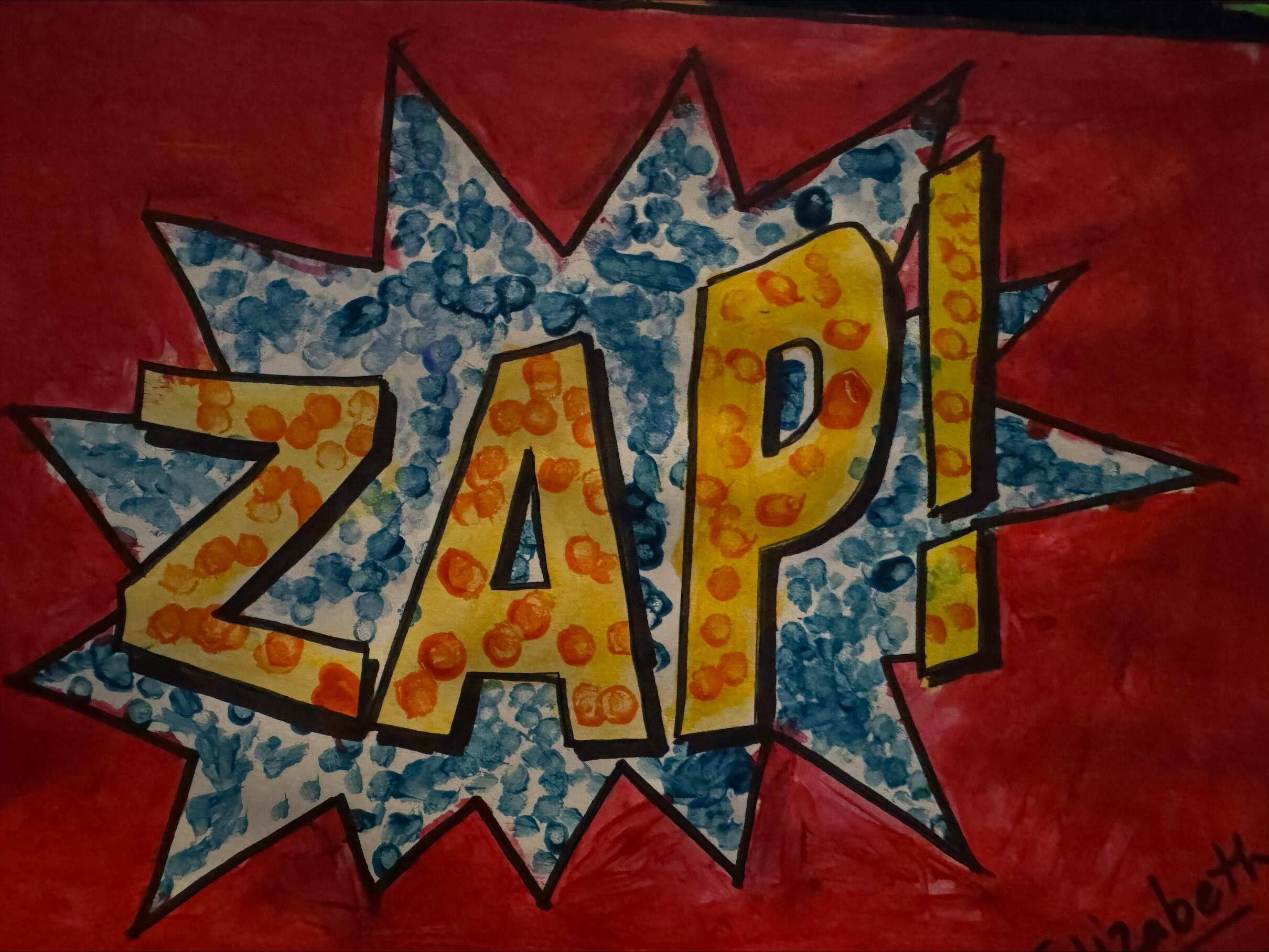
- Then dip a pencil eraser or small sponge in a contrasting color and stamp dot patterns across the open areas of the image, mimicking the Ben-Day dots Lichtenstein made famous.
- Bold black outlines finish the piece.
- When finished, ask: What message does the image send? Would this style work for every subject, or does it change what a thing means?
Roy Lichtenstein student art
Uncover The New Renaissance: Christianity and the Arts
Display Your Work: Ideas for Sharing with Your CC Community
Hands-on art projects for kids carry even more meaning when they are seen and shared. Consider these ideas for celebrating your Cycle 3 American history art projects.
At Community Day: Set aside a wall or table for a class gallery. Label each piece with the artist who inspired it and with one sentence from the student describing what they noticed or learned.
As a 250th Anniversary Display: Arrange all four projects together as a series, with a brief description of each artist’s American story. This makes a meaningful hallway or dining room installation for the anniversary month.
In Your CC Portfolio: Photograph the work and add a short written reflection from your child. This becomes both a memory and a record of growth through the academic year.
As a Gift: Framed student artwork makes a meaningful gift for grandparents or community members. Grandma Moses-inspired scenes and Rockwell-style family illustrations are especially well-suited for this.
Frequently Asked Questions About Homeschool Art Activities and CC Cycle 3
What artists are featured in CC Cycle 3?
Cycle 3 introduces students to American artists as part of its American history memory work. The four artists explored in this article are Grandma Moses, Georgia O’Keeffe, Norman Rockwell, and Roy Lichtenstein. Families should refer to their current Cycle 3 Foundations materials for the full list.
What art projects can we do to celebrate America’s 250th?
Projects inspired by American painters and folk artists are a meaningful way to mark the anniversary. This article pairs each CC Cycle 3 artist with a hands-on activity: a Grandma Moses-inspired folk art scene, a Georgia O’Keeffe close-up painting from nature, a Norman Rockwell everyday life illustration, and a Roy Lichtenstein pop art panel. Each project connects directly to the Cycle 3 memory work and requires only basic supplies.
How does art fit into a classical Christian education?
In classical education, art is part of the Great Conversation. Students encounter the work of history’s great artists to develop aesthetic judgment, creative vocabulary, and the ability to express truth, goodness, and beauty through their own work. In Foundations, the study of art is an invitation to attend and imitate carefully, delighting in beauty.
How do I teach art history to homeschool kids?
Classical education offers a natural framework. Begin with looking: spend time attending and observing a single work before discussing it. Then invite imitation, asking children to create something in the artist’s style. Finally, connect the art to history and culture by asking who made this, when, and why. This attend-imitate-connect pattern is woven throughout the Foundations program.
What are good art activities for American history homeschool units?
The four hands-on projects in this article pair directly with American history study. For broader activities, consider folk art inspired by Colonial-era crafts, silhouette portraits in the style of early American portraiture, or illustrated maps of American physical features. Always connect the art to the historical moment: who lived here, what did they value, and what did they make?
A Nation Worth Remembering
Together, these four artists present a thoughtful artistic conversation about America. Grandma Moses celebrates heritage and home. Georgia O’Keeffe reveals the majesty of the land. Norman Rockwell portrays the heart of community and citizenship. Roy Lichtenstein examines the influence of modern culture and media. Each artist reflects a different aspect of the American experience, and together they help our children see that art is deeply connected to history, culture, and human identity.
The founders of America understood that self-government required virtuous and educated citizens. In Classical Conversations, we continue that vision by helping our children pursue wisdom, cultivate wonder, and recognize beauty. The study of great artists is part of that greater formation. When our children imitate brushstrokes, observe composition, or discuss meaning, they are learning to attend deeply: to art, to history, to their communities, and ultimately to the world that God has made.
America’s 250th anniversary is an opportunity not only to remember the past, but also to consider the future. What stories will the next generation of Americans tell? What virtues will shape the nation in the years ahead? The works of Grandma Moses, Georgia O’Keeffe, Norman Rockwell, and Roy Lichtenstein remind us that art has always helped societies answer such questions. As classical educators, we welcome our children into that great conversation, helping them understand that beauty and truth are worth studying, preserving, and passing on, for generations to come.
Dive into more American-themed activities with these resources:
- America’s 250th Anniversary: Ideas for Homeschool Families
- Cycle 3 Series: Hands-On Science Activities for America’s 250th
- 50 State Recipes for Homeschool: Cycle 3 American History Meals & Activities
- The Best Books for Classical Conversations Cycle 3: A Complete Reading List
Written by: