Every parent wants their child to discover what they are made of. Jennifer Leeds has spent years watching that discovery unfold within Classical Conversations communities, not in moments of ease but in moments of effort. In this article, she introduces the National Number Knockout competition and makes the case for why the hardest thing your student does this academic year might also be the best. Some students surprise everyone. Often, they surprise themselves.
“Nothing ever comes to one, that is worth having, except as a result of hard work.” — Booker T. Washington, Up from Slavery
Most kids don’t seek out hard things. Given the choice, they’ll take the easier path. That’s why what we put in front of them matters.
Something shifts when children are guided to do hard things and to stick with them long enough to become good at them. They stop avoiding hard things. They start believing they can handle them. When that happens, they discover something about themselves that no easy thing could ever teach them. Often, what once felt too hard becomes something they enjoy.
What Is National Number Knockout?
What the Game Looks Like
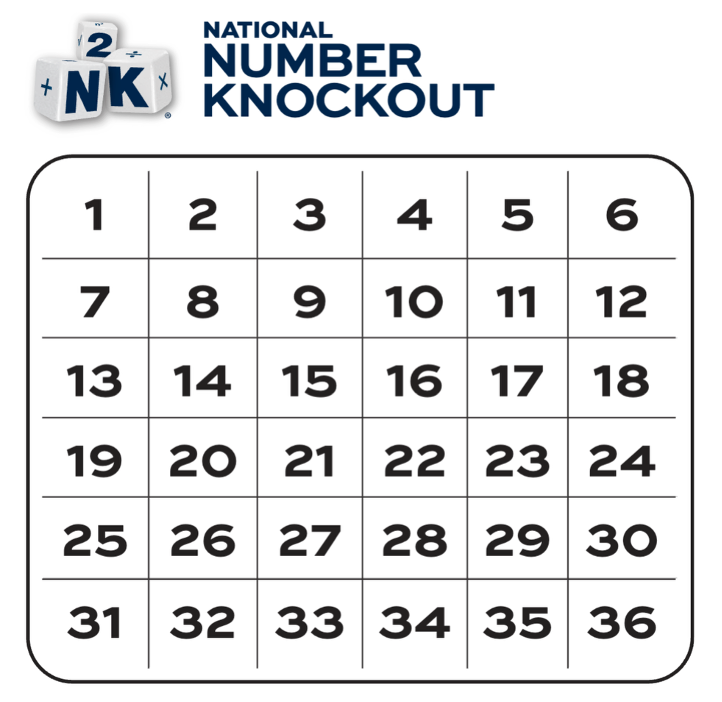
National Number Knockout (N2K) is a Classical Conversations national mental math competition, and exactly the kind of hard thing worth putting in front of them. The game, also known as “board slam” or “number knockout” in local Classical Conversations communities, is deceptively simple: a 6×6 grid of numbers, three dice, and a set time. Players roll the dice and use any combination of math operations, including addition, subtraction, multiplication, division, roots, and exponents, to knock as many numbers off the board as possible before time runs out.
Once the game becomes familiar, it’s deeply satisfying. It’s the kind of game that’s easy to pick up and might end up on your kitchen table just for fun.
But what if the kitchen table is just the beginning of the work? Preparing for the national competition increases the challenge. It requires mastery of multiplication tables, squares, and cubes. It demands speed and accuracy under pressure. It takes a student willing to practice, stumble, practice again, and keep going. The good news is that it is attainable, and the students who commit to that process find out it was worth the work.
Who Can Participate in N2K?
Students ages 11 to 14 enrolled in Essentials, Challenge A, or Challenge B are eligible to compete. The competition is open to homeschool students across the Classical Conversations community, which means your student is already in exactly the right place to get started.
What Hard Things Actually Produce
Think back to some challenge in your own life, one that was deeply satisfying in the end because it was hard and you refused to quit. That experience points to something worth believing: doing hard things produces a love for that hard thing.
N2K is the most concrete proof of that principle. Students who prepare for this competition push past complacency and discover they are capable of more than they thought. They build a memoria of math facts wired deep. They learn they can hold up under pressure. More than that, they develop a genuine love for math.
Past champion Ethan G. described it this way:
“N2K has radically changed my view of mathematics and exponentially inspired my love for mental math.”
N2K was built with a mission to knock out innumeracy by making math feel like something worth loving. This kind of transformation takes effort. It comes from hard work that is practiced consistently, with support, over time.
Why Math Competitions Matter in Classical Education
Classical education has always understood that excellence is formed, not discovered by accident. The trivium arts: grammar, dialectic, and rhetoric, are not shortcuts. They are disciplines. A student who competes in N2K is doing something deeply consistent with this tradition: submitting to a standard, practicing toward mastery, and learning that the mind can be trained.
For many families, N2K becomes a living demonstration of what classical education promises. The competition gives math an audience, a stake, and a story. That combination changes the way students relate to numbers, not as abstract facts to endure, but as something they can actually wield.
Learn How to Get Better at Math: 5 Tips for Parents
How the N2K Competition Works
Each January, a scouting video submission window opens for a brief period. Students film themselves playing on the official board, and judges select 16 finalists from across the country.
Each finalist and one parent are invited to the national championship on a Caribbean cruise in May, with travel support provided. Three rounds of competition determine the champion.
The submission window is short, which means families who want to compete need to start practicing well before January. The Rule Book and a sample classic game board are available to download at Classical Conversations National Number Knockout, along with a how-to-play guide that walks families through the basics and prepares students for competition-level N2K.
How to Prepare Your Student
Preparation for N2K is not complicated, but it is consistent. The students who reach the finalist round have generally done the same things: they learned the board, drilled their math facts until speed became instinct, and practiced under timed conditions.
Work through the how-to-play guide together as a family, then set up regular practice sessions at home. Even ten to fifteen minutes a day builds the kind of fluency the competition requires. Students who treat it like any other classical discipline, returning to it daily, with patience and repetition, tend to be the ones who surprise themselves by January.
Listen to Becoming a Math Person on the Everyday Educator podcast
Frequently Asked Questions About N2K
What is the Classical Conversations N2K competition?
National Number Knockout (N2K) is a national mental math competition hosted by Classical Conversations. Students use three dice and a 6×6 number grid to knock out as many numbers as possible using any combination of math operations within a set time.
Who is eligible to compete in N2K?
Students ages 11 to 14 who are enrolled in Classical Conversations Essentials, Challenge A, or Challenge B programs are eligible to participate in the national competition.
How does a student enter the N2K national competition?
Each January, a scouting video submission window opens. Students film themselves playing on the official N2K board and submit the video for judging. Sixteen finalists are selected from across the country.
What does a finalist receive?
Each of the 16 finalists and one parent are invited to the national championship, held on a Caribbean cruise in May. Travel support is provided.
Where can families find the N2K Rule Book and how-to-play guide?
Both are available for download at classicalconversations.com/national-number-knockout.
How should a student prepare for N2K?
Start with the official Rule Book and Parent How to Play Guide. Build a daily practice habit, drill multiplication tables, squares, and cubes, and practice timed rounds to develop speed and accuracy.
The Student Who Surprises You
Here’s what families who’ve gone through N2K consistently report: it’s not always the student they expected who rises to the challenge.
Sometimes it’s the kid who never loved math. Sometimes it’s the one who was convinced they weren’t “a numbers person.” For students who never connected with math on paper, the game flips a switch. The speed of it, the puzzle of it, the way it turns arithmetic into a competition does what hard things often do: it turns a subject they avoided into one they pursue.
If you have a student in that 11 to 14 window, download the Rule Book, work through the how-to-play guide together, and let them try. Not because it’s easy. That’s exactly why it’s worth it. The students who come out the other side are never quite the same. And that’s a good thing.
Ready to learn more? Visit classicalconversations.com/national-number-knockout for details and key competition dates.
Want to dive into more classical math topics? Check out these resources:
- The Math Map | Classical Conversations Math Curriculum
- Making Math Count (podcast)
- Why Math is Important: A Student’s View
Written by: