
The best homeschooling books for parents are the ones that do more than explain a method. They shape the way you see your calling.
Have you ever left a homeschool conference with a notebook full of titles and a quiet sinking feeling that you will never get through them all? The reading list for a classical Christian educator is gloriously long and perpetually growing. You are also a person with real limitations: a household to run, lessons to prepare, and children who need you present.
The question is not whether you should read. The question is what to read first.
This list of the best homeschool books for parents was built with exactly that question in mind. These ten titles span educational philosophy, daily practice, and personal encouragement. They are organized thematically, not by difficulty, so you can start where your need is greatest. And because no list of ten is ever quite sufficient, you will find at least one alternative suggestion alongside each title. Consider them seeds for a longer journey.
Why Reading Widely Makes You a Better Homeschool Parent
There is a particular kind of confidence that comes not from having all the answers, but from having asked better questions. Reading widely as a homeschool parent does that for you. It gives you language for what you are already doing well, clarity about what to strengthen, and a richer sense of the tradition you are inviting your children into.
Classical educators have always understood that formation precedes instruction. Before you can lead your children well, you need to be growing yourself. The best books for homeschool moms and dads are not extra reading stacked on top of a full life. They are part of the calling itself.
What makes the best homeschool curriculum books different from general parenting reading is the through-line of classical philosophy. The titles below are not a syllabus to complete; they are companions for a long journey. Some will meet you in the weeds of a hard Tuesday. Others will lift your eyes to the larger vision of what you are building. The most rewarding ones will do both.
Start where you are. There is good reading at every point on this list.
Books That Build Your Educational Philosophy
Classical education is not primarily a curriculum. It is a way of seeing: the child, the skills, and the purpose of learning itself. These five titles will deepen your philosophy, expand your vocabulary for what you are doing, and give you a vision worth working toward.
1. The Habits of a Classical Education by Leigh Bortins
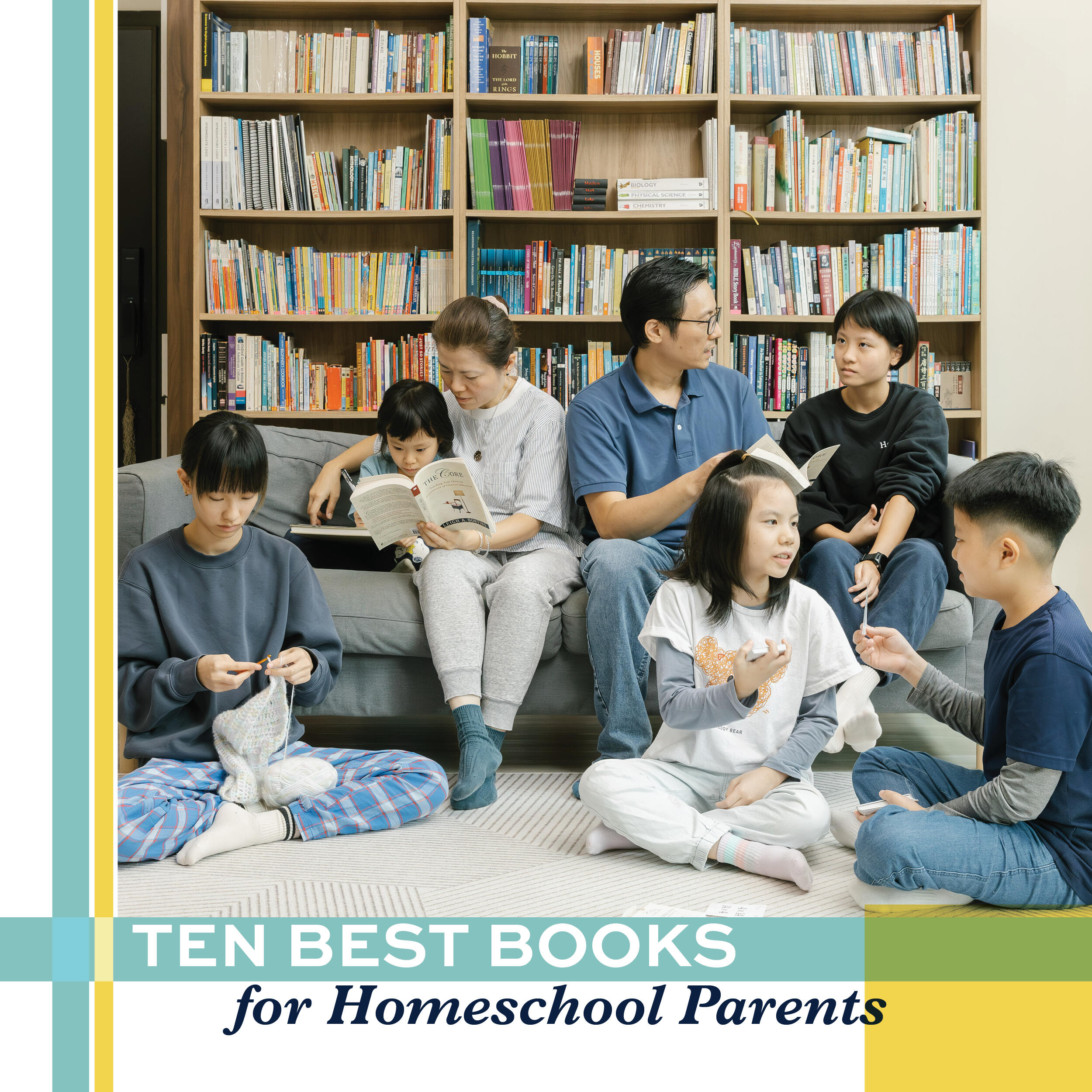
The Habits of a Classical Education: Practicing the Art of Grammar is the most practical entry point into classical homeschooling philosophy available today. An updated and expanded edition of Leigh Bortins’ earlier work, The Core, this book focuses on the five foundational practices that anchor a classical household: Naming, Attending, Memorizing, Expressing, and Storytelling. These are not abstract principles. They are habits, meaning they are formed through daily, intentional repetition over the years of your child’s education.
If you are new to Classical Conversations, this is the first book to read. If you have been homeschooling for years, it is the book to re-read. The clarity it brings to your everyday practice is the kind that deepens rather than diminishes with time.
Also worth reading: Echo in Celebration, also by Leigh Bortins, is a free downloadable introduction to her work and to the history of Classical Conversations. It is a warm, accessible starting point if you want a preview before committing to a longer read.
2. The Question by Leigh Bortins
Where The Habits builds the grammar foundation, The Question moves into the art of dialectic, equipping you to have deeper, more substantive conversations with your students. Bortins introduces five common topic questions as a framework for dialogue, giving you a way to draw out your child’s thinking rather than simply delivering information to them.
The question-centered approach of this book will change the texture of your dinner table conversations, your community day interactions, and the way you read literature with your students. It is a book that quietly expands what you believe a homeschool education can be.
Also worth reading: Dorothy Sayers’ essay “The Lost Tools of Learning” is a brief and foundational introduction to the trivium arts that pairs naturally with Bortins’ work. It is available as a free download at the Classical Conversations Bookstore.
3. The Conversation by Leigh Bortins
The third volume in Bortins’ series addresses the art of rhetoric, where classical education culminates in a student’s ability to synthesize what they have learned and express it with clarity, conviction, and grace. The Conversation is the most challenging and also the most rewarding for parents whose students are in the upper Challenge years.
Reading it gives you a vision for what you are working toward across all the earlier years. It reframes the long work of grammar and dialectic not as preparation for some distant payoff, but as the slow, faithful building of a person who can think, speak, and live well.
Also worth reading: Total Truth: Liberating Christianity from Its Cultural Captivity by Nancy Pearcey is a natural companion to The Conversation, pressing into the deeper question of how a Christian worldview shapes not just what we teach but how we engage every area of life and culture.
4. Words Aptly Spoken: American Documents
A classical Christian education does not only look backward toward Greece and Rome. It also looks inward at the tradition that shaped this nation. One of the quiet losses of modern education is that most of us were never taught to read the founding documents directly. We learned about them. We were given summaries, timelines, and conclusions. But the Founding Fathers were careful, articulate thinkers who chose their words with precision, and there is something that summaries simply cannot give you: the experience of reading the argument itself.
Words Aptly Spoken: American Documents puts those primary sources back in your hands. Speeches, poetry, articles, essays, and legal documents that shaped the United States are gathered here, from the Mayflower Compact and the Declaration of Independence to Patrick Henry’s “Liberty or Death” and the Federalist Papers. Reading them alongside your students builds the kind of historically grounded, thoughtful patriotism that no textbook can manufacture, because it comes from genuine encounter with the words themselves.
Also worth reading: Words Aptly Spoken: American Literature covers the poetry, short stories, sermons, and prose of great American authors, many of whom were shaped by the same founding convictions found in American Documents. The two volumes work together naturally for Challenge I families and reward parents who read them alongside their students.
5. Norms and Nobility by David Hicks
Widely considered the seminal book on classical education, Norms and Nobility is not a quick read. It will ask something of you: patience, attention, and probably a few re-readings of certain passages. It is worth every bit of the effort.
David Hicks offers a rigorous and deeply humane account of what classical education is for: not the transmission of information, but the formation of a person oriented toward truth, goodness, and beauty. His historical, philosophical, and pedagogical scope is broad, and his curriculum suggestions are substantive for both homeschool and traditional school settings.
Read it with a mentor, a book club, or the companion podcast from Classical Conversations. The conversation around it is part of the experience.
Also worth reading: Repairing the Ruins, edited by Douglas Wilson, is a collection of essays from experienced classical educators that covers similar philosophical ground with a more practical bent. It walks through the whys and hows of the trivium, addresses specific disciplines, and makes a clear, accessible case for why classical Christian education matters for this generation.
Books for the Day-to-Day Homeschool Parent
Philosophy sustains your vision. These three books will sustain your practice. They are accessible, immediately applicable, and the kind of books you will return to across many years and many stages.
6. The Copper Lodge Library Echoes Series
Classical education has always understood that the moral imagination is formed before it is argued with. Children who grow up on myths, fables, and legends carry a storehouse of images and patterns that give them language for virtue, folly, courage, and consequence long before they can define those words. That formation happens through repeated encounters with stories worth telling, and as a parent who reads these volumes alongside your children, you are building fluency in the same imaginative world they are inhabiting. You will recognize the story your youngest is retelling at dinner. You will catch the allusion your oldest makes without thinking. That shared vocabulary is not incidental to a classical education. It is one of its most lasting fruits.
Each volume is organized around CC’s three-year Foundations cycle and filled with myths, fables, poems, and legends drawn from across history and geography. Ancient World Echoes pairs with Cycle 1, Old World Echoes with Cycle 2, and New World Echoes with Cycle 3. Start wherever you are in the cycle. Your youngest students will ask for them again and again, and that repetition is the whole point.
Also worth reading: For younger students, the Scribblers at Home curriculum includes a dedicated poetry section that introduces the youngest learners to verse in a gentle, memorable way. For older students, the Copper Lodge Library’s English Epic Poetry traces centuries of poetry that shaped Western thought and theology. Reading this alongside your Challenge II student is its own reward.
7. Honey for a Child’s Heart by Gladys Hunt
First published more than fifty years ago, this book remains one of the most practical resources a homeschool parent can own. Organized by age, it offers annotated lists of the best books for children, with the kind of thoughtful commentary that helps you understand not just what to read, but why.
If you have ever stood in a library aisle wondering what to put in your children’s hands next, Honey for a Child’s Heart answers that question well. Many of its recommendations are available at your local library, and a number of the titles it features have found their way into the curriculum of Classical Conversations over the years.
Also worth reading: The Writing Road to Reading by Romalda Spalding is CC’s primary resource for early literacy instruction, recommended for Scribblers families. Spalding’s method teaches reading, writing, and spelling together through a multisensory, phonics-based approach, so that reading itself is never taught outright.
8. Carry On, Mr. Bowditch by Jean Lee Latham
Some books do for your children what your own words cannot. This is one of them. The story of Nat Bowditch, a self-educated navigator who taught himself mathematics and celestial navigation largely from borrowed books, offers a portrait of intellectual perseverance that is both compelling and convicting. Included in the Challenge A curriculum of Classical Conversations, it is also an excellent family read-aloud.
Reading it alongside your children gives you a shared reference point for those conversations about effort, curiosity, and what it looks like to keep learning when the circumstances are hard.
Also worth reading: Little Britches: Father and I Were Ranchers by Ralph Moody, part of the Challenge B experience, covers similar themes of character formation and resilience. Ralph’s flaws and growth make him particularly relatable for modern young readers.
Books That Feed Your Soul as a Homeschool Parent
Homeschooling is not only an intellectual endeavor. It is a spiritual and relational one. These two titles nourish the person doing the teaching, not just the method.
9. Up From Slavery by Booker T. Washington
In a 1947 essay, Martin Luther King, Jr. wrote that the goal of true education is “intelligence plus character.” Up From Slavery is the living embodiment of that conviction.
Booker T. Washington’s autobiography traces his journey from slavery to the founding of Tuskegee Institute with a moral clarity that is both convicting and quietly inspiring. It is assigned in the Challenge I program of Classical Conversations, but it reads differently when you come to it as a parent. It reorients you toward what education is ultimately for: not the accumulation of knowledge, but the formation of a person.
Also worth reading: Born Again by Chuck Colson and The Hiding Place by Corrie ten Boom are both assigned in the Challenge I and Challenge B programs, and both offer portraits of character formed under pressure. Reading them as a parent, rather than simply alongside your students, is a different and worthwhile experience.
10. Practicing Affirmation by Sam Crabtree
Of all the parent resources in the Classical Conversations catalog, this small book earns the most repeat visits. The longer you homeschool, the more you will find yourself in need of what it offers: a biblical, practical framework for refreshing the people you love with genuine, God-centered affirmation.
It will convict you. It will also change you, and in changing you, change the atmosphere of your home.
Also worth reading: The Peacemaker by Ken Sande is a natural companion, addressing the relational side of homeschool life from a conflict resolution perspective. And if you need permission to simply rest in your calling, Teaching from Rest by Sarah Mackenzie was written for exactly that moment.
Frequently Asked Questions About the Best Homeschool Books
What are the best books for new homeschooling parents?
For beginners, start with The Habits of a Classical Education by Leigh Bortins for classical education foundations, Honey for a Child’s Heart by Gladys Hunt for building your children’s reading list, and Teaching from Rest by Sarah Mackenzie for sustainable encouragement in the day-to-day.
What is the most important book for classical homeschooling parents?
Norms and Nobility by David Hicks is widely considered the seminal work on classical education. For a more accessible starting point, begin with the Leigh Bortins trilogy: The Habits, The Question, and The Conversation.
Are these books only for Christian homeschoolers?
While many of these recommendations reflect a classical, Christian perspective, several titles offer value to any family seeking strong literature and genuine character formation. Honey for a Child’s Heart, the Echoes series, Up From Slavery, and Words Aptly Spoken: American Documents are relevant across a broad range of homeschool philosophies.
What books help with homeschool planning and curriculum?
Honey for a Child’s Heart by Gladys Hunt is ideal for book selection across ages and stages. The Habits of a Classical Education by Leigh Bortins provides both a philosophical and practical framework for classical curriculum planning. The Classical Conversations catalog is also a thoughtfully curated resource for selecting quality curriculum materials throughout the academic year.
What are the best classical education books for parents?
The best classical education books for parents include the Leigh Bortins trilogy (The Habits, The Question, and The Conversation) and Norms and Nobility by David Hicks. Together, they give you a complete picture of what classical education is, how it works, and how to practice its arts in your home.
Where to Begin
There is no reading list that will fully prepare you for the adventure of homeschooling, and that is part of the gift. The best homeschool books for moms and dads are not a curriculum to finish; they are companions for a long, worthwhile journey. Start with one. Read it slowly. Lend it to a friend.
Before any title on this list, though, the Bible remains the first and foundational book for classical Christian education and personal formation. Every other volume here finds its rightful place in the light of Scripture. If you are building a reading life, build it from there outward.
Click HERE to download our free printable of all the best books for homeschool parents.