
In the Beginning Was the Word: Introducing the Common Latin Curriculum
The search for a Latin homeschool curriculum often ends with grammar drills and not much wonder. Jennifer Courtney, Chief Academic Officer of Classical Conversations and a veteran Latin educator, offers a different vision: Latin as a window into Scripture, grammar as a path to theology, and a curriculum designed to gather the whole family around the same text. Common Latin was built for exactly that.
Why Classical Conversations Created a Latin Curriculum for Homeschoolers
Salvēte. When the Common Latin Book Club launches this summer on Wednesday afternoons, every session will begin the same way: Salvēte. Not “hello,” but “be well.” When I greeted my Challenge students each week, “Salvēte, discipuli” was not a casual greeting but words to set the tone for our time in community together. “Be well, disciples.”
That is why Classical Conversations Multimedia has produced the Common Latin resources. Not merely to cultivate students who can conjugate verbs or decline nouns — though they will be able to do both — but to cultivate students who know that language is a gift from God, that the words of Scripture carry weight that rewards a lifetime of careful attention, and that the slow, laborious, deeply rewarding work of learning to read in another tongue is one of the most powerful ways a Classical Christian education can form the soul.
In addition to joining our live Common Latin book clubs, families will have the opportunity to discover how to learn a language this summer at free parent practicums around the world.
Visit ccpracticum.com to find an event near you.
Why Homeschoolers Should Study Latin
In principio erat Verbum, et Verbum erat apud Deum, et Deus erat Verbum. “In the beginning was the Word, and the Word was with God, and the Word was God.” (John 1:1) Words are important. In Classical Conversations, we have often said that there are two ways to know God — through His Word and through His world (with a nod to Francis Bacon). Our culture today has a habit of ignoring grammar and the literal meanings of words. What happens to the people of the Word when we no longer strive to know what the words mean?
Dorothy Sayers wrote in her landmark essay “The Lost Tools of Learning” that modern education had left young people “at the mercy of the printed word.” We had taught them to read, she argued, without teaching them to think about what they were reading.
“They do not know how to ward off words or blunt their edge or fling them back. They are prey to words and their emotions instead of being masters of them and their intellects.” — Dorothy Sayers, The Lost Tools of Learning
That essay was written in 1947. Today, in an era of AI-generated content, social media feeds, and the constant reengineering of language to serve political ends, Sayers’ warning feels more urgent than ever. Her essay points directly to why Classical Conversations has emphasized the importance of the Grammar strand, and of grammar instruction in both English and Latin.
We are a people of the Word. The God of Scripture revealed himself not through images alone but through language. He spoke, and the world came into being. He sent his Son, and John described that Son as the Word made flesh. The meaning of words — their precise, literal, grammatical meaning — is not a pedantic concern. It is a theological one.
This is the vision at the foundation of Common Latin: to develop an understanding of the beauty and complexity of language by translating God’s Word from Latin.
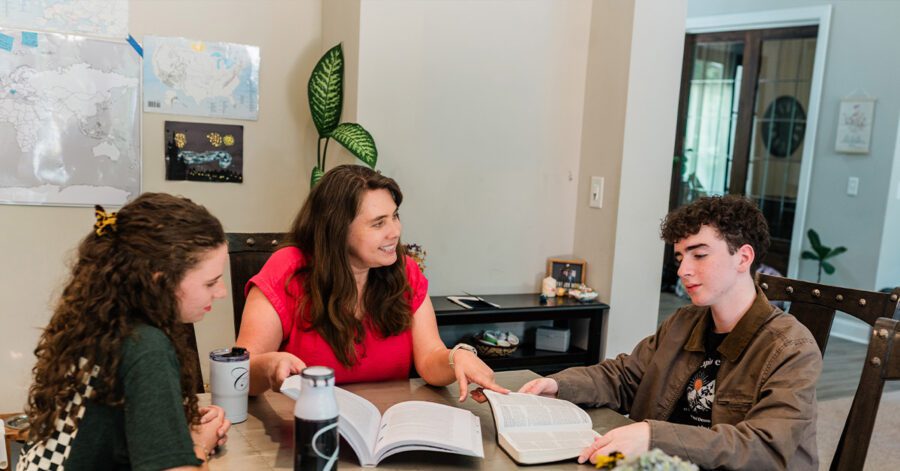
We also want to embrace Latin as it unifies our communities. Our first community is the family. The soon-to-be-released Latin curriculum will allow families to gather around the dining room table together, no matter the number of children or their ages, to read and listen to the Latin Vulgate together, to copy the words, to memorize them, and to translate them.
The next community is our weekly Classical Conversations communities which will be united around using the habits of classical linguists to translate together. Our largest community is the one of worldwide Christian families in CC communities. As it was in the Middle Ages, we will be unified by the Latin language once more as we read and translate the same passages of Scripture.
Discover the Power of Community on the Everyday Educator podcast.
How Common Latin Works: A Classical Approach to Language Learning
From the Whole to the Parts and Back Again
The methodology of Common Latin is to begin with the whole, then examine the parts, and then reassemble them into the whole. This is, after all, how we learn our mother tongue — immersed in sentences, stories, and conversation long before we ever define parts of speech or diagram sentences.
We have designed the soon-to-be-released Common Latin Curriculum to apply that same pattern of learning to Latin. Students begin not with grammar rules in isolation, but with a full chapter of Scripture. They read the entire chapter first as a whole. They attend to the words and patterns that they see. They notice which words that are familiar. They ask questions about what the ones that are unfamiliar. Then, through six carefully structured tasks, they break the passage into parts in order to refine their understanding before returning to the whole chapter with fresh understanding.
Those six tasks will feel familiar to any families who have participated in the Essentials program.
- Read Latin — encounter the whole passage and notice what’s familiar
- Recite rules — build the grammatical foundation through a Latin catechism of 28 weekly recitations of the most common grammar rules
- Memorize vocabulary — practice flashcards the same way a parent reviews Foundations memory work
- Practice forms — copy charts and internalize the patterns of Latin grammar just like the Essentials charts
- Study syntax — learn how the parts work together to produce meaning
- Parse and translate — use the familiar method of Quid et Quo to examine each word individually before putting them back together and returning to the whole
None of these tasks is new to Classical Conversations. What is new is the way they are organized around Latin Scripture — and the theological fruit that grows from that soil.
Learn Why Latin Matters: Connecting Essentials to Challenge in Classical Homeschooling
What Students Discover When They Study Latin at Home
Grammar leads to theology. This is a bold statement that may sound strange to modern ears. Diving into the literal meanings of words and the ways they work together to form claims and arguments leads to Truth.
I have been testing the idea of Common Latin with my students for a number of years now. One group of students, transitioning into the Vulgate for the first time, noticed something in the Gospel of John that they had never seen before. First, they noticed that they were using present participles for the first time ever. Second, they noticed that two present participles kept appearing, over and over:
dicens — saying — and sciens — knowing.
Their previous curriculum had rarely used present participles, because they had been reading Caesar, and Caesar lived in the past. When they noticed the repetition of these two words in the Gospel of John, they decided that these were an excellent description of Jesus’ earthly ministry. They went on to reflect that the present participle is critically important here. Jesus is still dicens (speaking) to us today.
With another group of students, I worked through John 1:1 — In principio erat Verbum, et Verbum erat apud Deum, et Deus erat Verbum — and decided to diagram the sentence the way they had learned in Essentials. When they finished, one student stood back and looked at what they had produced.
“Hey! This doesn’t make sense. The middle clause says the Word was with God. And the last one says the Word was God. How can he be with God and also be God?”
My reply: “Welcome to the beautiful mystery of the Trinity.”
It was a revelation to me as well. We attended to a familiar Scripture in a new language, practiced skills we had acquired many years ago, and then we saw Him with new eyes. These moments are not coincidences. They are the natural result of doing the hard, patient, slow work of translation.
We ended our year by translating Rev. 22:1–5. When we arrived at verse 5, we were gobsmacked.
‘et nox ultra non erit et non egebunt lumine lucernae neque lumine solis quoniam Dominus Deus inluminat illos et regnabunt in saecula saeculorum’
‘And night shall be no more. And they shall not need the light of the lamp, nor the light of the sun, because the Lord God shall enlighten them. And they shall reign for ever and ever.’
As we pieced together the translation on the whiteboard, I asked simple questions. “What kind of a light is a lamp?” The students replied, “A man-made light.” “What kind of a light is the sun?” “A god-made light.” In the end, we will need neither because the presence of God Himself shall enlighten us. Inluminat. He shall be our spiritual light, certainly, but this verse claims that He will be the physical light as well.
The attention to the meaning of the words and sentences is grammar, an art that leads directly to worship.
Classical Education Myth #2: Why Learn Latin? The Truth Behind Classical Education’s “Dead Language”
How to Get Started with Common Latin
Common Latin launches in Challenge A, B, and 1 in the 2027 academic year. The Common Latin Book Club begins in June 2026. Register for a 2026 Parent Practicum at ccpracticum.com. Visit leighbortins.com to join the Common Latin Book Club starting June 3, 2026.
Frequently Asked Questions About Latin Homeschool Curriculum
What is the best Latin curriculum for homeschoolers?
The best fit depends on your child’s age and your family’s approach. Common Latin from Classical Conversations integrates Latin into a classical Christian framework, making it a natural choice for CC families and classical homeschoolers.
What age should children start learning Latin?
Latin can be introduced as early as ages 6–10 through the grammatical skills of memorizing and chanting. Formal language study typically begins around middle school.
Is Latin hard to teach if I never studied it myself?
Common Latin is designed for homeschool parents without a Latin background — the materials guide both teacher and student through each lesson.
Find more Latin resources here:
- 10 Latin Flashcard Games That Make Homeschool Memory Work Fun
- Why Learn Latin? The Top 3 Reasons It’s Worth It
- What If Learning Latin Could Actually Be Fun? (Spoiler: It Is!) (podcast)
Written by: