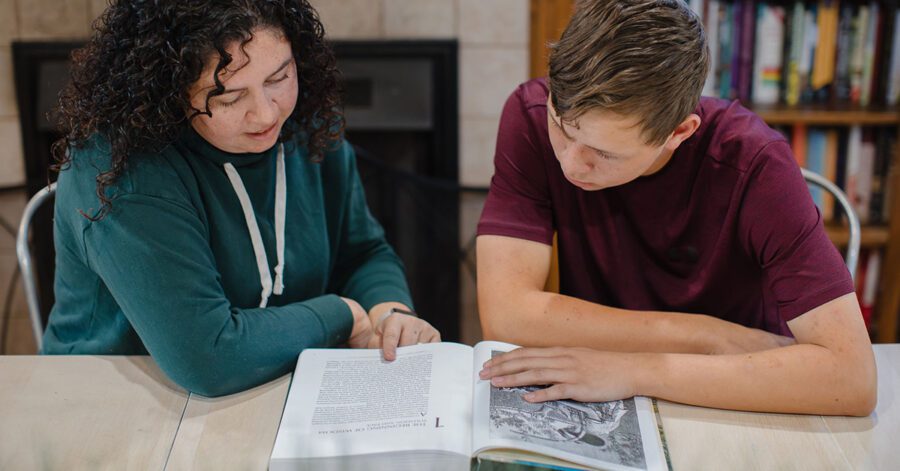
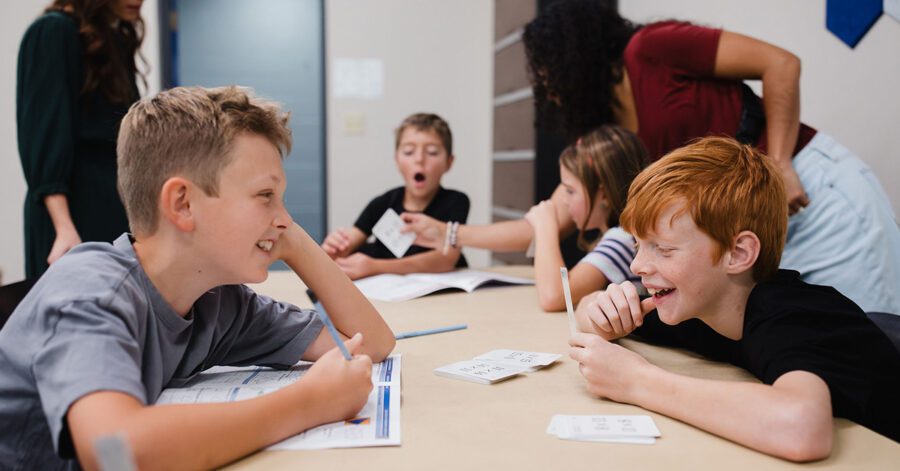
Homeschooling middle school students is absolutely possible, and with the right curriculum, organization strategies, and a few grace-tested hacks, you can navigate these years with confidence. If you’ve been wondering how to keep your middle schooler motivated, which curriculum fits this season, or how to manage a growing workload, you’re asking exactly the right questions. Homeschooling middle school looks different from the early years, but that’s not a sign something is wrong. It’s a sign your student is growing.
The families who thrive in this season aren’t the ones who have it all figured out. They’re the ones who stay curious, stay consistent, and lean into a curriculum and community designed for exactly this stretch of the journey. Classical Conversations has walked alongside thousands of families through the middle school years, and Jennifer Hester, a CC mom, Challenge Director, and Lead of Program Support for Classical Conversations, has walked these roads long enough to know that wisdom is waiting on the other side of the hard seasons. Read on to be encouraged by her advice on homeschooling middle school students.
When the Garden Grows and the Waters Rise
Come with me for a moment.
Let’s step back to those early years of parenting: the days of sippy cups, bedtime battles, and heroic levels of sleep deprivation. Remember how we used to whisper to ourselves, If we can just get through this stage, it will get easier?
Our “once they…” list felt manageable back then.
Once they sleep through the night. Once they’re potty-trained. Once they can read on their own. Once they can sit still for more than fifteen minutes.
Surely, we thought, life would smooth out after that.
Oh, what a tender, hopeful, beautifully naïve season that was.
Why Middle School Homeschooling Feels Different
Somewhere between phonics lessons and first independent chapter books, the ground shifted. Our tiny humans grew opinions. Logic sharpened. Emotions deepened. And in homeschooling, the stakes suddenly feel higher. Middle school doesn’t just knock politely at the door. It moves in, rearranges the furniture, and asks hard questions about algebra, identity, and why we believe what we believe.
For many of us, this is the stage we didn’t quite prepare for. Or did we?
What if middle school isn’t merely a season to endure, but a sacred stretch of the journey where we as parents, and our beautifully awkward, slightly confusing teenagers hovering between piles of laundry and newly acquired hair products, learn not only to survive, but to thrive together under God’s grace?
Be a Gardener, Not a Gatekeeper
In the first year of the Challenge program, students read The Secret Garden by Frances Hodgson Burnett. At the beginning of the story, the garden is locked. Hidden. Protected. Likewise, the main characters, Mary and Colin, were closed off. In this endearing novel, students encounter the theme of opening up rather than closing off, and the incredible benefits of relationship over solidarity. What happened once the garden was opened? It began to grow again.
Not because someone forced it. Not because someone yelled at it. But because someone chose to tend to it with love and gentleness.
Now, if you’re anything like me and have a certified black thumb when it comes to gardening, this metaphor might already make you feel like you’re failing before you’ve begun. While the garden grew with ease in the novel, my own flowerbed lacks such success. Is it the flowers? Is it me? I digress.
Regardless of what your flowerbed looks like, this is a great metaphor for middle school students. In many ways, middle school students are just like a garden. They are unpredictable. Demand a great deal of time. Require a great deal of patience and labor and frequently make you question your own abilities. Don’t worry—stay with me. You don’t have to be a master gardener to nurture something beautiful.
The children in The Secret Garden were not master gardeners. They were faithful.
Like a gardener, our role as parents isn’t to force the growth—it’s to faithfully plant the seeds, clear space for sunlight, and cultivate rich, nourishing soil where roots can grow deep and strong.
Psalm 144 beautifully captures this calling:
“Then our sons in their youth will be like well-nurtured plants, and our daughters will be pillars carved to adorn a palace.”
It’s a reminder that our daily tending—the patience, the grace, the steady care—shapes lives meant to grow strong and stand beautifully. In homeschooling middle school students, we are not meant to guard knowledge or measure who is worthy. We are meant to cultivate curiosity, courage, friendship, and virtue — in ourselves and in our children.
Listen to Why Essentials are So Important on the Everyday Educator podcast
Choosing Your Middle School Homeschool Curriculum
Every garden needs the right soil for the right season. A seedling has different needs than a sapling, and a sapling has different needs than a young tree putting down deep roots. Classical Conversations understands this. The programs designed for the middle school years aren’t generic. They are carefully cultivated for each stage of growth, giving students exactly what they need to take root, stretch upward, and eventually bear fruit. Here’s how the programs align with each stage.
Essentials (Ages 9 to 11 / Grades 4 to 6)
Think of Essentials as the season of first blooms, when students discover the foundational work that makes everything else possible. The Essentials program is where students begin to develop the grammar art of the English language. Students study composition through the Institute for Excellence in Writing alongside formal English grammar using the Essentials of the English Language curriculum. This is the season for building strong writing habits, sharpening editing skills, and developing the language arts that will carry students through the Challenge years and beyond.
Challenge A (Age 12 / Grade 7)
This is the season of first real stretching, when roots that were quietly forming begin to push toward something larger. Challenge A marks a significant transition into a new stage of learning ownership. Students begin to move into more rigorous reading and writing and are introduced to Latin. The reading list includes books like The Secret Garden and Carry On, Mr. Bowditch, chosen deliberately to build virtue, wonder, and reasoning. Good gardeners don’t panic when a plant pushes past its trellis. They celebrate it.
Challenge B (Age 13 / Grade 8)
By Challenge B, the roots are deeper, and the growth is unmistakable, even when it doesn’t look tidy. Challenge B continues to build the skills of learning, pressing students toward independent thinking and written argumentation. Students read Defeating Darwinism by Opening Minds, continue Latin, and expand their writing through formal essays and research. By the end of Challenge B, students have developed the study skills, academic discipline, and reasoning habits that will carry them into the high school Challenge programs and beyond. The faithful tending of these years will show.
Three Ways to Tend the Garden
Using Classical Conversations as the soil, memory work as the seeds, questioning as sunlight, and opportunities for growth as water, your middle schooler can flourish.
- Give your student freedom in how they approach open-ended assignments. In Challenge A, students create a glossary of geographical terms. Let them use the Nature Sketch Journal to draw and define. Maybe it’s beautiful and colorful. Maybe it’s not. Either way, let them have ownership of the final work.
- In Challenge B, students read Defeating Darwinism by Opening Minds and are encouraged to use the highlighting system in the guide. Let them choose the important facts from the text and bring questions to the family for dinnertime discussion. Ownership builds investment.
- As students work to memorize math facts, The Math Map Flashcards are a fun, active way to practice. Get outside. Go for a walk as you flip through cards. Set a timer and stop when it goes off. Your students are still young. They still want to play. Let them.
Learn more with Moving On Up! The Challenge A Program
Be the Lighthouse, Steady Through Any Storm
Strangely enough, troubled waters on a cruise ship rock me right to sleep. As long as the storm isn’t too scary, I kind of enjoy watching the waves on the open sea. One of my favorite parts of cruising is watching the pilot boats lead the giant cruise ship in and out of port. Did you know the pilot boats carry harbor pilots who hop on the ship to navigate the ship through narrow waterways? It’s fascinating that even a cruise boat captain needs assistance. Mark 4 reminds us that God quiets the wind and calms the sea. He’s our own harbor pilot, guiding us through life’s storms!
The idea of guidance isn’t limited to God’s care. It’s a practical lesson in surviving middle school parenting. In Carry On, Mr. Bowditch by Jean Lee Latham, students meet Nat, a mathematician and navigator. Like all mariners of his time, Nat relied on lighthouses as a practical aid. Despite his expertise and improvements in navigation methods, he used lighthouses as he came and went from port.
However, a lighthouse is not the only thing used to help boats come and go safely. What purpose does a lighthouse serve that a tug boat does not? While both a lighthouse and a tug boat provide maritime assistance, they do so differently. How are they different? Why would we want to be a lighthouse for our students rather than a tug boat?
| Lighthouse | Both | Tug Boat |
| A lighthouse has a power beacon visible for miles. | Both have energy to operate. | A tug boat has a strong endive for pushing or towing. |
| A lighthouse is used for long distance guidance. | Both are used to navigate ships. | A tug boat is used for entering or leaving ports. |
| A lighthouse provides visual assistance. | Both support maritime safety. | A tug boat provides physical assistance. |
One of the more practical ways we can shine light for our students is through rhythm. Lighthouses are dependable. Sailors know what to expect. The same is true for middle school students in CC. The weekly rhythm of assignments provides a structure for parents and students that makes the workload manageable. The routine becomes the beacon, offering stability and confidence.
Middle School Homeschool Organization Hacks
Even a steady light doesn’t eliminate waves. The question becomes, how do we actively support our middle school students as they venture onto open water? What does it look like, in everyday homeschool life, to stand firm as the lighthouse while they learn to captain their own ship? Classical Conversations offers resources designed to put that structure directly into your student’s hands.
The Student Planner helps students take ownership of their week, build organizational skills, and develop independence in managing their own workload. Rather than tracking every assignment for them, hand them the planner, walk through how to use it, and let them practice managing the schedule. Consistent use across the academic year builds the habits that high school will require.
The CC Highlighting System Kit brings color and clarity as students learn to synthesize information. Rather than handing your student a system to follow, let them decide what each color means and build annotation habits that are genuinely their own.
Tips for Homeschooling Middle School: Keeping Students Motivated and Building Independence
- Maintain consistency with a weekly routine. Don’t redesign the plan just because it’s hard. Consistency brings security. Students are meant to struggle forward. Let them do that now, while you’re there to guide. Be the lighthouse that helps them adjust their course.
- Provide resources, not rescues. Create checklists, a dedicated workspace, and visual aids so students can find answers themselves. As Matthew 4:19 reminds us, giving a man a fish feeds him for a day; teaching him to fish feeds him for a lifetime.
- Celebrate course corrections. Car rides are perfect for this. No phones, no radio. Ask: What was your biggest challenge today? What can we adjust tomorrow? Help them build the navigation skills to pivot when something doesn’t work.
Find out about Mock Trial: Challenge B’s Capstone Project
Frequently Asked Questions About Homeschooling Middle School
What curriculum should I use for middle school homeschool?
Classical Conversations offers a complete path through the middle school years. Essentials serves students roughly ages 9 to 11 (grades 4 to 6) and focuses on English grammar and the writing arts. Challenge A serves 7th-grade-level students and introduces Socratic discussion, Latin, and formal research. Challenge B serves 8th-grade-level students and continues building dialectic reasoning and writing in preparation for high school.
How do you keep middle schoolers motivated?
Rhythm and ownership are two of the greatest motivators. Give students the Student Planner to manage their own workload, and allow real choices in how they approach assignments. Consistent community also plays a meaningful role. Students who present their work to peers and participate in weekly discussions tend to stay far more invested than those working in isolation.
Is homeschooling middle school hard?
It is a different kind of hard than the early years. The academic load increases, emotions run deeper, and students begin asking bigger questions about faith, identity, and the world. What makes it manageable is structure, community, and a curriculum designed for this season.
How do you organize homeschool for middle school?
Start with a weekly planner that your student manages themselves. Build a consistent daily rhythm, and use your CC community day as the backbone of the week, scheduling independent work around that anchor.
The Garden Is Growing. The Light Is On.
Middle school is a beautiful time to move students towards growth in independence and ownership. If we tug too much, we rob them of growth. If we shine a light for them they build confidence and reasoning skills necessary to navigate rough waters.
And isn’t that the goal?
Not perfectly completed planners.
Not color-coded glossaries worthy of display.
Not even flawless memory recitations.
But young men and women who know how to think, how to wrestle, how to recalibrate, and how to return to the Light when the fog rolls in.
Middle school is not a detour in your homeschool journey. It is not an awkward holding pattern between “sweet little kid” and “capable young adult.” It is formation. It is the stretching of roots. It is the strengthening of beams. It is the slow, steady shaping of souls.
You are not behind.
You are not failing because this stage feels different.
You are doing holy work.
Some days, that holy work looks like a tough discussion around the kitchen table.
Some days it looks like tears over Latin declensions.
Some days it looks like closing the books early and taking a long walk because hearts needed tending more than assignments did.
Growth is rarely loud. Most of the time, it happens underground.
The garden doesn’t bloom because it was rushed.
The ship doesn’t learn to sail because it has always been towed everywhere.
And our children don’t mature because we controlled every current.
They grow because someone stayed.
Because someone tended.
Because someone kept the light on.
So when the questions get harder…
When the opinions get stronger…
When the workload feels heavier and the stakes feel higher…
Remember this: You were equipped for this season, even if you didn’t realize it at the time.
All those years of bedtime stories, character talks, Scripture memory, and patient correction? They were root work. Now you are watching the branches stretch.
Stay the gardener.
Stay the lighthouse.
Stay steady.
And by God’s grace, you don’t have to survive this season. You get to watch something beautiful grow. Keep trusting the One who calms the sea and makes gardens bloom. The harvest is coming.
Looking for more tips on homeschooling? Check out these resources:
- Homeschool Hacks for Elementary: 30+ Ideas to Simplify Your Day
- Top 3 Tips for Starting Challenge with Classical Conversations
- Raising Children of Character: Tips for Homeschool Moms
Written by: