One of the most important milestones of your child’s education is learning how to read. Unfortunately, another increasingly common mile marker seems to be when your child ceases to read—usually immediately upon graduation, when it’s no longer required—replacing reading’s role in leisure and lifelong learning by the attention-grabbing gremlins of our screens.
In the battle of books vs screens, books are fighting an uphill battle against our dopamine-driven addictions. Screens have flashing lights and colors and sounds to grab our attention, and they require nothing from us once they have it—no long attention span, no deep focus, no critical thinking. As much as we may love books, admit it. This is not a fair fight.
If we want our children to be lifelong learners, and if we believe books to be a vital source of that self-education, then it’s a bleak thought to imagine that our children’s literary exploration will end as soon as no one is forcing their hand.
So how do we get kids to love reading—raising bibliophiles that look to the classics for wisdom instead of the internet for entertainment?
Three Steps to Interest Your Child in Reading
Why This Battle for How to Get Kids to Love Reading?
Before I begin, I need to first answer the question of “why this battle?” Parenting already comes with plenty of opportunities for conflict; why should helping kids love reading be where you stand your ground?
Besides the simple fact that literacy is key to participating fully in society, reading provides the added benefits of deep focus, cultural literacy, and empathy.
- Deep focus: because one must give sustained attention to a book to learn from it. The book does not demand our attention the way devices do; we must give our attention, just like we need to give our attention in deep work, prayer, and relationships.
- Cultural literacy: because our Western culture was formed by those who came before, those whose words have been deemed important enough to record but may be forgotten if we neglect to read them.
- Empathy: because reading takes one out of his narrow worldview and gives access to the world outside of himself, both geographically and chronologically.
Learning to Read: A Bibliophile’s First Steps
When teaching your children to read, keep the end in mind. Teaching your children to read is a time to plant deep roots so that their love of reading will be far-reaching and long-standing.
Read aloud—and don’t stop
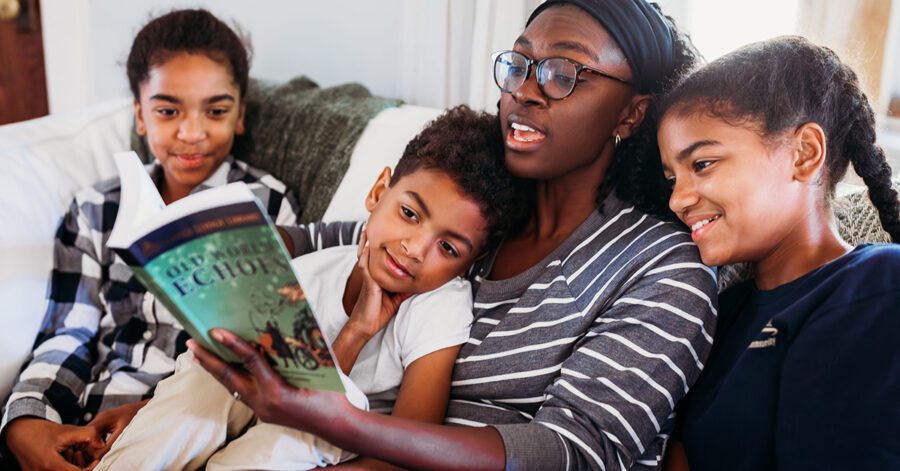
You’ve probably heard about the reading aloud benefits when children are young. But the key is not to stop reading aloud to them! Here are some ways to make family reading time meaningful:
- Take on long chapter books above their reading level to keep it interesting for you. They don’t have to understand all the details to enjoy quality time with Mom and Dad!
- Ask questions to keep them engaged like “What happened last time we read the book?” “What do you think is going to happen next?” “What does this scene smell/sound/taste/feel like?” Have them use all their senses to enter fully into the story.
- If they’re having trouble answering these questions, model it for them. E.g., “Last time, Goldilocks was about to eat the bear’s porridge. I think she is going to split them all out! What do you think she’ll do?” Don’t be afraid to guess the wrong thing; it teaches your young readers it’s okay not to know! Curiosity is the name of the game.
The Magic of Reading Aloud
Balance Reading with Play
If you’re reading before bed, your kids might just want to sleep. Great! But if you’re reading during the day (which I highly encourage), you might have some antsy kids on your hands.
- Keep their hands moving with Play-Doh, Legos, or fidget toys.
- Have them act out the stories! It’s a great way to keep them interested in the story and get their energy out.
- Take breaks when needed. Remember, you’re trying to teach them to love reading, not to resent it.
Books, Books, and More Books
In sight is in mind, and you want books to be constantly on their minds!
- Have bookshelves in all rooms of the house, not just the living room.
- Keep a basket of books by their bedside (and yours!). Bedtime is a great time to build a habit of winding down with books. And if they see you do the same, that means a lot!
- Keep books in the car for long (or even short) trips. If motion sickness is an issue, audiobooks are your best friend to keep the whole family engaged together in the car.
- Give books as gifts to create the association of books with something exciting, not just something for school. And give beautiful books so they come to love not just the content but the physicality of books—the look, the feel, the smell—which cannot be replaced by technology. (Check out our book lists at the end!)
The Deep Connection of Reading
Make a nook
If you build it, they will come—if you make reading a special activity with a special space, they will seek it out.
- Make the space comfy with a blanket nest and lots of pillows.
- Leave enough space for you to join them there! Reading together in that space will make it feel even more special.
- Fill it with books at their reading level so it’s comfortable and accessible.
- But plant some beautiful, harder books there, too, so they have something to look forward to and to strive for! Children are often more capable than we—or they—think. Give them a goal, and they’ll often rise to the challenge.
- Keep it screen-free. This is a sacred space for reading, and in the battle between high-stimulation screens and low-stimulation reading, screens will always win. So don’t let the battle happen!
Homeschool Room Ideas: Practical, Fun, and Focused on Learning
Consider the Reading Level
Meet your readers where they are. Always pushing them will only breed resentment. Remember, we’re cultivating a love of reading here, not just a skill. Plus, children learn at different paces. You don’t need to be stressed by the expectations set by others. As long as they learn eventually, the timeline really doesn’t matter.
- Use Lexiles to find their reading level. A Lexile is a measure assigned to students when they take standardized exams. You can match your child’s Lexile measure to a book’s Lexile measure to find reads right at their level! The Lexile Hub has thousands of books listed by Lexile measure. Note: These books are not vetted, so do your own research before giving them to your kids! The staff at CLT put together our own CLT Book List with beautiful and appropriate classics for 2nd-12th grade reading levels.
- Have “easy reads” to fall back on when your child becomes frustrated. We want to encourage the love of reading, not make it feel like a chore.
- Incentivize your “lazy” readers to read more challenging books by offering to buy them the next books if they start tackling a hard series.
Keeping Them Reading: Charting the Bibliophile’s Course
Teaching your children to read is only half the battle, and in many ways, it’s the easier half. As our kids grow and mature, their interests and loves naturally diverge from ours and become their own. But they aren’t all on their own just yet. It’s still the parents’ responsibility to guide and cultivate this growth towards healthy loves and away from the mindless entertainment that the world offers.
So how do we encourage reading in our teenagers, once we’re no longer the only voice telling them how to spend their work and leisure?
Read aloud—I mean it!
It can be surprising how much of what makes our young ones avid readers stays relevant for keeping our teenagers reading. It doesn’t matter how old they get—the companionship fostered by reading aloud is an evergreen good.
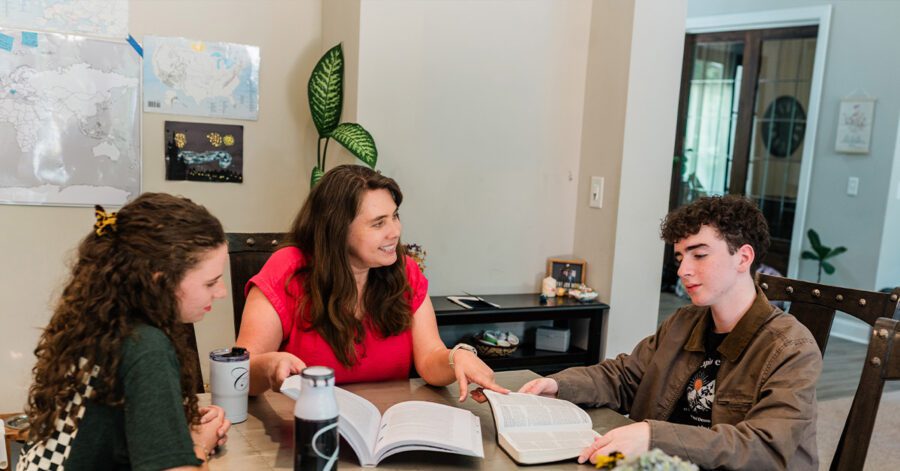
- Get the whole family involved. Your teen may no longer want to sit on your lap while you read The Chronicles of Narnia, but if the whole family comes together to listen, he can get all the satisfaction of hearing the adventures of Reepacheep while maintaining his “coolness.” If other adults are just as engaged as the kiddos, he’ll see that these are stories worth listening to.
- Rotate who reads. It’s still good to read aloud to your teens, but have them take on some of the responsibility, too. Have your teen read aloud to their younger siblings (which has the added benefit of freeing up some of your time) or even to the whole family. Make reading aloud a sign of maturity that your kids can grow into.
- Let them pick the book. As wonderful as Narnia is for all ages, your teen may want to try something new. As long as it’s age-appropriate for all the listeners, encourage your teen to find something they’re interested in and share it with the family.
Everyday Educator podcast: Reading…Together
Make Time for Family Reading, and Make It Special.
Reading has to be more than just another school subject. Work the habit of reading (because it is a habit that you have to build like any other) into your daily lives, far beyond just school assignments.
- Go everywhere with a book. Bring them in the car for long road trips or short errands to the grocery store. Have them in your purse to read while waiting at the dentist. Bring them on walks so in case you run into a friend, your kids can read instead of looking at screens or incessantly tugging on your sleeve.
- Talk about books. You can tell what’s important to someone by what they talk about. If you want reading to be a staple of your family’s culture, you have to set the example. Share a great quote you read at family dinner. Ask your teen what the latest plot update is in her novel. Make book recommendations to your teens based on your interests and theirs.
- Read independently, together. Connection through reading can happen outside of read-aloud time. If you need some quiet time, invite your kids in to read their own books beside you on the couch. Or better yet, if you see your teen reading, ask if you can join, not disturbing her space, but supporting her and joining her as a peer.
- Go on reading dates. You can make anything extra special by adding ice cream. So do that with reading! Bring your books to an ice cream shop, a cafe, a park, or pick out some new book at a bookstore and curl up on the couches to dive in together.
Dig Deeper
- Learn about the authors. Make the books real by learning about the real people that wrote them. Do the authors’ lives sound similar or different from the things they write about? What might that mean for the story? These kinds of questions can reveal otherwise unexplored depths in the books.
- Encourage re-reading. Reading a book is like having a conversation with the author. While friendships may be formed after just one conversation, it wouldn’t be a very good friendship if you left it to just that one conversation. Whether they love a book or are utterly confused by it (and those two things coincide more than you’d think), encourage them to revisit it and become better acquainted with it.
- Practice textual analysis. It may seem over your head, especially if you haven’t formally studied literature, but anyone can practice textual analysis. I can’t dive into a “how-to” here, but there are so many resources for this! Textual analysis is like the algebra of literature—it’s a more advanced skill, but your high schooler can take it on, especially with the help of a tutor, an online class, or even YouTube videos. Many times it’s the challenge of digging deeper than kindles the life-long love of literature.
The Rhythms of Reading: Preschool to Post-School
Be Flexible
Probably the best and worst part about watching your kids grow up is seeing how very different they are from you. Their interests will divert from yours in some very big ways, which is a growing pain, but a necessary one.
- Let them explore genres. While some books are objectively better than others, it is wonderful to let your teens explore their interests in the safety of the home. If there’s a book they want to read that you’re not quite sure about, read it together and have a discussion about the themes and values, what is good and what may be misguided.
- Balance entertainment with content. Just like there are picky eaters, there are picky readers. Sometimes your teen just wants to read “chicken nuggets” books instead of “beef stew” books. While we can battle this out, like for picky eaters, at some point, the priority just becomes making sure they eat! The same goes for reading. You can still introduce and encourage those “beef stew” books using the tips above, and with any luck, your teen will develop a taste for them!
- Fall back on audiobooks. If your child has trouble with sitting and reading—whether it’s dyslexia or ADHD or just simply high energy—work with it! If they would rather listen to an audiobook while climbing a tree, so be it. Being active is good, too, and not every child will be a “blanket and tea” reader.
The Copper Lodge Library Classics-Perfect for Families
Remember the goal: The Bibliophile’s Finish Line
Among all the tips above, don’t lose sight of the goal! You want to raise a bibliophile, someone who loves books and will always return to them for inspiration, education, and leisure. When we’re fostering a love of something, it cannot be forced. The best we can do is to love it ourselves and share that love with our children—it’s up to them to carry that torch into the rest of their lives.
Classic Learning Test exists to reconnect knowledge and virtue through meaningful assessments and connections to seekers of goodness, truth, and beauty.
CC members: Login to your CC Connected account to access 25% off any CLT exam! You can find CC-specific resources on CLT’s CC landing page.
Non-CC members: Be sure to check out CLT’s main website at CLTexam.com.
Need some great Read-Aloud book lists? Here are our favorites!
- 10 Great Read-Alouds for the Homeschool Family
- Our Favorite Read-Alouds for Every Level
- The Best Christmas Read-Alouds for Every Student
- Your Definitive Summer Reading Guide
Written by: