A Challenge-level homeschool schedule moves a family from hands-on instruction toward mentoring, one year at a time, as a parent works toward the goal of every homeschool parent: teaching a child how to learn anything. That shift is something Classical Conversations families can look forward to.
The years spent attending to nature on walks and memorizing new grammar around the kitchen table have built something durable, and in Challenge that foundation begins to bear fruit in a new way. From Challenge A to Challenge IV, a student takes on more of the work of learning, while a parent steps back and steps into the role of mentor and guide.
Family conversation and discussion still anchor the week, and what a parent gives up in daily instruction, a family gains in depth: richer debate and more meaningful discussion as a student grows able to engage ideas alongside the people who raised them. A Challenge-level homeschool schedule looks different by design.
Here is what that schedule can look like, how to balance independent study with your weekly community day, and how to build a rhythm your whole family, from your youngest reader to your oldest Challenge IV student, can live inside.
Why Challenge-Level Scheduling Looks Different from the Elementary Years
A Shift from Instructor to Coach
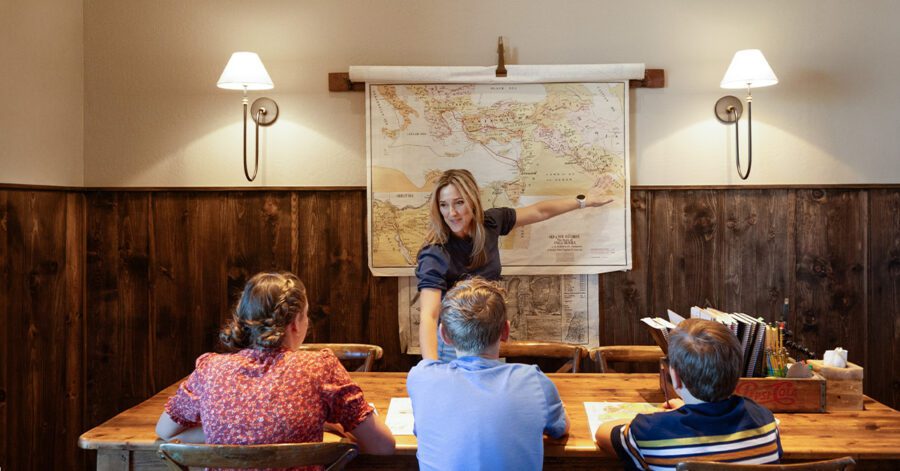
In Foundations, a homeschool schedule usually centers on a parent, moving through memory work subjects side by side with a young student. In Challenge, that same schedule reorganizes itself around the student’s own independent work, with parents shifting from instructor to coach and accountability partner. This is not a loosening of standards.
Challenge students typically invest 20 to 25 hours each week in their studies, and one community day, usually 6 to 7 hours long, anchors 4 additional days of coursework at home across the program’s 6 strands: Logic, Research, Reasoning, Debate, Grammar, and Exposition. Because Challenge I through IV also functions as a complete, college-preparatory homeschool curriculum for high school, a workable schedule matters as much as the coursework itself.
New Skills for Parents, Too
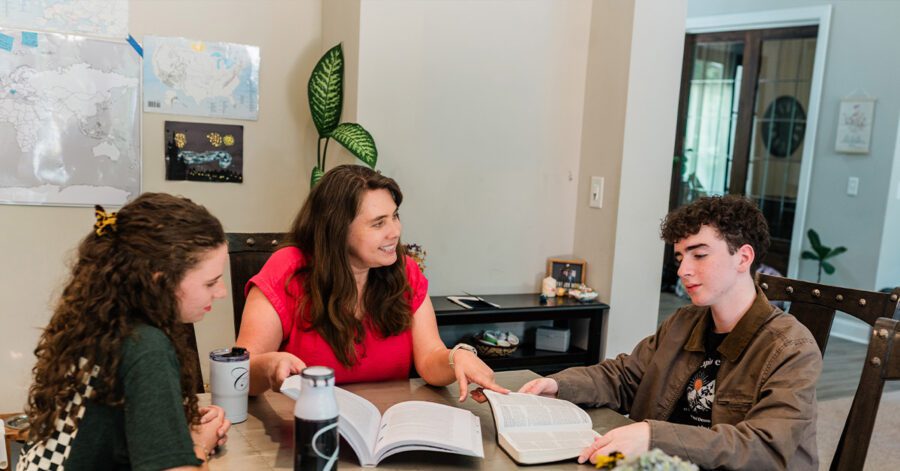
That shift asks something new of parents, too. Rather than teaching every topic firsthand, a parent is training a student to assess a workload, prioritize tasks, and complete assignments with growing independence, skills that carry a student well beyond graduation.
Higher-level Challenge students are capable of doing far more of their own work than they, or their parents, might expect. They will still have questions. They will still need a parent to check completed assignments and provide accountability. But for the bulk of the day, an older Challenge student can and should be working largely on their own, while a parent’s attention shifts toward younger children who are not yet ready to learn independently.
Learn more about the Challenge A program
A Sample Challenge-Level Daily Schedule
A Typical Day at Home
Every family’s rhythm will look a little different, but a sample Challenge-level homeschool schedule at home might include:
- 7:30 to 8:30 a.m.: Family Scripture reading, prayer, and a shared read-aloud or discussion
- 8:30 to 9:00 a.m.: Reviewing the day’s plan together, while younger students begin memory work and older students preview their own assignments
- 9:00 to 11:30 a.m.: Family discussion time with The Math Map and Common Latin. Independent study blocks, during which Challenge students work through research assignments on their own, checking in with questions as needed
- 11:30 a.m. to 12:30 p.m.: Lunch and a shared break
- 12:30 to 3:00 p.m.: Continued independent study, writing, or reading, with a parent circulating to help older students now that the younger students have completed their tasks
- 3:00 to 5:00 p.m.: Electives, music lessons, or other outside activities
- Evening: Dinner together, a brief review of the day, and a look ahead to tomorrow
What Community Day Looks Like
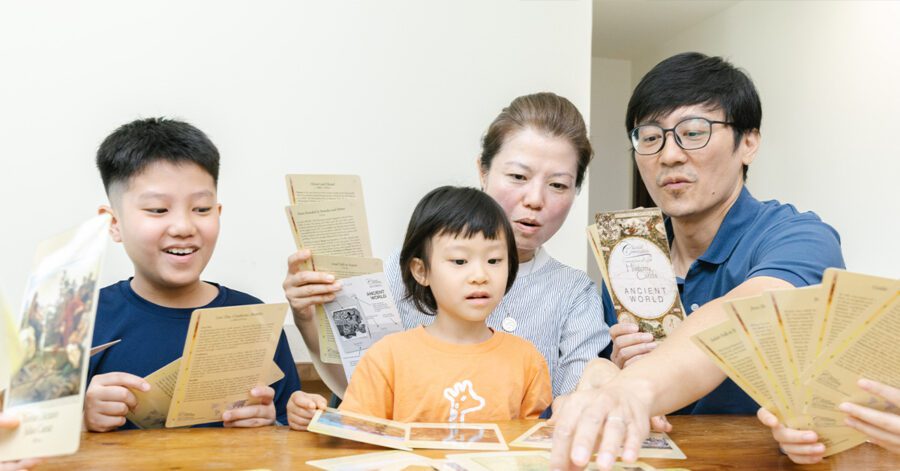
On community day, the rhythm shifts entirely. Parents and young children attend Foundations while older students undertake a seminar of discussion, debate, presentations, and hands-on work alongside their Tutor and classmates, then everyone returns home ready to apply what they practiced to their next set of discussions. Families with several children often find that community day, more than any other day, reveals how well the rest of the week’s rhythm is working.
A student who arrives at seminar unprepared might point to a gap somewhere in the independent study blocks at home, not to a lack of ability. Meeting regularly with your Challenge students throughout the week adds a level of accountability that will enhance their community day conversations.
Read more about the Challenge B program
Balancing Independent Study Time with Community Day
Your Challenge Guide and Tutor as Partners
The heart of a Challenge-level homeschool schedule is the relationship between independent study, parent partnership, and community day. A family’s Challenge Guide lays out the academic year’s six strands, and a student’s Tutor partners with the family to facilitate weekly discussions, model learning, and offer support when the workload feels heavy. Neither one replaces a parent’s role as a student’s primary teacher.
Using CC Connected to Plan the Week
CC Connected, the member’s portal, offers strand-specific notes, video tutorials, and discussion guides that can shape how a family builds the at-home portion of the schedule around each week’s assignments. Many parents find that spending fifteen minutes each weekend previewing the coming week, much like planning meals and assignments for younger students, keeps the independent study blocks focused instead of aimless.
Protecting Rhythm, Not Just Productivity
Balance also means protecting relationship, not just productivity. A homeschool routine is a rhythm, not a rule, and even a Challenge-level schedule benefits from an anchor at the start and close of the day, whether that is Scripture and prayer in the morning or a shared meal and conversation in the evening. Those anchors matter as much for a sixteen-year-old in Challenge III as they did when that same student was reciting memory work in Foundations.
Explore the Challenge I program
When the Schedule Needs Adjusting
Even a well-built Challenge-level homeschool schedule will need adjusting from time to time, and that is not a sign of failure. If a student consistently arrives at community day unprepared, look first at whether the independent study blocks have enough structure, rather than assuming the student needs more hours in the day. If a student moves through assignments with time to spare, that may be an invitation to add depth rather than more work. Keep a pencil handy, and revisit the schedule as often as real life requires. A schedule that flexes to meet a hard week is doing its job well.
Discover more about the Challenge II program
Frequently Asked Questions About Homeschool Schedules
How is a Challenge-level homeschool schedule different from elementary?
It shifts toward more independent study and student-led time management, alongside the weekly community day. We are teaching our children the skills to learn anything on their own.
Should older homeschool students still follow a set schedule?
Yes, though it typically becomes more flexible and student-owned than a young learner’s schedule.
How many hours a week does a Challenge student spend on schoolwork?
Challenge students generally invest 20 to 25 hours a week between at-home coursework and community day, which usually runs 6 to 7 hours.
Learn more about the Challenge III program
Building a Schedule Your Family Can Grow Into
A Challenge-level homeschool schedule is not simply an elementary schedule with more independence added on. It is a different kind of day, built to train a student in the ownership and discipline that will serve them well beyond Challenge IV. Trust the process, lean on your student’s Challenge Tutor and Challenge Guide, and give your student room to grow into the responsibility a Challenge-level schedule invites.