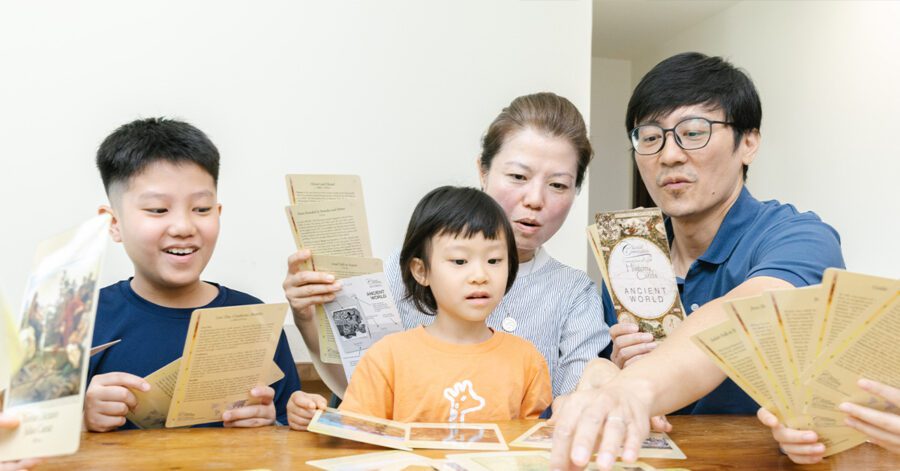

A homeschool schedule works best when it is built from vision to details: start with the academic year, then narrow to the week, then to the day. Jennifer Courtney learned this firsthand as a state manager and Practicum speaker for Classical Conversations, fielding this exact question from parents again and again. Here, she shares the planning rhythm that carried her own family of four through Foundations, Essentials, and Challenge.
Here are some ways that she discovered can make the day-to-day so much easier:
Plan Your Homeschool Year
Start with broad strokes and create a plan for the academic year.
Each summer, my husband would give me a precious gift: he took the children somewhere fun, like the zoo or the science museum, and left me alone in a quiet house to plan for the academic year. During my “planning retreat,” I took advantage of the peace and calm to organize each child’s books and supplies into their file box for the year.
Read: “48 Best Homeschool Field Trip Ideas”
Set Your Homeschool Goals for the Year
I wrote out my goals for each child in three areas: Academic, Spiritual, and Responsibility.
In the academic goals, we listed our ideals for what we would like each child to master that year, such as reading chapter books, mastering the multiplication tables, memorizing Latin vocabulary, and so on.
For their spiritual goals, I listed and prayed about character qualities that need extra attention and training, such as complaining and impatience.
Then, I considered new chores that we wanted them to tackle for the year, such as mopping, laundry, or making lunch.
Later, my husband would review the list, and we would make revisions together.
Also during my retreat, I would also make a list of books and supplies that I had neglected to pick up at the homeschool convention or online.
After I’d cast a vision for the year, I’d get down to the nitty-gritty, planning our weekly schedule based on our goals and expectations and then developing a daily routine.
Read: “How to Prepare for a New Year”
Plan for the Week Ahead
On Sunday evenings, I’d sit down for an hour and plan out our week.
For each child, I’d write out an assignment schedule for the week and, this is very important, plan our meals. I found that if we had a menu planned in advance and purchased the ingredients, we were less likely to panic on an unexpectedly busy day.
Don’t get me wrong: we still ate our share of fast food on those crazy days, but the menu prevented us from caving in every night.
The same was true of our assignment schedule. I found that having everything written down in advance helped me think clearly in the midst of chaos. If I needed to give extra attention to my youngest, my eldest could look at our plan and keep working.
And here’s another helpful tip: I wrote everything in pencil so that I could make adjustments when life happened.
Set Your Homeschool Expectations for the Week
When I originally wrote this article, I was preparing my eleven-year-old to enter the Classical Conversations Challenge program in the fall, so I was especially passionate about him taking more responsibility for his own education.
I carefully considered his activity load each day and outlined his plan of study accordingly. I expected him to work on his assignments independently, coming to me with questions and concerns and checking off completed work.
In math, I expected him to read the lesson and start to work. If I were sitting down to do the same studies with him now, I would use The Math Map to assist me with this training. Each weekly booklet includes reference charts and worked examples, so I would train him to review them before coming to me. Other times, if he needed to, he could check the glossary to look up a math vocabulary term to solve the problem, which further taught him to seek out answers on his own.
My nine-year-old was also being trained to work independently by having her own assignment guide. I expected her to complete some work independently so that I could work intensively with my six-year-old on math, reading, and handwriting and with my two-year-old, who was potty-training.
Often, my older children would assist my six-year-old with her math while I finished folding a load of clothes. My daughters enjoyed quizzing each other on their memory work, and my son enjoyed helping his sister with diagramming sentences and writing papers. My older children enjoyed playing teacher, a job that offered a built-in review of concepts they had already learned.
Plan Like a One-Room Schoolhouse
This is where the vision of the one-room schoolhouse helped me most.
In a one-room schoolhouse, one teacher may oversee any number of students of varying ages, which means the teacher must be especially efficient with her time.
So, I pictured a young sixteen-year-old girl with up to sixty pupils of varying ages and abilities. For her, it was very important to introduce lessons and concepts and then leave the pupils to do the hard work of reading, writing, and calculating. That way, she could better focus her attention on individual students.
Like the sixteen-year-old girl, I would introduce lessons and then remain close to my children, either sitting next to them at the table or in the next room while they completed their work. (Normally, I would choose the room next to our kitchen for school so that I could clean or prepare meals while they were working). If they had questions, I was nearby. If I saw a chance to help develop a concept or model a skill, I was nearby.
In the afternoons, when they were reading independently, I could plan and finish my work, and I always enjoyed them stopping in to tell me about their reading.
Read: “The One-Room Schoolhouse Approach”
Planning for the Day
With fear and trembling, I have included what a typical day looked like for us:
7:30–9:00: Bible reading, read aloud, breakfast
9:00–9:30: Review memory work, including maps
9:30–10:30: Math (We needed quiet, uninterrupted time this year, so my youngest was allowed to watch Sesame Street or Veggie Tales while I got us started. For those who don’t like any TV at this age, try quiet time in the playpen or bedroom. This was usually the only time that she was not right in the room with us or playing close by.)
10:30–11:30: Language Arts (grammar, spelling, and writing)
11:30–12:30: Piano practice and lunch
Afternoon: Reading in science, history, or other interests as well as piano lessons, art class, dance class, book clubs, and tennis
And that’s it! When planning a homeschool schedule, plan for the year, plan for the week, and plan for a typical day. Write down your long-term goals, set down your expectations, and plan like you’re a student yourself running a one-room schoolhouse.
Frequently Asked Questions
How do I make a homeschool schedule that actually works?
A homeschool schedule holds up over time when it starts broad and narrows down: set goals for the academic year first, then plan the week, then the day. Building in that order keeps your daily routine anchored to real goals instead of guesswork, and it leaves room to adjust in pencil when life happens.
Is there a homeschool schedule template I can use?
Rather than a fixed template, approach homeschooling with a flexible framework: write out your yearly academic, spiritual, and responsibility goals, translate them into a weekly assignment and meal plan each Sunday evening, and sketch a simple daily rhythm like the one above. Many families find that framework serves better than a rigid template, since it can flex with each child’s age and season.
What’s a sample daily homeschool schedule?
A sample daily homeschool schedule might include Bible reading and breakfast first thing, memory work review, focused math time, Language Arts, and then piano practice or lunch before an afternoon of reading, electives, and activities. You’ll find a full sample schedule above, drawn from a real day with four children spanning several programs.
How far in advance should I plan my homeschool schedule?
Planning works best in three layers: cast a vision for the whole academic year each summer, refine an assignment and meal plan every Sunday evening, and hold the daily routine loosely enough to adjust as needed. That rhythm of planning, revisiting, and revising keeps a homeschool schedule sustainable all year long.
Watch: Planning a Homeschool Schedule
For more encouragement on building a rhythm that fits your family, watch: Planning a Homeschool Schedule
Here are more resources for your homeschool routines and schedules:
- 5 Keys to Finding a Homeschool Routine
- Morning and Evening: Setting a Rhythm for the Day
- Schedules for Real Life (podcast)
- The Habits of a Classical Education: Practicing the Art of Grammar (book)
Written by: