[L]et us run with perseverance the race marked out for us. Hebrews 12:1 (NIV).
Several weeks ago, my Challenge II students had a Socratic discussion based on the model described in Matt Copeland’s book, Socratic Circles. This article will give you a glimpse into that discussion. But first, let us briefly review Socratic Circles, the Socratic Method, and its important role in classical, Christian education.
A Socratic Circle is a formatted discussion designed by Copeland to help teachers implement Socratic dialogue. Copeland’s goal is to help instructors organize, facilitate, and evaluate group discussions and help students to investigate—to inquire into—the content of whatever they are studying. It encourages students to do this in a civil, enjoyable, and educational way.
I made the following observation in an initial article about this topic, The Power of Questions: Why the Socratic Method?, which appeared in last month’s Director Connector: Not only is questioning a powerful tool for learning the most important lesson humanity can learn—that is, truly recognizing the nature of God and acknowledging His dominion over all of creation—but that the Lord in fact invites Christians to question with Him on our paths to sanctification in Him (Isaiah 1:18). I then suggested that Socratic dialogue is a good method for training students to engage in this important questioning process.
The importance of questioning has clear biblical precedent, but it is also embraced in many books about classical, Christian education. For example, Simmons says the following in his book, Climbing Parnassus (one of the featured resources for our upcoming 2012 Parent Practicums, “Meeting the Challenge”):
[T]he Socratic Method…is a teaching device seeking…to make all knowledge personal by rigorous questioning…The novice is…led through…his assumptions and biases to the clear light of knowledge. The teacher holds him responsible for all words and ideas he utters, pressing him to define them with great exactitude…The pupil isn’t so much taught as guided, first to recognize his own ignorance, and second to spring from this illumination to true knowledge and understanding. Thus does knowledge rise out of ignorance. Thus can knowledge lead to wisdom (Simmons, Tracy Lee. Climbing Parnassus: A New Apologia for Greek and Latin. Wilmington, DE: ISI Books, 2007. pp. 51-52).
Bringing it to a more pragmatic level, the Bluedorns talk about the “dialectic” in their book Teaching the Trivium in this way:
[T]each the skill of reasoning—to critically question, analyze, evaluate, and discern causes, motives, means, purposes, goals, and effects—to investigate… (Bluedorn, Harvey and Laura. Teaching the Trivium. Muscatine, IA: 2001. p. 101).
In his book, Loving God with All Your Mind, Gene Veith sums up not simply what the dialectic, questioning process produces educationally, but why it is in fact a hallmark of Christianity itself:
Because Christianity is so comprehensive and open to paradox, it is very flexible intellectually. This does not mean compromising the absolutes of biblical doctrine. Rather, by accepting those doctrines, it is possible to … make sense of a wide range of ideas, evidence, and experiences…This paradoxical play of the mind, which Christianity encourages, is open to truth wherever it may be found, but it refuses to take one limited perception as absolute. It accepts reason without making limited human reason the judge of all truth…(Veith, Gene Edward, Jr., Loving God with All Your Mind: Thinking as a Christian in the Postmodern World. Wheaton, IL: Crossway Books 1987. p. 141)
The Socratic Method is, therefore, of tremendous value in the classical, Christian model of education, and I have used it often during the last three years as a Challenge tutor. This frequently takes the form of my introducing questions that open the forum for students to begin investigating; all are encouraged to interject their own questions, observations, insights, and conclusions and to connect the material we are studying with other areas of study—or even other areas of personal interest in their lives.
I emphasize to students that it is not enough for them to make assertions, but that they must support their views with evidence (citations from texts, for example). Many students have told me that at first they dreaded the anticipatedquomodo (Latin, meaning “how so?”) question from me—it is my typical response to any claims they might have made. But over time, I have found that I have unleashed the quomodo less and less as students began to understand that they needed to provide a logical and factual justification for any assertion. Their answers do not have to agree with my answers, but if their answers reveal that the students have not really understood the questions, or are inadequately defending their answers, my students have learned to expect that I will (time permitting!) probably continue to question them, holding each student—as Simmons recommends—“responsible for all words and ideas he utters, pressing him to define them with great exactitude.” I also expect the same of myself, and encourage students to actively “catch me out” in error, and to expect me to defend my own assertions with equal accountability.
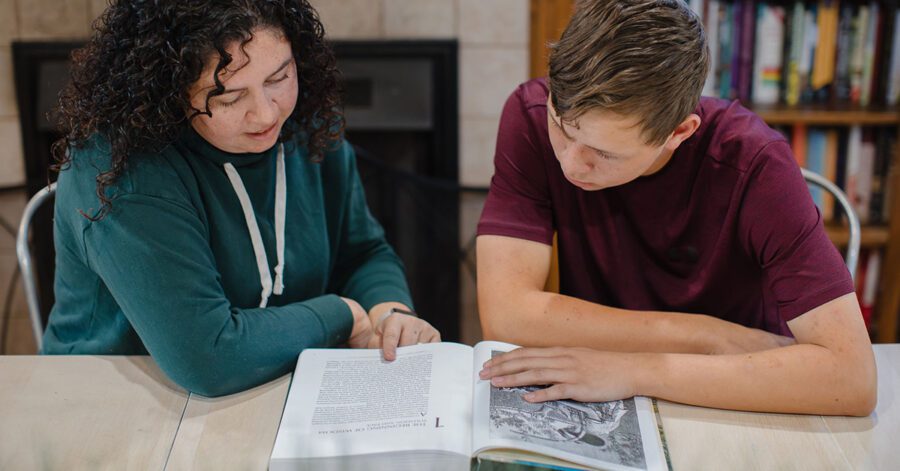
So, although my students were accustomed to the method, sitting down for a strict Socratic Circle as outlined by Copeland was a much more structured activity. Dividing up into the “inner” and “outer” groups added a sense not only of formality, but of gravity. The students had also been given a very specific text to prepare for the circle, Henrik Wergeland’s poem, The Army of Truth (http://www.poets.org/viewmedia.php/prmMID/16538). They had been asked to read it carefully once a day, to annotate it with their notes, questions, and insights, and to come to seminar prepared to share five to ten questions about the poem. They were also particularly encouraged to think about how the poem integrated with Arthur Miller’s Crucible, in which the testimony of words plays such a critical role.
I asked for a volunteer to read the poem in its entirety, and then randomly divided the students into two groups. The outer group sat quietly around the inner group as I asked one of the students to step forward to open the discussion. She began with the question, “What is the power in a poem?” and the conversation took off for about twenty minutes. The discussion focused on several areas. Integrations were made with other texts (such as C.S. Lewis’ The Lion, the Witch and the Wardrobe), biblical connections, man’s denial of the truth, and with how words have been sent to be a light for us but how they can also be used to twist the truth, spread superstition, and incite violence. The group also examined how the truth in words bears fruit in actions. At the end of the discussion, the outer group gave the inner group their feedback about the conversation: The students in the outer group shared which ideas they had appreciated, pointed out how their own understandings of the poem had been deepened through the listening process, and explained how they felt the students in the inner circle had handled differences of opinion and facilitated the conversation.
The students then switched places—the outer circle became the new inner circle and vice versa. Again, a student volunteered to open the discussion with a question. This new inner circle had fresh ideas to share as they built upon the old. They discussed the question of how humanity fit into the poem. They evaluated how the truth could enter men’s hearts through words, thereby preparing men to defend it. The students entertained the possibility of the poem being a dream. They played with the concept that perhaps the serpents surrounding the temple in the poem represented the bastions of modern-day relativism. One student drew the profound conclusion that the role of humanity in the poem was that through words—through Logos—we are transformed into words ourselves, and thus gain immortality, becoming an eternal army pouring out of “Truth’s pure mouth.” After about twenty minutes, the outer group offered their feedback on the ideas discussed and the behaviors of those participating.
I can only begin to scratch the surface of all that was discussed. Both conversations touched on human rebellion, the importance of the Word (John 1:1), the power of words in defense of the truth, and the process of sanctification. In contrast to the power of words of truth, both groups also examined how in The Crucible the words twist and obscure truth, and ultimately cloud judgment and bring about confusion, chaos, and destruction. All the students participated actively in the inner circles, and although differences of opinion did emerge, and some students did not always immediately grasp the points of others or see justification for those points right away, in both conversations they conversed calmly, politely, thoughtfully, and intelligently in pursuit of greater common understanding.
At the close of the Circle, I offered the students my feedback. Several students had led with great strength, facilitating the discussion, guiding it, keeping it on track, and seeking to include every member. Others were just slightly more reticent, and I encouraged them to be more proactive in sharing their views. One or two needed a gentle reminder not to interrupt others, and to focus on the overall work of the group rather than on making their individual points. I also gave each student feedback on ideas I had heard from them which I had not thought of on my own, and for which I appreciated having been given insight. Finally, I asked several closing questions: (1) Had the students enjoyed the conversation? The answer was a resounding “Yes,” with several students avidly requesting that we repeat the experience often. (2) Had the students learned something during the conversations that they had not known before? All said that they had, and some added that they were intrigued by what they had newly discovered. (3) Had the students ever read a poem—or any other text, for that matter—in this manner, seeing so many possibilities and implications? All the students answered that they had not, but were eager to repeat the experience.
I was impressed with the maturity the students demonstrated as they tackled over an hour of sustained listening and discussion without any adult moderation or guidance whatsoever. The depth of their analysis, the insights they offered, and the way they navigated through their differences of opinions and misunderstandings in order to find common ground also made an impression on me. And the fact that they were energized and excited by the discussions gave me assurance that these students are indeed developing the kind of conscience that David Hicks describes in Norms & Nobility, the development of which proceeds from Socratic inquiry and is one of the truly important purposes of education because it aligns with God’s invitation to us to come and reason with Him as we run the race (Hebrews 12:1):
[T]he aim of a classical education [is] the formation of a mature person who loves inquiry…who makes the connection between this knowledge and his responsibility in the life of virtue…Conscience is identified with the whole of knowledge, the totality of truth. It perpetually calls man to account for what he knows: first, by stinging him when he fails to take responsibility for his knowledge and act upon it, and second, by forcing him to weigh his knowledge of himself and of his purposes and to find it inadequate and self-contradictory…Conscience urges upon man the ancient injunction: Know thyself!…Conscience enforces the claims of dialectic on the student, blocking his retreat into…ignorance… Conscience commits the student to truth…, establishing in him the good life, the life of virtue, and urging him to overcome his superficial, selfish, and utilitarian orientation…(Hicks, David V., Norms & Nobility: A Treatise on Education. Lanham, MD: University Press of America, Inc., 1999. pp. 66-69).