
The Classical Conversations Essentials program is a bridge: it carries the memory work built in Foundations toward the Latin language study that begins in Challenge A. Longtime Classical Conversations mom and now as a curriculum developer for Classical Conversations MultiMedia, Kathy Donegia, has spent years mapping that bridge. In this article, she traces how the grammar, writing, and math skills practiced in Essentials prepare students for the Common Latin Curriculum ahead. The scaffolding is already in place. This is how to see it.
Language Starts in the Word
Scripture begins with language. We read in John 1:1, “In the beginning was the Word.” God created through His words, revealed Himself through His Word, and ultimately sent His Son into this world as the living Word. Human language, though imperfect, extends that gift by enabling us to know God, know one another, and cultivate the world that He has created.
In the same sense, studying language is not merely learning rules. It is learning how to build bridges that faithfully carry truth from one person to another. Practicing the art of grammar provides strength. Engaging in the art of dialectic ensures that a bridge can bear weight. Utilizing the art of rhetoric invites others to cross it. And wisdom determines whether the bridge leads people toward what is true, what is good, and what is beautiful.
A well-built bridge is almost invisible; you simply trust it enough to cross. Likewise, well-crafted language allows readers and listeners to focus not on simply the mechanics of communication but instead on the ideas that are being shared. The better we study language, the more faithfully and fervently we can bridge the distance between hearts and minds.
Where Essentials Fits on the Bridge
The Essentials program of Classical Conversations is one of the strongest supports in that bridge. While students strengthen their command of English, they also develop the habits of mind that prepare them for the study of Latin. Long before they encounter complex Latin sentences, they have already begun learning how to learn a language.
Students who have completed both Foundations and Essentials recognize many of the familiar tasks that classical language learners practice every day. In Foundations, they memorize English grammar rules and word lists while joyfully reciting Latin vocabulary, verses, and grammar forms. Those early years establish the habit of storing truth in memory.
The Essentials program builds upon that foundation. Students continue memorizing grammar terms, definitions, and charts while entering the dialectic art of learning. Instead of merely reciting information, they begin to:
- ask questions
- make distinctions
- compare ideas
- and apply grammar principles in increasingly thoughtful ways.
They discover that language is not simply something to remember; it is, in truth, something to understand. The practice of these skills prepares students beautifully for Common Latin.
Read Why Latin Matters: Connecting Essentials to Challenge in Classical Homeschooling
From English Grammar to Latin Grammar
Although Essentials serves as an excellent launching point, the Challenge program extends students’ study of grammar by intentionally exercising the Fifteen Skills of Learning. Three of these skills become especially important for every Latin student: Attending, Memorizing, and Comparison.
Attending
A student learning Latin must first attend carefully to every detail of a word. A single ending may reveal whether a noun is the subject or object of a sentence, or whether a verb describes one person or many. Small details carry significant meaning.
Memorizing
Next comes memorizing. Latin cannot be mastered without storing vocabulary, declensions, conjugations, and grammar charts in one’s long-term memory. The work students practiced in Foundations and Essentials becomes invaluable because they have already learned how to memorize systematically and confidently.
Comparison
Finally, students employ comparison. They continually compare English grammar to Latin grammar, familiar endings to unfamiliar ones, one case to another, or one verb tense to the next. Comparison allows them to recognize patterns instead of memorizing isolated facts. As they parse and translate, they begin seeing language as an interconnected system rather than a collection of disconnected rules.
Understand How to Master the 15 Classical Skills: A Parent’s Guide to the Trivium
Learning Through Successive Tours
One of the most familiar features of Essentials is its three tours through the curriculum. Rather than expecting mastery after a single exposure, students revisit the same concepts year after year. Each pass deepens understanding, strengthens confidence, and increases proficiency in their native language.
Common Latin follows this same philosophy of layered learning.
Instead of three tours as in Essentials, students may journey through up to six tours of the Common Latin Curriculum, each building naturally upon the last. Throughout all tours, students repeatedly encounter the same passages from the Latin Vulgate. Each year, they read and translate more verses, understanding them with greater depth and accuracy than before. By the sixth year, the capstone of the program, students draw together everything they have learned to translate a variety of authentic Latin texts with increasing independence and confidence.
This spiral approach allows students to experience the satisfaction of genuine mastery rather than hurried coverage.
Discover Common Latin: A Homeschool Latin Curriculum Built for the Whole Family
The Familiar Rhythm of Charts
Students entering Common Latin quickly discover another comforting familiarity: as in Essentials, mastering charts remains central to learning.
Just as Essentials students devote time each week to mastering grammar charts, Common Latin students continually practice Latin forms. Every student recites the same Latin catechism, creating a shared body of knowledge across all tours.
Students in the earlier tours concentrate on portions of the noun and verb charts each week, carefully building a foundation one section at a time. As students advance into Tours Four and Five, their focus shifts toward increasingly sophisticated syntax, or how words work together to form ideas. They master all verb forms, study verbals that function as nouns or adjectives, and analyze subordinate clauses while reviewing previously learned charts until the forms become second nature.
Rather than leaving earlier material behind, every new concept rests securely upon what has already been mastered.
Read Classical Education Myth #2: Why Learn Latin? The Truth Behind Classical Education’s “Dead Language”
A Natural Progression
The sequence of learning language itself reflects this gradual growth. Early tours introduce foundational concepts such as noun cases and verb tenses. Later tours expand that knowledge by exploring more advanced structures, including participles, infinitives, gerunds, gerundives, and complex sentence constructions.
In Common Latin, students are never asked to leap across a gap. Instead, each new concept extends a bridge they had already begun building in their studies in Foundations and Essentials.
Here is an example of this natural progression of skills in relation to a noun, defined in English as a person, place, thing, or idea:
- In Foundations, students begin by memorizing the definition of a noun, the Latin noun declension endings, and the cases and roles those nouns perform in sentences.
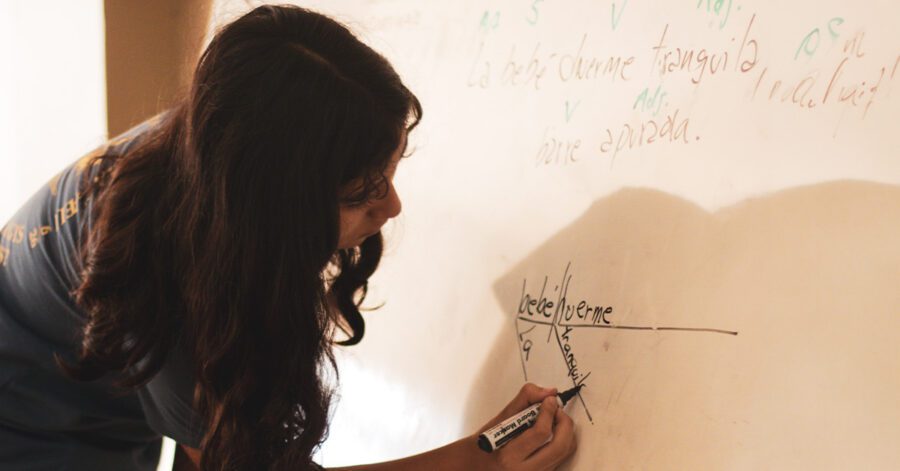
- In Essentials, they deepen this knowledge by attending to the syntax of their native language, identifying and diagramming nouns as subjects, direct objects, indirect objects, objects of prepositions, possessives, predicate nominatives, and other grammatical roles.
- Finally, in Challenge, as students navigate the Common Latin curriculum, they apply these same concepts to a new language, mastering Latin noun declension endings and case uses. By parsing nouns according to their form, function, gender, number, and case, students learn to recognize how grammatical relationships communicate meaning, enabling them to read Latin with even greater precision and understanding.
This example is only one of many present across the three programs of Foundations, Essentials, and Challenge. This carefully ordered progression ensures that each new layer of grammar strengthens the last, cultivating learners who can appreciate and discuss any language with confidence, with accuracy, and with insight.
Enjoy 10 Latin Flashcard Games That Make Homeschool Memory Work Fun
Introducing Common Latin: A First Look at April 2027
Classical Conversations plans to release the Common Latin Curriculum in April 2027 for students in Challenge A. Essentials does not include Latin itself, but it builds the grammar, writing, and mental math skills that make Challenge A’s Latin study approachable rather than overwhelming. Students who have practiced attention, memory, and comparison throughout Essentials arrive at Common Latin already equipped with the habits that Latin study demands.
What Classical Conversations Essentials Families Can Do Now to Prepare
Families do not need to wait to begin preparing for Common Latin. The most valuable preparation is already underway: consistent attention to grammar charts, faithful memory work, and daily practice comparing English structures to new ones. Continuing to nurture these three skills, attending, memorizing, and comparing, will serve students well whenever they open their first Common Latin lesson. As more details about the curriculum become available, families can watch for updates through the Classical Conversations blog and the CC Connected Learning Center.
Frequently Asked Questions: Classical Conversations Essentials
What is the Essentials program in Classical Conversations?
Essentials is a homeschool program for upper-elementary students (ages 9-12) that builds on the memory work from Foundations, strengthening grammar, writing through original sources, and math skills.
How does Foundations memory work prepare students for Latin?
Foundations builds the habit of storing truth in memory through English grammar rules, word lists, and joyful recitation of Latin vocabulary and forms. That early habit of memorization becomes the foundation every Latin student later relies on.
What is the new Common Latin Curriculum?
Common Latin is the Latin course launching in Challenge A from Classical Conversations in April 2027. It extends the same layered, spiral approach already familiar from Essentials, expanding from three tours to as many as six.
When does Common Latin release?
April 2027.
Language as a Lifelong Bridge
When viewed together, Foundations, Essentials, and Common Latin form a beautifully connected pathway. Foundations fills the mind with the building materials of language. Essentials shows students how those materials fit together. Common Latin invites students to walk confidently across the bridge they have been constructing all along.
As students attend carefully, memorize faithfully, compare thoughtfully, and practice consistently, they discover that the study of Latin is about far more than another language. It trains them to think with greater precision, read with greater attentiveness, and communicate truth with greater clarity.
Ultimately, every grammar rule, every chart, every parsed sentence, and every translated verse serves a greater purpose. Language is God’s gift for cultivating communion with Him and with one another. The better we understand language, the better equipped we are to receive truth, proclaim truth, and continue faithfully building bridges that carry His Word into the world.
Learn more about the Essentials program with these helpful resources:
- Master Fourth Grade Spelling and Beyond with Essentials
- Touring CC Connected: “Essentials” You’ll Want For the Trip
- Before You Begin Essentials: Bridge Building (podcast)
- Why is Essentials SO Important (podcast)
3 Reasons to Study Latin (for Normal People, Not Language Geeks)
Written by: