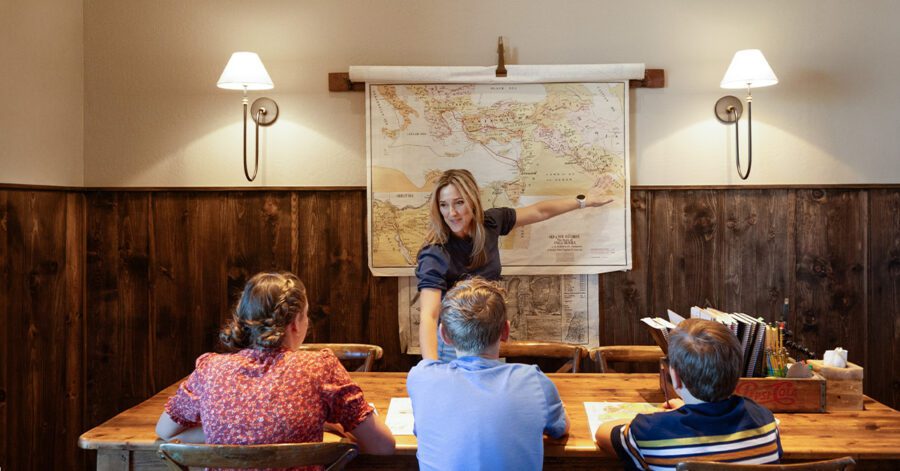
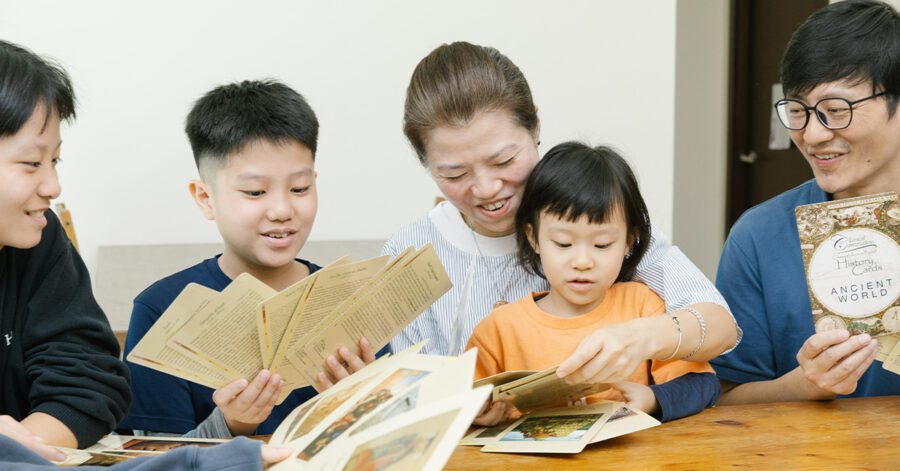
Homeschool history curriculum for elementary students works best when it moves beyond the page and into real life through stories told aloud, timelines drawn by hand, and afternoons spent making things that bring the past forward.
Lisa Bailey has spent more than twenty years as a homeschooling mother, a Classical Conversations curriculum developer, and the host of the Everyday Educator podcast, where she has spent years helping families do exactly that. In this article, she draws on the Five Core Habits of classical education to show how CC Foundations families can bring American history to life right at home during Cycle 3.
The history is rich. The activities are waiting. All that is left is to begin.
“It is a great thing to possess a pageant of history in the background of one’s thoughts… the imagination is warmed. The present becomes enriched for us with the wealth of all that has gone before.” — Charlotte Mason, A Philosophy of Education
Why History Is the Foundation
What a beautiful gift to give our children — a “pageant of history in the background” of their thoughts! This virtual parade of rich, colorful stories becomes the framework children will use to make sense of the world. Without such a framework, the “who, what, where, when, why, and how” facts encountered and memorized might seem like random threads produced without a planned pattern and in jarring colors.
But as we read, listen, think, converse, and explore, stitching the stories together to discover truths revealed, we see the significance of lives lived and lessons learned. History studies can introduce and explain the world while delighting young hearts.
As parents, we have two main endeavors when we take up history studies: to help our children see history as a captivating story of people, places, and happenings, and to build a framework that can grow in complexity of detail as we add to the stories. We want both to delight and to empower!
As we share stories of real people with real struggles and triumphs, we will begin to provide the details that will later lend themselves to questions and comparisons, judgments, and thoughtful considerations. To build a solid future, our children need to have a firm understanding of the past.
Learning at Home and Around the Country
How will we “delight and empower” as we study a homeschool history curriculum with our children? What do we want to learn alongside them? What will best equip them for citizenship in heaven and citizenship in this world? These are the questions that should guide us as we build a culture of learning with our children. As we begin Cycle 3, how might we bring history to life with our families?
What a gift we have this year, as we celebrate 250 years of freedom (the semiquincentennial) in these United States! Our families have some unique chances to delve into the history of the US with folks from across our country. Be sure to start early and search for local, state, and national celebrations of the birth of America.
We should all be active in our study; home-centered education is not “stay home” education! Opportunities for learning on the go abound:
- national parks
- museums
- historic re-enactments
- libraries
These are just a few of the amazing spaces for exploring history in hands-on ways that appeal to kids of all ages. Families can cultivate the habits of wonder and inquisitiveness; awe is a great motivator, and asking questions is a fine catalyst for discovery. Taking a field trip is a simple way to bring history up close.
There are many easy ways to have fun with history right at home, though. A look at a few of the fifteen classical skills might give us some ideas.
Discover homeschool field trips to historical cities such as Boston and Washington, D.C.
The Five Core Habits: A Framework for Learning
Many may be familiar with the Five Core Habits: naming, attending, memorizing, expressing, and storytelling. These practices are “core” because they are central to learning; they are “core” because they provide strength and stability to everything we learn. They are also “core” because they are rooted in relationship.
It takes two to name; attending is more exciting when you can share what you perceive; memorizing is easier with a co-learner; expressing is more satisfying with an audience. Storytelling needs a listener. They are also “core” because these habits are the seeds of all other learning skills!
The Five Core Habits help us build a foundation of knowledge about our world, its past, and its present. When we practice these habits routinely, they become part of how we look at the world. They become our default method of taking in, processing, and sharing what we learn. When our senses are attuned to these habits, we take in so much more of the world around us! We enjoy what we take in more deeply, and we see the “big picture” more readily. These simple habits can make historians of us all.
Uncover how the Five Core Habits establish lifelong learning
Naming: Building a Vocabulary for American History
“…Learning a term or a set of words by which a person, place, thing, activity, or idea is known, addressed, or referred to in order to gather a copious vocabulary.” — Scribblers at Home
Like Adam naming the animals God brought to him, identifying something by name is the first step in knowing that thing. As Adam observed the animals, their features and manners, he named them, and so they became known by all. Their naming allowed them to be identified by anyone and discussed by everyone. The individual names allowed the animals to be differentiated as well as grouped by kind, acknowledging both similarities and differences. When we name things with our children, we make possible conversations that compare and contrast, extend our knowledge, or correct a faulty idea. Naming lets us speak the same language and extend our communal learning.
Put It Into Practice: Naming
So, what could we name as we introduce our children to American history in our homeschool curriculum?
- Begin by naming family members, both those children know and those they don’t. Make a family tree, plot your family’s growth on a timeline, and name the cities where your family lives.
- Interview family members, asking questions about where they’ve been, what they’ve done, and who they’ve met. Name the jobs they have had, the famous landmarks they’ve seen, and the historical events they’ve witnessed.
- Name the countries your ancestors came from, and the capitals and states they’ve lived in.
- Name events like the American Revolution, the American Civil War, the Industrial Revolution, and the World Wars, then find out which of your ancestors played a part in those conflicts. What did the people left at home do?
- Collect stories from family and friends, and weave those into the timeline you are building and learning. You might even plot the books you are reading on your timeline! You are collecting hooks for future knowledge as you build your storehouse of memories.
Hands-On Naming Activities for Cycle 3
Children like hands-on learning, so don’t forgo projects that make all your naming memorable. Here are a few activities to try alongside your CC Cycle 3 memory work:
- Build a famous American landmark — the Grand Canyon, the Statue of Liberty, or the Washington Monument — from clay, cardboard, or building bricks
- Create a newspaper that tells all about a famous American event from your history sentences
- Interview an older neighbor or relative for a short “documentary” on days gone by
- Draw a map of your neighborhood, your town, your state, or the whole country, labeling as you go
- Make a homeschool history timeline wall across a hallway with index cards or sticky notes, adding names and events as you encounter them in Cycle 3
Read 6 Tips for Doing Classical Conversations Foundations with Young Children
Attending: Paying Attention to the World Around You
“…Focusing all our physical and intellectual energies on the details around us in order to cultivate situational awareness.” — Scribblers at Home
Much as the shepherd in Matthew 18 attending to the one lost sheep among the ninety-nine within the fold, we want to teach our children to attend to the details of their world. When we train ourselves to slow down and mark the small details that surround the big picture, we open ourselves up to new delights and discoveries.
Attending is giving attention to what is at hand. In the education of children, attending is often connected to the senses: we pay attention to what we see, hear, smell, touch, and taste. We take in new information about new things — or familiar things — when we use our senses intentionally. How does attending help us explore American history with our children?
Put It Into Practice: Attending
Think about what we do with our children every day. We have a devotion time, reading a Bible passage and praying. We read stories. We copy sentences to practice penmanship. We practice with numbers and shapes. We explore outside. We do chores. We visit family and friends.
- When you read stories or “fact books” with your children, attend to the customs of the characters and the settings of the stories, including the historical time period. What kind of food are they eating? How do they celebrate holidays? Do they have pets? Consider how life has changed in the US in the last 250 years!
- You might explore American history and geography by cooking a recipe from various regions of our country.
- You could make a “fashion book” of the clothing worn from the birth of the US until now!
- You might search out music prevalent in the US in different time periods, or try a sport or dance from another era. You might even ask, “What else was going on in the world when _____ was happening?” Almost any story is a springboard to more exploration when a curious learner gets interested.
- When we explore outside or visit a park or museum, we attend to the sights, sounds, and smells we encounter. Could you visit a cemetery and talk about what life was like for people who lived long ago?
- Could you visit a historical re-enactment and see, hear, and smell what life was like in Colonial times, or on a battlefield?
Remember that children learn best by doing, and their imaginations are stoked by interesting experiences.
Hands-On Attending Activities for Cycle 3
- Learn to make bricks the colonial way, use a quill pen, or make paper from fiber
- Churn butter, dye cloth with stains made from vegetables, or make simple instruments by hand
- Create a “fashion book” with drawings or printed images of American clothing from the 1700s to today
- Listen to music from different periods of American history and talk about how it changed
Enjoy the best book for Classical Conversations Cycle 3: A Complete Reading List
Memorizing: Building a Library of the Mind
“…Retaining, categorizing, and connecting knowledge in order to build a library of the mind.” — Scribblers at Home
Memorizing details preserves them for later use. When the Psalmist “hid God’s word in his heart,” it was so that the precepts of his Lord would keep him from sin; it was going to be useful to him (Psalm 119:11). When we give our children excellent content to memorize, we are equipping them with the knowledge they need to categorize and connect the pieces of the world.
This connection goes even further, as our children connect God’s world to His character and traits. It draws them to Him as they see His love and provision. As what our children know and remember about the world grows, their awe for, and worship of, Creator God grows also.
Children have an easy time with memorization; parents, you may need to exert effort to keep up! Lots of tips for memorizing make a challenging task fun; children love to play, and memorizing can be a game for homeschool history curriculum.
Put It Into Practice: Memorizing
- Practice your memory work by putting it to music and singing your timeline.
- March to your timeline and your history sentences, or add hand motions to help you remember — the sillier the better!
- Draw pictures to help you remember your facts, or look at photos that represent historical events.
Talk about your memories with your children, and encourage them to ask older relatives about their lives as children and young adults.
- Look for scrapbooks, journals, and records.
- Ask for stories at family reunions, weddings, and birthday parties.
- Ask about special family heirlooms or family traditions: where did they come from, and why are they special?
- Record the old stories from family members, and record how they made you feel.
- Memorize the names and deeds of American explorers, scientists, and artists.
- Study the lives and times of people from American history. How are they different? How are they like you?
Hands-On Memorizing Activities for Cycle 3:
- Practice the CC Timeline song at home — sing it in the car, at meals, or during morning time to keep it fresh between community days
- Act out timeline events with silly motions that your family invents together
- Make a set of illustrated flashcards for Cycle 3 history sentences — one drawing per sentence
- Build a “memory box” with small objects or drawings representing each event on the timeline
- Interview a grandparent or elder in your community and record their story on video or in a journal
Memorize to make connections, to learn from the past, and to appreciate the past.
Learn more about Foundations Memory Work and how to review
Expressing: Demonstrating Knowledge Through Creative Output
“…Demonstrating knowledge through various physical forms such as reciting, drawing, dancing, and singing in order to communicate creatively.” — Scribblers at Home
God has made us in His image, giving us both the ability and desire to create. Expressing allows us to demonstrate what we know in all the ways that seem best for us and our audiences; expressing is communication beyond words.
Like David, who was moved to dance and shout as he celebrated before Israel and before the Lord, we can share the exuberance of our discoveries as we learn. We can choose the mode of expression that suits our creative spirit, the time and situation in which we share, and the audience who will receive our message.
The Gift of Creative Expression
Is anyone as joyfully expressive as a child who loves something? When our children fall in love with learning, and when they truly enjoy what they are discovering, they can’t help but share. Their bright minds, active bodies, and eager spirits move them to dance, sing, draw, sculpt, march, and chant. A parent’s job is to introduce them to the world in stimulating ways, and to provide materials that can be used to express the new information.
Expressing what is learned in different ways helps children hold on to their knowledge by creating new pathways in the brain. Art, music, and movement carve unique neural pathways, giving minds multiple ways to access and retrieve information. Expressing also allows children to use their passions and proclivities to celebrate what they’re learning.
How delightful for a child who loves to draw to be able to practice the timeline by drawing the events and people on it. How satisfying for a loving parent to see a child being who God made her to be as she expresses in her own language what she has learned.
Put It Into Practice: Expressing
As you look for ways to express what you are learning together, consider how you can use your senses to echo what you’ve been exploring together. Here are some ideas organized by sense:
Hands-On Expressing Activities for Cycle 3
What might you create that would be a feast for the eyes?
- A poster of American milestones, of famous American leaders, or of American flags through the years
- A costume that turns you into a famous person from history
- A replica of a life-changing invention
- A copy of a painting from American history events
- A hand-drawn map of your country
What might you create that would tickle your ears?
- A song that puts a history sentence to music
- A tin whistle tune like one from the “old days”
- A clapping or stomping rhythm to accompany your timeline rendition
- A chant of the presidents in order — maybe in a funny accent
More Ways to Express What You Are Learning
What might you create that would appeal to your sense of smell or taste?
- A savory dish from a region of the country you’ve visited — or want to visit!
- A herb garden with herbs that grow across different regions of the country
- A pastry tasting with offerings from different time periods
- A taste test of milk from various sources
What might you create that you could touch or feel?
- A display of wool, from sheep shearing to cloth
- Lace or other decorative ornamentation from period clothing
- A collection of tools from historical eras
- Products made in different parts of the country
What might you create that would draw from your memories?
- A newspaper set in a rich historical time period, complete with pictures and stories
- A journal of stories from your grandparents
- A travelogue of famous American landmarks you’ve studied or visited
- A recitation of your timeline with dramatic presentation
What could you do or create by moving?
- A dance to music from Americans throughout our history
- A game played in another era
- A clapping or tossing game to review CC memory work
- A listening time to enjoy music from different eras of American history
Try Cycle 3 Recipes from all 50 states
Storytelling: Narrating the Past to Understand the Present
“…Narrating a spoken or written account in order to share common experiences.” — Scribblers at Home
Jesus was the master storyteller, and the lessons he taught through his stories were profoundly effective. He knew how to capture the attention of his audience and how to keep them listening. The point of a story often dawned on his hearers suddenly, meeting them where they lived, revealing Truth. Bible stories in both the Old and New Testaments introduce us to people, places, and situations from Bible times; they also reveal our own natures, offering cautionary tales from poorly made choices as well as inspirational accounts of godly men and women for us to emulate.
Stories give us the opportunity to judge decisions and consequences objectively. Living through story characters, we can see the results of choices without having to live with the real consequences; we learn from others’ mistakes, discovering how to interact with the world more wisely.
Sharing stories can plant seeds that bring conviction or inspiration, or impart lessons we glean through the experiences of others. Telling and reading stories can provide winsome ways to begin cultivating virtue in your child; a story with a brave hero inspires courage. A resourceful heroine teaches resilient, out-of-the-box thinking. Stories also increase the moral imagination. When we live vicariously within the tales we read and hear, we learn to empathize with the struggles of others.
Stories That Reveal Truth
As Jesus showed, the best stories reveal truth to the listeners. A well-told story draws listeners in, appealing to hearts and imaginations. When we listen to stories, we immerse ourselves in other times, other worlds. We go places we’ve never been and may never visit physically. We get to know people from long ago and far away, and discover how different they are from us — and how similar!
As we’ve stated already, the best way to begin a study for homeschool history curriculum is to read and tell stories that draw children in, introducing them to people, facts, and ideas along the way. Stories about famous men and women, stories about people in our neighborhoods, stories about the world’s beginnings, stories about strange and distant lands — all these appeal to children’s curiosity about the world. How can you practice the habit of storytelling as you and your child explore American history and geography?
Put It Into Practice: Storytelling
- Begin with short stories of people you encounter in your everyday life: doctors, store owners, librarians, pastors, farmers, grandparents. What do these people do now? Who did these jobs in the past? How are those jobs done differently? Does anyone you know well have that job?
- Then, choose some “famous” people you are studying and read short biographies.
- Choose some people from the literature you read and from the timeline you create. Children love to meet the people of their timeline in their reading.
- Be sure you choose various types of literature: fiction, non-fiction, poetry, songs and ballads. You want to acquaint your children with all types of stories, poems, and songs, developing their ear as you introduce them to well-told stories. They will learn to recognize the parts that make up good stories, and when they are ready to tell their own stories, they will imitate what you’ve shared.
- One way to add storytelling to your study of American history is to have your child re-tell or act out an event you’ve studied together. They can narrate the event, embellish and add some “artistic license” details, or even write the story as a newspaper article to be shared.
Hands-On Storytelling Activities for Cycle 3
Children are natural-born storytellers. They will turn everything that happens to them into a “story” to be shared with anyone who will listen! Value these stories, and encourage them also to re-tell the stories you uncover together. This re-telling is called “narration,” and is the first step in learning to create stories of their own. Many children enjoy telling and re-telling stories as a way to think about them again; it is a processing tool for new information. It is a way to make sense of a new experience or new idea.
Stories will grow the knowledge of places and augment current events in later years. Children should hear about the economics, climate, trade, politics, and culture of the places they study. They will begin to build a “full picture” of the places they’ve been — even if only in their minds!
- Have your child narrate a Cycle 3 history sentence in their own words, then illustrate it
- Read aloud a biography of an American figure from your timeline, then act out a scene together
- Write a short “newspaper article” set during a historical event you’ve been studying
- Create a family oral history project: record relatives telling stories about their lives and your family’s history in America
- Stage a “living history” dinner where each family member comes as a character from American history
Discover the Power of Storytelling
Frequently Asked Questions About Hands-On History in CC Cycle 3
What history does Classical Conversations Cycle 3 cover?
CC Cycle 3 focuses on American history and geography, spanning from early exploration and colonial settlement through the modern era. Foundations students encounter history through weekly memory sentences, timeline cards, and geography work that together build a framework for understanding the American story.
What are good hands-on history activities for elementary-aged kids?
The best hands-on history activities for elementary students engage the senses and connect to what children are already memorizing. Making timelines, cooking regional recipes, acting out historical events, building landmarks, and listening to period music all give children physical and imaginative anchors for the facts they are learning. The Five Core Habits — naming, attending, memorizing, expressing, and storytelling — provide a natural structure for choosing activities that go beyond the page.
How do I supplement CC memory work for homeschool history curriculum?
Start with the memory sentences and timeline your child is learning in their Foundations community. From there, choose one or two activities each week that connect to that content. Reading a biography of a figure on the timeline, drawing or singing the memory sentence, or finding a recipe or craft from the same historical period all reinforce what your child is memorizing without adding a separate curriculum to your week.
What is the Foundations program in Classical Conversations?
The Foundations program is Classical Conversations’ core curriculum for children in kindergarten through sixth grade. Students meet weekly in a CC community led by trained Tutors and a Director, where they memorize grammar-level content across six subject areas: history, science, math, English grammar, Latin, and geography. The Foundations program follows a three-year cycle (Cycle 1, Cycle 2, and Cycle 3), with each cycle building knowledge that students will revisit and deepen in later years.
Why is hands-on learning important for homeschool history?
Kinesthetic and sensory experiences create stronger memory pathways than reading or listening alone. When a child builds a model of the Washington Monument, sings a history sentence, or tastes a colonial recipe, they are encoding the same information through multiple channels simultaneously. This is why classical education has always valued the arts of grammar, dialectic, and rhetoric — not just as subjects, but as ways of forming the whole person.
Bring History Home This Cycle 3
History at home can be a blast! Bring the past to life by diving into your explorations with all your senses, and create new memories as you relive past days through reading, drawing, re-enacting, creating, exploring, and savoring. Cycle 3 offers both focus and a wide-open opportunity to dive into American history, and this year’s semiquincentennial is the perfect occasion to celebrate. The pages of history are full of people who shaped the nation your children are inheriting. Give them the stories. The stories will do the rest.
Looking for more Cycle 3 activities? Check out these resources:
- Cycle 3 Foundations Hands-On Science: Anatomy, Chemistry, and Probability for Homeschoolers
- Celebrate America’s 250th: Hands-On Art Activities from CC Cycle 3
- America’s 250th Anniversary: Homeschool Celebration Ideas, Activities, and Service Day
Written by: